The new age of narrative warfare
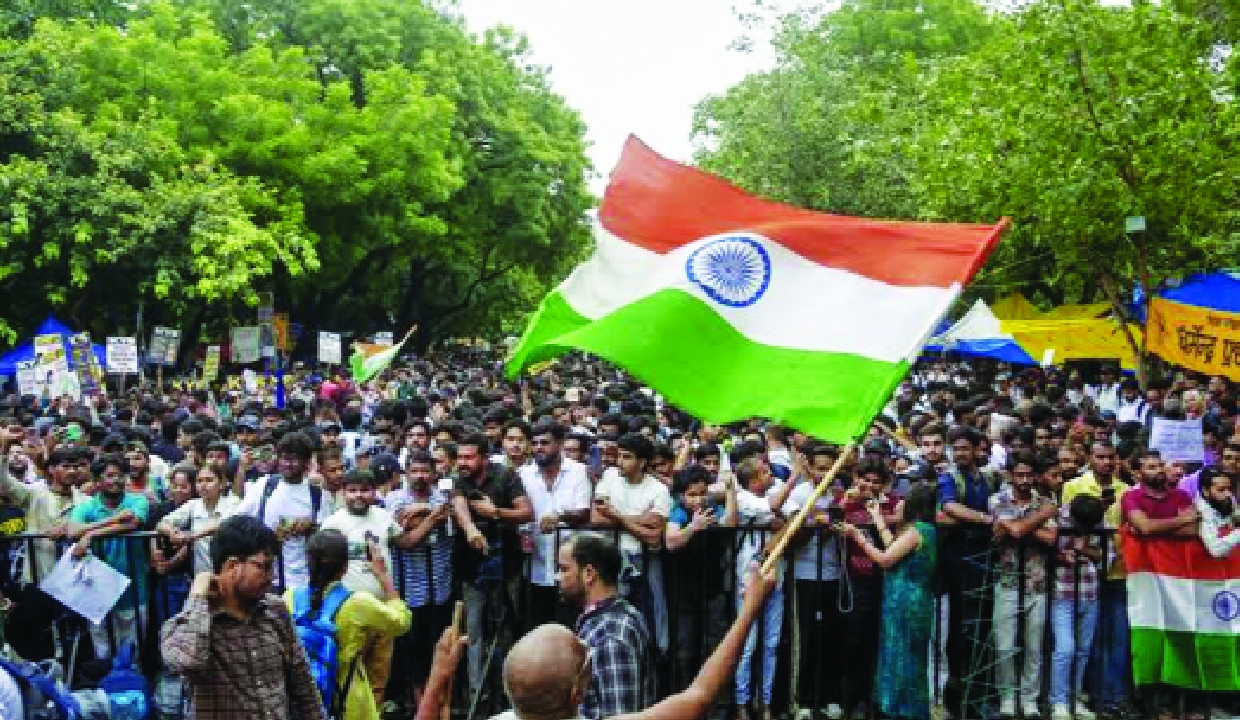
What looks like an organic wave of outrage online may sometimes be carefully engineered. In this new age of psychological warfare, the most vulnerable society may not be the one with the weakest military, but the one that gradually loses the ability to distinguish truth from manipulation
Wars once required weapons - armies crossing frontiers, nations measuring their safety in tanks and treaties, invasions you could see coming and fronts you could point to on a map. That world hasn’t disappeared, but a second battlefield has opened quietly beside it — one fought not with bullets but with belief. A country can now be destabilised without a shot being fired: not through tanks at a border, but through engineered narratives, algorithm-driven opinion, and psychological conditioning at social-media scale. Call it what it actually is.
Not “online propaganda.” Not “digital activism.” This is cyber psychological warfare, and most of us are standing inside it without realising.
Consider what happens after any major Supreme Court observation. Within days, anonymous pages appear from nowhere, amassing followers and engagement that no ordinary account could earn organically in years of patient work.
Sudden, unexplained scale like that is rarely luck - more often, it’s bot networks, coordinated engagement rings and paid amplification working in concert.
This deserves a name: Narrative Terrorism — a deliberate campaign to reshape what a population believes, fracture its unity, erode confidence in its institutions, and condition the young before they’ve learned to question anything. Conventional terrorism destroys buildings. Narrative terrorism destroys certainty. Its target isn’t infrastructure. It’s the mind.
What makes this form of warfare so effective is its invisibility. Nobody feels manipulated in the moment. Platforms are built to keep surfacing emotionally charged content, and repetition does the rest: exposure breeds familiarity, familiarity breeds acceptance, and acceptance eventually passes for truth. The economics reward this pattern: outrage travels faster than accuracy, anger out-competes nuance, division earns more attention than consensus.
India is unusually exposed here.
As one of the world’s youngest digital populations, its Gen Z consumes an extraordinary volume of content daily — reels, shorts, memes, influencer takes, anonymous opinion pages - often without the tools to separate verified reporting from propaganda, satire, paid promotion or ideological manipulation. That gap is exactly what outside actors, whether political, ideological, geopolitical or commercial, are built to exploit.
They don’t need to attack India militarily. They only need to erode the trust binding citizens, institutions and communities together, because a divided society is a manipulable one.
This matches an old historical pattern: great civilisations are rarely toppled by armies at the gate. What actually finishes them off is what happens earlier — a citizenry too confused, too demoralised and too fractured to notice the gate was left open.
The contest has quietly relocated - from geography to psychology, from checkpoints to comment sections, from missiles to machine-learned feeds - and artificial intelligence raises the stakes further. AI systems learn from the information ecosystem around them, and an ecosystem already saturated with manipulated narratives and artificial amplification risks producing AI that echoes those same distortions back at a scale no single campaign could reach alone.
This isn’t only India’s problem; it’s civilisational. As the world enters the AI era, India has a chance to lead not merely through technology, but by offering the deeper solution this moment actually demands: free thinking. A population capable of independent reasoning and genuine intellectual openness cannot be easily herded by algorithms or engineered narratives. India’s most valuable export in the AI age may not be innovation at all, but the revival of a civilisation built to question.
That starts with how India educates its children. A society that only memorises isn’t educated - it’s just informed. Students need to be taught how algorithms work on emotion, how propaganda operates, how to verify a source, and how to tell information apart from conditioning. Machines can already retrieve facts instantly; the one human advantage still standing is judgement - the intellectual immunity to resist a narrative even when it feels emotionally true.
India doesn’t need to invent this capacity. It needs to remember it. The Upanishadic dialogues, Buddhist debate traditions and classical Tamil philosophy all treated inquiry as the essence of learning, not an interruption to it. The phrase “Neti, Neti” - not this, not this - was a civilisation practising the discipline of continuous doubt long before psychology gave manipulation a name.
So the response to narrative warfare cannot be purely technological. It has to be philosophical and educational too, aimed at producing citizens who verify before believing, question before reacting, understand how algorithms work on them, and value truth over virality.
None of this makes technology the villain. Fire can cook a meal or raze a city; the outcome depends on the hand holding it. AI, social media and algorithmic platforms can educate and unite just as easily as they can manipulate and divide - the responsibility sits with citizens, educators, technologists and policymakers alike.
India stands at a genuine crossroads: positioned, through its demographic weight and technological depth, to become the world’s model for protecting intellectual independence, and to push for narrative manipulation to be treated as a serious matter of national security. Not every trend that goes viral is organic, not every influencer is independent, and not every movement is spontaneous. Borders once had to be crossed on foot; today they are crossed silently, through a screen. The strongest defence was never going to be firewalls or regulation alone - it is a citizenry that can still think for itself.
A people that think for themselves cannot be occupied from within. In the age of AI, that may be the fact on which democracy’s survival ultimately rests.
The phrase “Neti, Neti” - not this, not this - was a civilisation practising the discipline of continuous doubt long before psychology gave manipulation a name
The writer is State Secretary Tamil Nadu BJP; Founder, Project TamilAI & Science Saga - centre for free Ai training for rural; Views presented are personal.