The NEET 2026 agitation — Youth, democracy and the future of India
In 1947, when India attained Independence, its population was approximately 350 million. Today, India’s population has grown to nearly 1.5 billion. Out of this, nearly 350-400 million citizens belong to the younger generation, commonly referred to as Generation Z (Gen-Z). This demographic constitutes one of the country’s greatest strengths and has the potential to shape India’s future in significant ways.
Every morning in India’s metropolitan cities, one can witness thousands of young men and women riding motorcycles, scooters, bicycles and public transport with backpacks on their shoulders, rushing to their workplaces or educational institutions. They often compete for every available space on the roads, reflecting not only the pressures of urban life but also their determination to build successful careers. This generation understands the value of education, employment and financial independence. At the same time, lakhs of students aspire to become doctors, engineers, professionals and Government officers. Similar scenes can be witnessed in rural India, where young farmers work diligently in their fields despite adverse weather conditions. Members of the labour class also continue to work tirelessly in scorching summers and freezing winters. There are numerous inspiring examples of children from economically weaker sections who have studied under streetlights and eventually risen to become senior Government officers and accomplished professionals. These stories symbolise the resilience and aspirations of India’s youth.
The leakage of examination papers is unfortunately not a new phenomenon in India. The National Eligibility-cum-Entrance Test (NEET) was introduced by the Government of India in 2013 as a common entrance examination for admission to undergraduate medical, dental and allied healthcare courses. Since its inception, NEET has periodically faced allegations of question paper leaks. Similar allegations have also surfaced from time to time in respect of several competitive examinations conducted by both the Central and State Governments. However, based on information available in the public domain, such incidents had generally remained localised and had never escalated into a nationwide public movement.
The situation changed dramatically in 2026. Allegations regarding the leakage of the NEET examination paper generated widespread concern among students and parents across the country. Reports suggested that the uncertainty created by the controversy, coupled with examination pressure and the cancellation of the original examination, allegedly contributed to nearly twenty student suicides nationwide. To restore confidence in the examination process, the Government conducted a nationwide re-examination on June 21, 2026. More than 1.7 million students appeared for the examination, and over 900,000 candidates successfully qualified.
During this period, a person reportedly residing abroad announced the formation of a forum called the “Cockroach Janta Party” (CJP). Within a remarkably short span of time, the organisation attracted widespread attention. It was reported that lakhs of people began following its social media platforms and applied for membership. Thus, the emergence of CJP became one of the most talked-about developments arising out of the controversy.
The rapid growth of CJP surprised many observers. Its founder, Abhijeet Dipke, appointed spokespersons and other office-bearers to establish the organisation. Questions were raised by various sections of society regarding its sources of funding. Some individuals strongly believe that the organisation may be receiving support from anti-India groups or other entities having political interests in India or seeking to influence the country’s political narrative. These concerns continue to remain matters of public debate. It is expected that CJP will maintain complete transparency regarding its funding and organisational functioning.
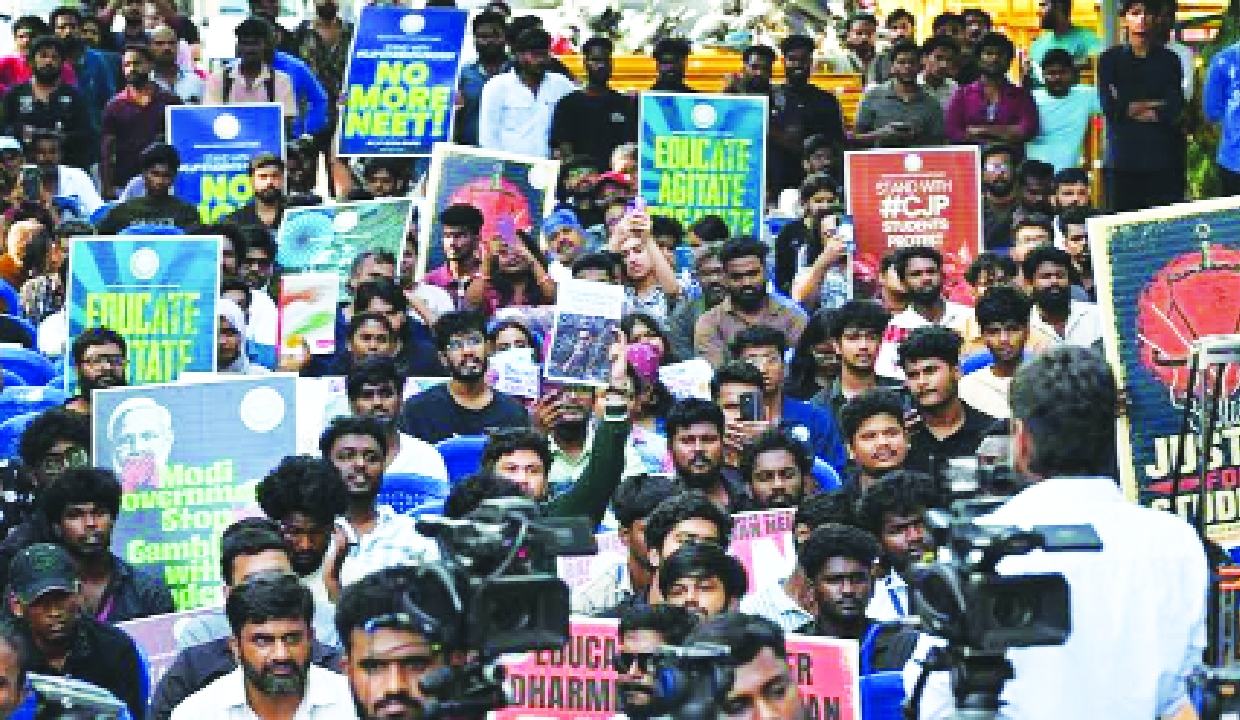
Realising that its supporters expected concrete action, CJP announced peaceful and non-violent protests. It demanded the resignation of the Union Education Minister, comprehensive reforms in the education and examination system, and financial compensation for the families of students who had allegedly committed suicide during the controversy. Social activist and innovator Sonam Wangchuk, known among other things for his significant patent holdings and educational initiatives, extended his support to these demands.
Many observers believed that the Government of India did not initially respond with adequate urgency or engage in meaningful dialogue with the protesters. As media coverage expanded, demonstrations spread across the country. India has always taken pride in its tradition of Ahimsa (non-violence), and the protests were announced as peaceful demonstrations. However, it was also alleged that certain disruptive elements infiltrated the movement and attempted to disturb its peaceful character, resulting in isolated incidents of violence and clashes between protesters and the police.
The removal of Sonam Wangchuk from the protest site at Jantar Mantar reportedly became a turning point, triggering the arrival of thousands of additional protesters at the venue. Faced with increasing public pressure and widespread demonstrations, the Government ultimately accepted a majority of the demands raised by CJP.
The unprecedented growth of CJP and the developments surrounding the NEET controversy have undoubtedly altered the country’s political discourse. India currently has nearly 350 million young citizens belonging to Gen-Z, many of whom are receptive to new ideas and emerging platforms. CJP has already announced its intention to raise several additional public issues in the future. Although the organisation has not formally aligned itself with any major political party, discussions regarding the political affiliations of some of its office-bearers, including their reported association with the Aam Aadmi Party, continue in the public domain.
Generational participation has always played a significant role in shaping India’s democratic evolution. In PUCL v. Union of India (2003) 4 SCC 399, the Supreme Court observed that the Fundamental Rights enshrined in the Constitution do not have fixed content. The Court remarked that, over time, it has filled “the skeleton with soul and blood and made it vibrant.” It further observed that “most of the Fundamental Rights are empty vessels into which each generation must pour its content in the light of its experience.”
Part III of the Constitution of India guarantees Fundamental Rights such as the Right to Equality, Freedom of Speech and Expression, the Right to Assemble Peacefully, the Right to Form Associations or Unions, and the Right to Life and Personal Liberty. These rights have consistently been recognised as forming part of the Constitution’s Basic Structure. Article 13 further provides that Parliament cannot enact laws that are inconsistent with or violate these Fundamental Rights.
Article 19 of the Constitution of India guarantees (a) Freedom of Speech and Expression, (b) to assemble peacefully and without arms, (c) to form association or unions. During protests and thereafter serious allegations of violence between Protesters and Police was reported. In view of the above Fundamental Rights, the Supreme Court Bench headed by Chief Justice Surya Kant issued salutary balanced interim directions, directing release of all the detained student protestors under 18 years age who do not have any criminal records. It directed preservation of all CCTV Footage, drawn recording, PCR Log relating to demonstration. The order barred coercive steps against student protesters without past criminal antecedents and allowed ongoing enquiries without harsh steps. These directions have been accepted and welcomed by all.
In independent India, only a few nationwide public movements have significantly influenced the country’s political landscape. The Jayaprakash Narayan Movement ultimately led to the formation of the Janata Party, while the Anna Hazare anti-corruption movement paved the way for the emergence of the Aam Aadmi Party. Both movements eventually contributed to changes in the political landscape and the formation of Governments at the Centre.
Only time will determine the ultimate impact of the NEET 2026 agitation. CJP has neither formally declared its intention to enter electoral politics nor ruled out such a possibility. However, if the organisation succeeds in sustaining its growth, expanding its public support and eventually entering the political arena, it could emerge as a significant challenge to established political parties that have governed India in the past or continue to hold power today.
The author is a senior advocate; Views presented are personal.