The Naxal war is over. The battle of ideas is not
In April 2010, Dantewada in Chhattisgarh witnessed one of the deadliest Naxal attacks in Indian history, killing seventy-seven security personnel. The ambush involved IEDs, mortars, AK-47s, self-loading rifles, light machine guns, Sten guns, and grenades. This attack was one of countless attacks in that series.
I was travelling by train that day. Train compartments in India are often like mini parliaments, where strangers freely debate politics and current affairs. The incident shook us to our core, and it became the subject of discussion. While we deplored the Naxal ideology of armed struggle against democracy, we were perplexed by the sophistication of their operations. How do criminals living inside forests acquire arms and ammunition? How do they manage food, communication, intelligence, transportation, and logistics so effectively? Everyone had a theory.
Then a fellow passenger, who had introduced himself as a CA, interrupted with an interesting observation. He said that for every comrade in the jungle, there were two in the towns. According to him, while most foot soldiers are poor tribals with little education who are indoctrinated into Naxal ideology, their urban support base includes doctors, engineers, lawyers, chartered accountants, and other professionals. They ensure that the armed cadres receive money, weapons, food, intelligence, and supplies to continue the so-called struggle. They were not merely ideological supporters. They functioned as fundraisers, procurers, suppliers, facilitators, and intellectual justifiers of the movement.
That same year, a former Home Secretary estimated the annual funding of the Naxal movement at around a thousand crores. Such money, he said, was invested in gold, fixed deposits, and real estate through sympathisers and front networks. Highlighting the challenge, he warned that the Maoists were aiming to overthrow the Indian state by 2050.
The insurgency had reached its peak in the late 2000s, when nearly 180 districts were affected by Naxals. This vast stretch became known as the “Red Corridor”, with some areas effectively considered “lost” to them.
The term Naxal comes from Naxalbari in West Bengal, where a peasant uprising began in 1967 with the slogan “land to the tiller”. Over the decades, however, the movement strayed far from its original objectives. In the name of the poor and tribals, it often ended up harming them instead. Rather than enabling development, Naxals frequently opposed roads, schools, hospitals, telecommunications, and other infrastructure because development threatened their control.
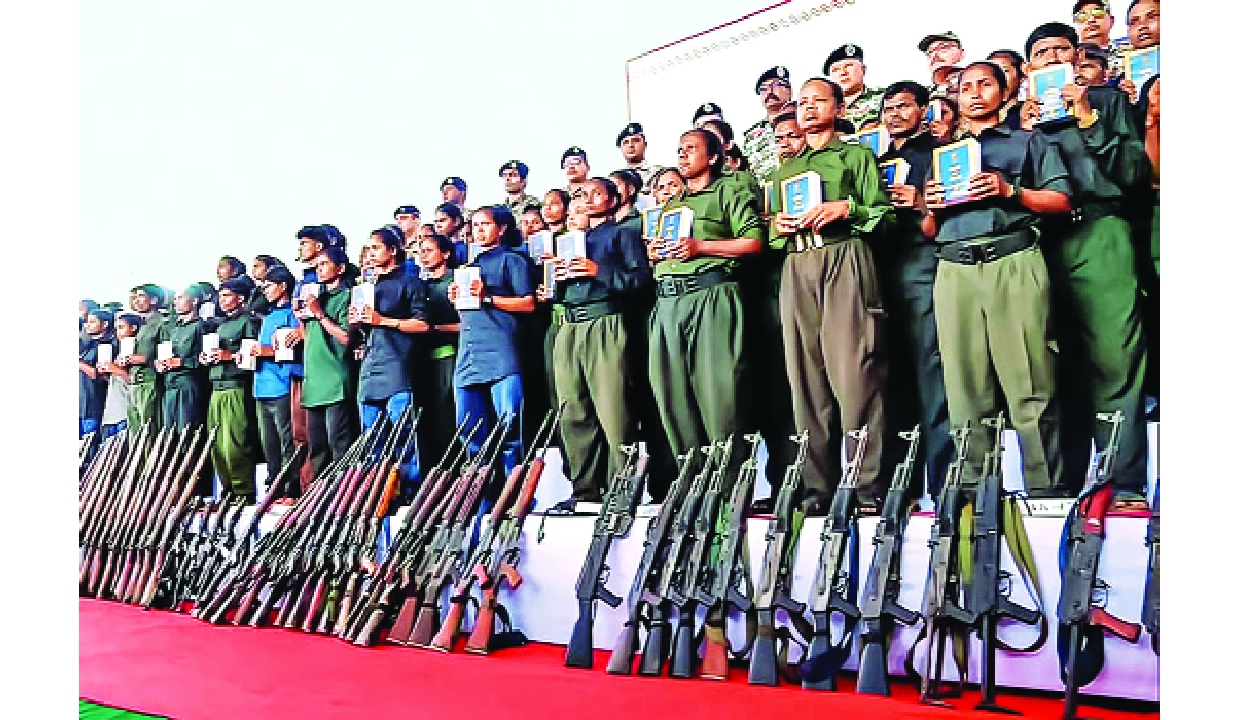
In recent years, India’s multidimensional strategy, combining security operations, development, and community engagement, has achieved significant success. Violence has declined sharply, the movement has been systematically weakened, and many affected districts are returning to the mainstream. The armed Naxal presence has been wiped out, though this progress has come at the heavy cost of more than 3,500 security personnel killed over the years.
But one crucial aspect is often overlooked: the Naxal fighters are only cannon fodder. Interestingly, even Charu Majumdar, regarded as the father of the movement, remained its chief ideologue rather than a fighter himself. This pattern persisted; poor tribals risked their lives while urban intellectual supporters remained safe, authoring articles and books, attending conferences, raising funds, and providing ideological justification for violence, portraying it as a revolutionary struggle.
The forests may have been cleared of armed cadres, but the ideological ecosystem can survive in intellectual and urban spaces. It can survive in intellectual circles, advocacy networks, and political discourse, waiting for circumstances that might allow it to re-emerge.
When Prime Minister Narendra Modi used the phrase “Dimagi Naxals”, he was pointing to this distinction.
Coming back to my train journey in 2010, the fellow passenger who had introduced us to the urban support base of the Naxals eventually confided that he was himself one such “cerebral Naxal”. He was returning from an annual conference in the Red Zone. That revelation changed the conversation. Until then, we had imagined Naxals as distant figures hiding in the jungles. Sitting across from us was someone who claimed to be part of the intellectual ecosystem that supported them.
India may have won the battle, but the war remains. Insurgencies are fought on two fronts: the physical battlefield and the battle of ideas. Winning the first does not automatically mean winning the second.
The writer is an Economist; Views presented are personal.