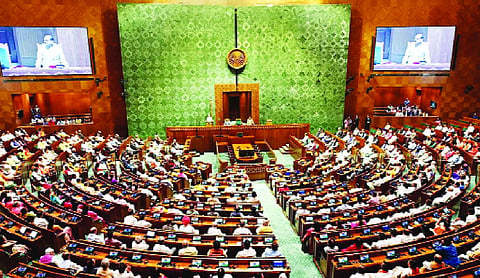

It is a well-established parliamentary convention to make a valedictory address before adjourning the House sine die. As a hallowed parliamentary practice, the valedictory address is given by the Speaker at the end of the last sitting of a session. The Speaker usually gives a brief summary of the legislation passed, Bills introduced, Bills referred to the Committees, time spent on discussions, etc. The Speaker also thanks the secretarial officers and staff for their hard work and cooperation and also the other agencies involved in servicing the House. The valedictory at the end of the last session of every Lok Sabha is more elaborate and full of nostalgic speeches. Ananthasayanam Ayyangar, the Speaker of the first Lok Sabha, in his valedictory address on 28th March 1957, profusely thanked the MPs for their industry, hard work and cooperation, the legislation passed, and appreciated all the secretarial officers and staff for their strenuous services.
A valedictory address by the Speaker is a parliamentary convention. It’s not a mandatory constitutional or statutory requirement. Of course, it’s another matter that the constitutionally binding direction to elect a Deputy Speaker has not been implemented as yet from the 17th Lok Sabha and as yet in the 18th Lok Sabha. In the absence of a constitutional provision, the Speaker can declare the House adjourned sine die without delivering a valedictory address or making remarks of farewell. However, the practice of making valedictory remarks has been in vogue right from the Constituent Assembly.
Dr Rajendra Prasad, in his address in the last sitting of the Constituent Assembly on 26th November 1949, gave vital information about the work of the CA and apprised the Members about the salient features of the Constitution, the labour of love involved and the expenditure incurred (?63,96,729).
It is interesting to recall that the 16th Lok Sabha, with 17 sessions, had invariably valedictory addresses. So was it during the 17th Lok Sabha, which had 15 sessions. In case the Speaker is not available, the valedictory reference is made by the occupant of the Chair. As the 17th Lok Sabha did not choose a Deputy Speaker, the address was made by a member of the panel of Chairmen. This only reinforces the view that it is customary to follow parliamentary conventions and precedents to make a valedictory reference or address.
Therefore, it is quite unusual for the Speaker not to make a valedictory reference on the last day of the Session. However, there is an exception. The last Budget Session was adjourned sine die on 18th April 2026 after singing of the National Song without the customary valedictory speech. Since there is no constitutional provision or Rule, the absence of a valedictory address does not invalidate the adjournment or the session. The Monsoon Session ran from 20th July to 13th August 2026, with 19 sittings by each House. The Session had constant disruptions, though the Government managed to pass as many as 11 Amendment Bills by voice vote amid din and uproar, without discussion. Both the Houses faced constant sloganeering and logjams. Even the Question Hour, considered the most potent parliamentary device to secure accountability of the Executive, was disrupted.
The Question Hour in the Lok Sabha functioned barely for 1 per cent, while in the Rajya Sabha it was 12 per cent. Taken as a whole, the Lok Sabha utilised 15 per cent and the Rajya Sabha 33 per cent of their time. Of the 11 Bills passed by the Lok Sabha, nine were passed without the participation of any member. The Minister in charge introduced the motions for introduction of the Bills, for consideration and passing, and the Bills were passed by voice vote. Only the Public Examinations (Prevention of Unfair Means) Amendment Bill, 2026, witnessed participation by 48 MPs in the Lok Sabha and by 35 MPs in the Rajya Sabha. Unfortunately, the Session was marred by logjams and protests within the precincts of Parliament.
Not only the MPs of the principal Opposition parties but even the MPs on the Treasury benches held protests. The Opposition demanded a statement by the Home Minister, and the members of the Treasury benches wanted the resignation of the Leader of Opposition. Another memorable feature was that both the Prime Minister and the Home Minister made appearances in the Lok Sabha on 20th July, when the National Anthem - ‘Jana Gana Mana’ - was sung, and on 13th August, when the National Song - ‘Vande Mataram’ - was sung immediately before adjournment sine die.
It is considered befitting to make some courteous valedictory references to the Session that is coming to an end. Such a reference helps remove the sense of discomfiture or acrimony between the Treasury and the benches opposite. The omission of a valedictory speech by the Speaker is probably reflective of the prevailing state of lack of trust, anguish and despair. Be that as it may, the conspicuous departure from the well-settled and salutary practice does not bode well for our competitive parliamentary democracy, claimed to be the Mother of Democracy.