The helix and the harvest: Why tribal India’s future lies in digital sovereignty
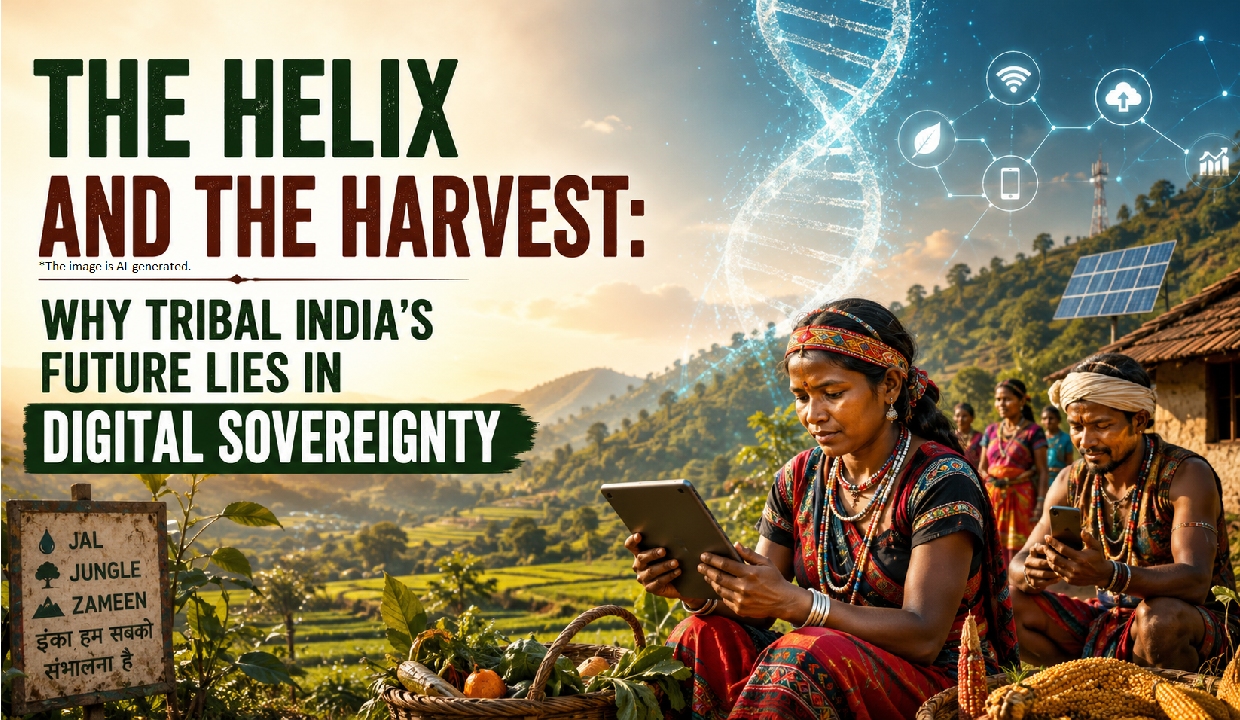
Every year on the 15th of November, India observes Janjatiya Gaurav Diwas to honour Bhagwan Birsa Munda, the legendary tribal leader who spearheaded the 19th-century Munda Revolt. His rallying cry - “Jal, Jungle, Zameen - Inka hum sabko sambhalna hai” (Water, Forest, Land - We must protect them all)-remains the moral compass for indigenous conservation. Yet, as India enters a deeply digital era, we face a critical policy paradox: How do we honour this sacred triad in a world dictated by climate volatility, complex agricultural supply chains, and rapid technological disruption?
For decades, public investments in tribal regions have focused on building physical infrastructure — roads, schools, and clinics. Yet, sustainable economic transformation and technology - driven livelihood opportunities remain elusive for many of India’s 1.45 lakh tribal villages.
Tribal agriculture is not a “development deficit” to be corrected by urban models; it is inherently sustainable, fascinatingly self-sufficient, and deeply self-dependent. The challenge is not to alter the tribal landscape or forcefully disrupt their microcosm, but to protect them from external exploitation by unscrupulous elements. In our rush to introduce “informatics” or “efficiency,” the greatest risk is accidentally overwriting centuries of harmonious, self-contained ecological balance.
The modern world has far more to take and learn from the philosophy and ecological harmony of tribal communities than it has to give.
To bridge this gap respectfully, the Smart Tribal Farming Project Initiative (STFI) — a framework officially recognised in the Economic Survey of India 2025-26 as a scalable model for rural transformation — has been structurally engineered not as an intervention to alter their landscape, but as a digital shield to protect it from outside exploitation.
The DFI-2022 recommendations and academic mobilisation
To bridge the gap between national planning and field-level execution, the STFPI directly aligns with the landmark recommendations of the Committee on Doubling Farmers’ Income (DFI-2022). Specifically, Volume 12B (Digital Technology in Agriculture) outlines a strategic blueprint for the structural application of digital public infrastructure through seven dedicated Mission Mode Programmes, explicitly introducing the foundational pillars of Smart Irrigated Farming, Smart Rainfed Farming, and Smart Tribal Farming. Under the leadership of Shobhit Institute of Engineering and Technology (Deemed-to-be University), Meerut, this national policy agenda was translated into a massive academic and civil-society outreach campaign.
The Centre for Agricultural Informatics and e-Governance Research Studies (CAIRS) of the University, established in 2013, has organized a comprehensive series of 245 specialised webinars-comprising 132 National and 113 International sessions-focused on the strategic deployment of technology in agriculture.
This sustained knowledge mobilisation successfully united policymakers, technology experts, and grassroots non-Governmental organisations, shifting the policy conversation from theoretical top-down planning to a synchronised, multi-stakeholder operational roadmap implemented across regional tribal village clusters.
Operationalising STFPI: The quintuple helix, 5W1H, and BharatNet framework. The practical deployment of the STFPI relies on a highly structured multi-stakeholder model powered by the Quintuple Helix Innovation Framework. This network seamlessly brings together Higher Education Institutions (HEIs), Government, Industry, Civil Society Organisations, and local Environmental Systems into a collaborative ecosystem. Within this framework, field execution is structurally driven by the 5W1H Planning Tool (What, Where, When, Why, Who, and How), which converts complex agricultural informatics into location-specific, customised actions for each distinct tribal village cluster.
The digital leap in India’s tribal heartland
The blueprint for transforming rural communities is being rewritten through a powerful fusion of high-speed digital infrastructure and grassroots self-governance. Leveraging the Government’s BharatNet expansion, a robust 1 to 10 Gbps data pipeline is now deploying directly to the Gram Panchayat level. While the unconnected panchayats are predominantly located in complex, hilly terrains-where several STFPI pilots are strategically positioned-targeted interventions are expected to rapidly close this digital divide. Notably, the PM JANMAN (Janjati Adivasi Nyaya Maha Abhiyan) explicitly targets data and mobile service saturation across tribal-dominated villages to link Particularly Vulnerable Tribal Groups (PVTGs). To aggressively absorb the remaining unconnected populations, the Government deploys parallel infrastructure programs financed by the Digital Bharat Nidhi (DBN).
Catalysing AgriTech and edge deployments
Beyond basic connectivity, this heavy bandwidth acts as an economic catalyst for remote production centres. By injecting high-capacity data pipelines into rural hubs, the initiative successfully supports advanced edge computing technologies. Critical tools-such as WebGIS participatory asset mapping, real-time IoT soil-moisture telemetry, and decentralised smart farming networks-are now expected to operate at peak capability with near-zero downtime, driving a technological revolution in rural agriculture.
Supercharging tribal enterprise and livelihoods
This digital backbone is tangibly transforming tribal enterprise. TRIFED is spearheading this shift via its network of over 1,205 operational Van Dhan Vikas Kendras (VDVKs), securing sustainable livelihoods for roughly 3.6 lakh tribal forest gatherers. These digital pipelines seamlessly link remote collection centres to global markets and 122 brick-and-mortar “Tribes India” retail outlets.
Localised governance and global scalability
Concurrently, under the ambitious Tribal Village Vision 2030 initiative, specialised single-window “Adi Sewa Kendras” are being established at the grassroots level. These centres localise, streamline, and optimise essential citizen services. By bridging state-of-the-art connectivity with local autonomy, this ecosystem offers a powerful, reproducible growth model for sustainable rural transformation-serving as a clear development blueprint for the entire Global South.
Global recognition: Entering the international scenario
The scale and global relevance of this framework have catapulted the initiative onto the international stage, establishing a benchmark for sustainable development throughout the Global South.
Scaling horizons: Commemorating UN world rural development day
As part of its extensive global outreach, Shobhit University teamed up with apex international bodies, hosting the International Online Webinar on Smart Tribal Farming: Achieving Sustainable Agriculture and Livelihood Opportunities. Organised in direct partnership with the African-Asian Rural Development.
Organisation (AARDO) and the UN Centre for Integrated Rural Development for Asia and the Pacific (CIRDAP) on 6th July 2025, this Webinar marked a definitive shift-positioning India’s domestic tribal informatics model as a universal roadmap for international agrarian development.
Redefining “SMART” from the ground up
In urban tech corridors, “smart” implies automated automation and top-down data extraction. At the grassroots level, non-Governmental organisations (NGOs) and HEIs working with indigenous communities have refined the acronym into five distinct, action-oriented
Strategic Pillars:
- S - Sustainable Hill Agriculture & Ecology: Replacing standard plain-land farming models with micro-water harvesting, participatory soil conservation, and community-led native seed banks.
- M - Market-Linked Enterprises: Building direct, intermediary-free trading channels by organising tribal collectives into Farmer Producer Organisations (FPOs) and creating place-based brand equity for premium “Tribal Products”.
- A - Appropriate & Augmented Technology: Deploying low-footprint, high-impact systems like gravity-fed micro-irrigation, localised vernacular mobile advisories, and decentralised solar-powered post-harvest units.
- R - Reviving & Validating Traditional Knowledge: Documenting and scientifically validating Indigenous Technical Knowledge (ITK) regarding resilient crop varieties and natural pest management.
- T - Tribal Ecotourism & Skills: Diversifying local economies through community-owned ecotourism, nature guiding, and cultural curation.
A Shield from the Periphery: Knowledge & Governance Architecture
To scale this vision nationally without coercive structural overhauls, India’s 28 State Tribal Research Institutes (TRIs) must be retooled. Following the principles of the landmark Bhubaneswar Declaration, TRIs must shift from purely archiving tribal history to engineering future-ready digital tools. This requires a multi-hub academic infrastructure to translate Agricultural Informatics into region-specific, socio-ecological practices. Integrating apex Central Tribal Universities ensures that advanced data systems are tailored to the distinct socio-economic realities of diverse tribal populations.
The author is former director general, National Informatics Centre (NIC), Government of India, professor emeritus and chairman, Centre for Agricultural Informatics and e-Governance Research Studies (CAIRS) & Centre for Smart Tribal Farming Programme Initiative (STFPI), Shobhit Institute of Engineering and Technology (Deemed-to-be University), Meerut; Views presented are personal.