The Great Indian Bustard and climate rights
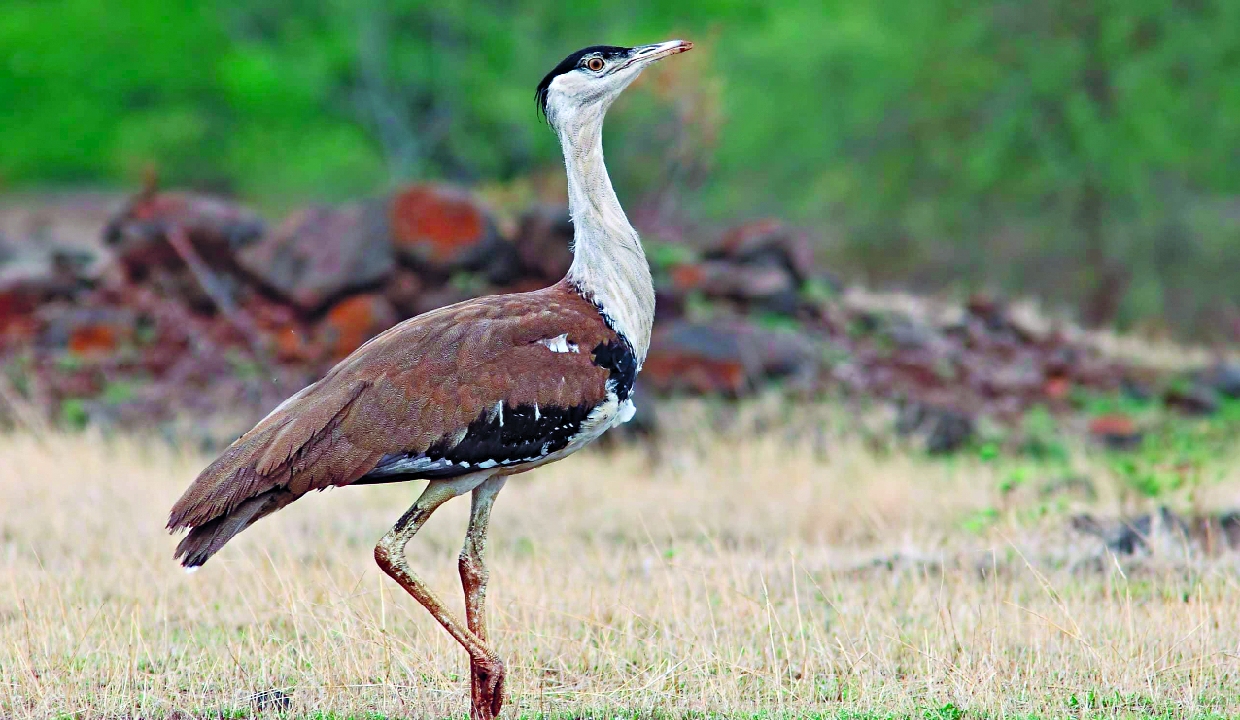
The chronology of factors leading to the recognition of the right to climate change action in India fortuitously involves a critically endangered bustard, a bird, a solar boom and two Supreme Court benches that produced something surprising: India’s first express constitutional right against the adverse effects of climate change.
In this regard, October 24, which falls this month and is commemorated as United Nations Day, also marks the International Day of Climate Action and is an apt date for raising a legal question: what promises does the Indian Constitution carry about the climate for Indians? Surprisingly, though, the answer begins with a bird, the Great Indian Bustard.
Evolution, which is oblivious to environmental impact assessments, gave the Great Indian Bustard eyes on the sides of its head, giving it wider peripheral vision in an open territory, handy for spotting predators. However, against a high-tension line, the same trait becomes problematic, as the bird has evolved to see predators around it, but that wide field of vision does not help it spot a thin power line in its path, and it gets injured by hitting against it.
In MK Ranjitsinh v Union of India, the Supreme Court initially intervened in April 2021 to protect the species, restricting certain overhead power lines across parts of Rajasthan and Gujarat. On March 21, 2024, the same litigation produced a landmark constitutional proposition: the right to be free from the adverse effects of climate change, grounded in Articles 14 and 21 of the Constitution. The Court recognised that climate change is not merely an environmental concern; it can also threaten constitutional rights. It described the right against climate harm and the right to a clean environment as “two sides of the same coin”. Although Article 21 had long been interpreted to protect the environment, the judgment expressly located climate change within India’s constitutional framework.
Though the right to climate protection surfaced in a case about a bird and energy projects, another test emerged in another case, brought by a child. In 2017, nine-year-old Ridhima Pandey of Uttarakhand asked the National Green Tribunal (NGT) to consider climate change in environmental impact assessments (EIA) and to make the government prepare a carbon budget. The Tribunal dismissed her petition in 2019, but she appealed to the Supreme Court.
The case became significant in 2025, when the Court called climate change an “existential predicament”, said environmental laws must impose enforceable duties to address it, and sought from the Power Ministry a plan to reduce emissions from power generation. In simple terms, the Court was asking: what should the government actually do about climate change? The case is still pending, and notably, its orders do not expressly invoke the climate right recognised in the bustard case.
Meanwhile, the bird’s own case moved on, and on December 19, 2025, the Court accepted the expert committee’s revised plan, which identified certain areas of Rajasthan and Gujarat for special protection, as they are important habitats for the bustard. In these areas, new wind turbines and large solar plants are restricted, while about 250 km of critical power lines are to be moved underground within two years. Whether this will be enough to save the bustard remains to be seen.
The International Union for Conservation of Nature (IUCN) has classified the bustard as critically endangered since 2011. A 2020 study by the Wildlife Institute of India estimated that around 18 birds could die each year from collisions with transmission lines. Its population remains very low, with much of its natural habitat already lost or no longer used by the bird. In Kachchh, only a handful of wild birds remain. For a species so close to extinction, even a small change in its habitat can have serious consequences.
But the story is no longer only about the bustard; rather, it brings us back to the larger question with which we began: what does the Constitution actually promise Indians in the face of climate change? The answer is important and still developing. Though the Supreme Court has stated that people have a right to be protected from the adverse effects of climate change, it remains unclear what a person can ask the government to do when climate change seriously affects their life or livelihood, what government action or inaction can be challenged, or what relief a court can grant. The Court’s reasoning also drew upon India’s international climate commitments, including the Paris Agreement, and the work of UN human-rights bodies. These materials helped connect climate change with threats to basic human rights and India’s constitutional guarantees of equality and life.
This is where Ridhima Pandey’s case may become as important as the bustard case. While the latter gave constitutional recognition to the right against the adverse effects of climate change, Ridhima Pandey’s case raises the harder question: what does that right require the State to do?
There is, therefore, an irony in the story. The Great Indian Bustard evolved for a landscape without wires, while Indian constitutional law evolved for a country without a declared climate emergency. A bird that could not see a power line has helped us see something that was largely invisible in constitutional law: the human consequences of climate change. Both the bird and the law are now improvising to survive a changed landscape — though only humans can take their case to court. The real test of this newly recognised right, and of the Court, will arise when a person approaches a court and says that a government decision, project or failure to act is exposing them to serious climate harm. Recognition of the right is only the beginning; the harder task is turning a constitutional promise into something that a person can actually claim and a government actually honours.
Siddhartha Mishra is Associate Professor at the Faculty of Law, University of Delhi, and Shazia Siddiqui is a legal scholar and independent researcher; Views presented are personal.