Teachers as architects of a Viksit Bharat
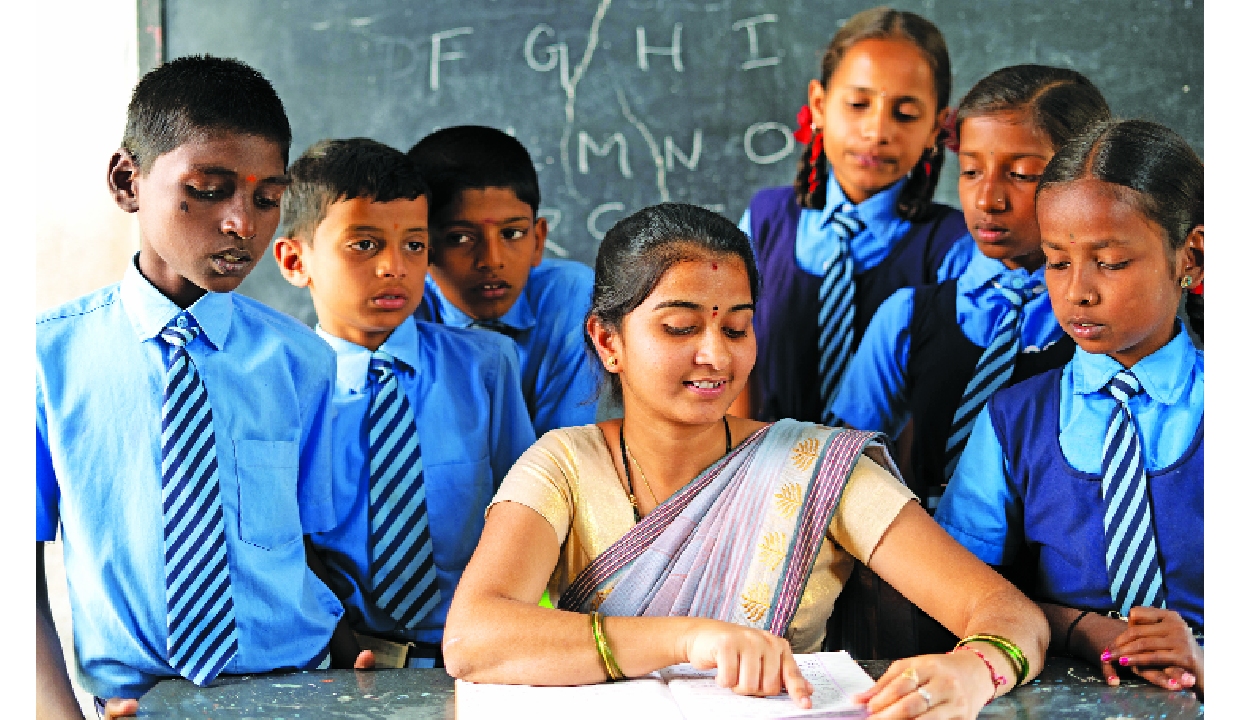
From the Guru-Shishya Parampara to the aspirations of the National Education Policy 2020, the enduring influence of teachers remains central to nurturing an enlightened, disciplined and responsible generation capable of carrying Bharat towards a stronger and more developed future
A nation that reveres its educators progresses on the path of growth and development. As we cruise towards the centenary of independence and our lofty goal of becoming Viksit Bharat@2047, it is worth pondering and exploring how ancient Indian wisdom and civilisational ethos, encapsulated in the Taittiriya Upanisad’s injunction “Acharya devo bhava” (regard the teacher as divine), on the teacher being supremely esteemed, who was looked upon not only as an instructor but as a spiritual and moral guide, remain profoundly and significantly relevant even today.
Ancient Indian education and the Guru-Shishya Parampara
The ancient Indian education system was a disciplined process of intellectual, moral and spiritual formation; not merely of inculcating the ability to read, write and calculate. It was anchored in the Guru-Shishya Parampara. Centres of learning assumed and developed different institutional forms, such as Taxila and Nalanda, over many centuries. At these, the acharya/guru was often more than a disseminator of information and knowledge. They mediated an intellectual inheritance and shaped the character, conduct and judgement of their pupils. Radha Kumud Mookerji’s classic study, Ancient Indian Education: Brahmanical and Buddhist (1947), remains the landmark scholarly account of how this teacher-centred model carried the essence of “Indianness” for over a millennium. Similarly, Hartmut Scharfe’s Education in Ancient India (2002) illuminates the centrality of oral transmission, memorisation, debate, apprenticeship and the close teacher-student bond in this long history.
The Upanishads express this relationship with unusual clarity. The Chhandogya Upanishad compares an ignorant person to someone left blindfolded in an unfamiliar land; once shown the direction, they can ask their way and reach their destination. The tutor does not walk every step for the tutee; they remove the blindfold, give direction and enable intelligent inquiry. Its conclusion (6.14.2) is striking:
“A person who has a teacher comes to know.”
The Taittiriya Upanisad goes further by presenting education as a moral compass. In the celebrated instruction to a departing student, the pedagogue says:
“Speak the truth. Practise Dharma. Do not neglect self-study.”
These simple words carry substantial weight during an individual’s formative years: the most crucial stage of their life’s journey. Bharat’s young population must be cognisant of the Indian education model’s enduring trajectory, which was not restricted to textual learning. The Gurukulas, where students and their guru lived together, influenced and moulded it. The former observed the latter’s daily living and learned from his conduct. Teachers can help cultivate in students the enduring values of patience, perseverance, tolerance, wisdom, compassion, empathy, truthfulness, honesty, sincerity and righteousness.
Guru as the fourth deity
The Taittiriya Upanisad’s Shikshavali, in its convocation address to graduating students, articulates (I.11.2):
“Let your mother be a God to you. Let your father be a God to you. Let your teacher be a God to you. Let your guest be a God to you.”
This matters for Teachers’ Day because, in Indian tradition, respect for teachers was tied to the gravity of their responsibility. Reverence was not merely ceremonial status; the teacher was considered an epitome of knowledge because education concerned truth, duty, self-control, perseverance and respect for his guru.
Teachers as the cultivators of civil order
Educators can infuse civic discipline and compliance by making the classroom a living school of responsible citizenship. Through their own punctuality, fairness, honesty, respectful conduct and adherence to rules, they can show that discipline is not blind obedience but the voluntary exercise of self-control in the interest of the common good. Like a potter’s hands create shapely vessels from shapeless clay, they can effectively make students frame and follow norms of punctuality in life, respectful speech, integrity, cleanliness, digital conduct, regard for elders and care for public property. At the same time, classroom discussions, debates and service activities can teach pupils to respect differences, accept accountability and translate constitutional values into daily action. In this way, they can nurture young citizens who are lawful without being unthinking, patriotic without being intolerant and free without being irresponsible; citizens whose honesty, civic-mindedness, environmental consciousness, respect for institutions and commitment to excellence will strengthen Bharat’s social fabric and advance the building of a strong, robust, Atma-Nirbhar and Viksit Bharat.
The guru-shishya legacy in NEP 2020
The New Education Policy (NEP) 2020 redefines education not only as literacy, numeracy and professional competence, but also as critical thinking, constitutional values, ethical responsibility, scientific temper and a commitment to fundamental duties. In doing so, it seeks to revive the timeless Indian ideal of Vidya Dana, where education is a sacred trust that nurtures both individual excellence and collective welfare. By rooting learning in civilisational continuity while embracing modern innovation, it positions educators as the moral and intellectual anchors of this enhanced vision. It states, “The teacher must be at the centre of the fundamental reforms” and calls for the restoration of teachers’ “respect, dignity and autonomy”. It envisions them not merely as disseminators of subject knowledge but as facilitators of holistic learning, imparting life skills and socio-cultural-emotional intelligence. Hence, their roles and functions acquire a new dimension in reimagining Bharat’s advancement.
Conclusion
Beyond other determinants, a Viksit Bharat will also be ascertained and measured by the quality of its human resources and civic culture. Teachers are uniquely placed to make this transition real and transformative. They can encourage young Indians to move away from the question, “What can the country give me?” to a more meaningful and equally pressing question: “What can I contribute to the country?” This self-introspection and self-reflection are not merely rhetoric. When instilled successfully, they will be seen in the collective endeavour of Indian citizens working towards nation-building by voluntarily practising responsibility, restraint, lawfulness, rule-following and concern for the greater good. In this way, our respected teachers can help achieve a Viksit Bharat by enabling millions of Indians to perform civic responsibilities towards the nation with a profound sense of purpose and sincerity.
The ancient Indian education system was a disciplined process of intellectual, moral and spiritual formation; not merely of inculcating the ability to read, write and calculate. It was anchored in the Guru-Shishya Parampara. Centres of learning assumed and developed different institutional forms, such as Taxila and Nalanda, over many centuries
The writer is a Senior Research Fellow at Bharat Ki Soch; Views presented are personal.