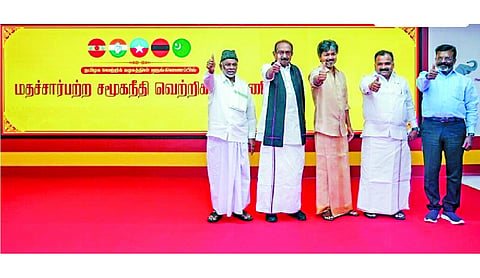

As the emergence of a new political front in southern Tamil Nadu took formal shape with the inclusion of the Congress, this new realignment of political forces in the southern state, though having a regional character, is bound to have an impact on national politics. The Secular Social Justice Victory Alliance (SSJVA), led by actor-turned-politician and Chief Minister C Joseph Vijay’s Tamilaga Vettri Kazhagam (TVK), with Congress as a partner, though playing second fiddle in the alliance, makes the new formation interesting.
The few months that Vijay has been in power in Tamil Nadu after dislodging the powerful ruling DMK have portrayed a new-era politician with a fresh outlook and unconventional ways of pursuing politics. Even in governance, though it is a very short span to form a view of his style of functioning, he has been exhibiting the courage to abandon the beaten tracks of traditional politics and harp on a new path to strike a better rapport with the public, particularly Gen Z, in line with his image as a young superstar turned political leader.
The formation of the new alliance has to be viewed against this backdrop. The fact that Congress, now sharing power in Tamil Nadu after six decades, has agreed to become part of it without any commitment or clear stand by Vijay on whether or not to join the I.N.D.I.A. bloc at the national level makes it both interesting and complicated.
Did Congress leader Rahul Gandhi jump the gun by abandoning the DMK before the recently held Assembly elections and joining Vijay’s bandwagon? Electorally, his judgement was not wrong, as TVK strode to an impressive victory, with Congress piggybacking to ultimately share power as part of what is known as the SSJVA. Prior to that, he had inclined towards fighting the 2024 Lok Sabha elections in alliance with TVK and not the DMK. But Gandhi’s proposal was scuttled by his own party leaders from Tamil Nadu, led by former Union Minister and now Rajya Sabha MP P Chidambaram.
Perhaps Gandhi had rightly understood the prevailing ground realities in the state, where Congress had been pushed to the margins by the Dravidian parties, which did not give the Grand Old Party (GOP) an inch on the Tamil Nadu turf. This was despite the DMK, a regional party, becoming a dominant partner in the Congress-led UPA governments and becoming the biggest beneficiary. The DMK chief, M K Stalin, had rejected the Congress demand, before the Assembly election, for a pre-poll understanding to share power with the GOP in case the alliance retained power. On the contrary, Vijay gladly accepted Congress as a partner in the government.
Although the DMK, after its defeat in the Assembly elections and Congress deciding to side with TVK, immediately severed its relations with the I.N.D.I.A. bloc, it still to chalk out a clear line of alignment at the national level. Will it go with the BJP-led NDA, stay neutral, or maintain a strategic connect with the Congress-led opposition parties’ alliance? Stalin has still to clear the mist despite sending mixed signals to keep the DMK’s political significance intact even at the national level. The most contentious issue preventing the DMK from joining the Narendra Modi-led NDA is the delimitation of constituencies and the consequential increase in the number of Lok Sabha seats. Under the scheme of things as planned by the BJP regime, the southern states stand to lose out to the cow-belt states, which are strongholds of the BJP, as it will further strengthen the saffron party’s grip on its traditional citadels.
That is where Stalin is stuck and unable to take a final call, though he is said to be negotiating with Modi and his team to extract a clear-cut assurance on delimitation being carried out in such a manner as not to harm the interests of the southern states. An indication towards this wait-and-watch game is seen in the Government not proroguing the Monsoon Session of Parliament even after nearly a month, to keep the window open for reconvening the same session in the hope that it arrives at an understanding with the ilk of Stalin and other political parties having reservations about the delimitation move.
There is a strong school of thought that believes that Gandhi should not have severed relations with the DMK, given the party’s strength in the Lok Sabha, by which it can help Modi sail through Parliament, ensuring the passage of crucial and contentious Bills such as those related to delimitation of constituencies and the Women’s Reservation Bill. No one knows the Congress strategy relating to this aspect and whether Gandhi has kept his personal channels open with Stalin, with whom he enjoyed good relations while being coalition partners.
It would be naïve to think that Congress would not have taken into account the significance of the DMK’s strength in the two Houses of Parliament, given the fact that the ruling NDA, with the BJP, is heavily dependent on alliance partners and outside support. If not so, the GOP should be ready to take the blame if the DMK decides to support the crucial Bills being piloted by the Government.
A vital question arising out of the new Tamil Nadu-centric alliance is: how will it impact the INDIA bloc and, in turn, national politics from the point of view of an anti-BJP alliance, particularly with an eye on the 2029 Lok Sabha elections? Will the SSJVA act as a counterforce and weaken the existing opposition combine at the national level? The three main characters in this act are keeping their cards close to their chests. This has resulted in speculation gaining currency as to the future shape of things on opposition unity. Gandhi’s silence, Stalin’s Machiavellian reticence and Vijay’s shrewd demeanour have made the act look complicated. In this game of political articulation, both Stalin and Vijay seem to be better and comfortably placed. This is because neither of them has a direct interest at the national level, whereas Gandhi (read Congress), being the premier opposition party, is the main rival to Modi and, for that, the pivot of the opposition unity. So, the stakes are greater.
The writer is a policy analyst; Views presented are personal.