Space as battlefield: The new frontier
The American disclosure of having on-orbit weapons raises the prospect of a new arms race in outer space, where international rules offer few safeguards
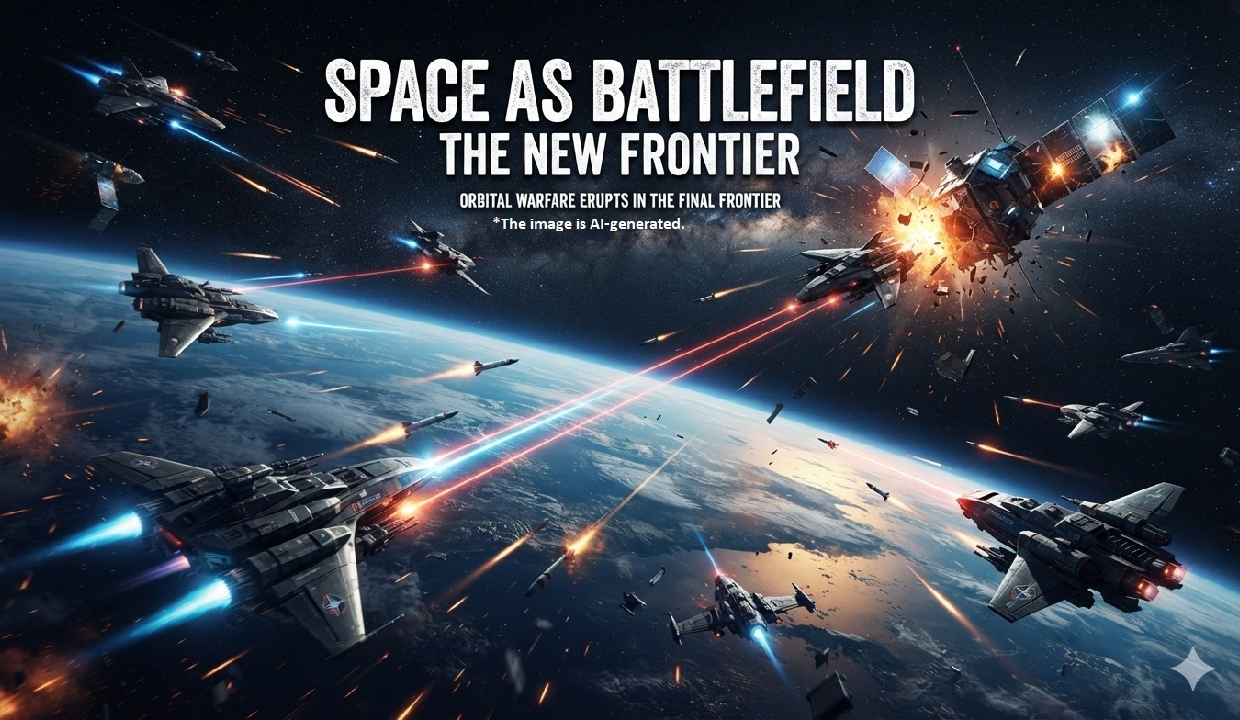
For decades, Washington maintained careful ambiguity about what orbits above us. That ended Monday at the Air, Space and Cyber Conference in Maryland, when Air Force Secretary Troy Meink told a packed hall that the United States now possesses “on-orbit space control weapons” able to defend American forces against hostile action. By his own admission, this was no slip - the phrasing, he said, was “very well thought out”. For the first time, a senior Pentagon official confirmed what analysts had long assumed but no administration had said aloud: America has weaponised orbit.
Nothing about the weapons — type, number, when they went up — was disclosed. That silence is itself the message. Meink offered only that the systems serve offensive and defensive purposes, and pointed, unprompted, to nearly two decades of watching Russia and China build their own counter-space arsenals. The admission lands alongside the Golden Dome missile-shield programme, backed by an initial $25 billion in congressional funding and envisioning layered orbital interceptors as the backbone of homeland defence — a project Beijing and Moscow have jointly warned risks “spurring an arms race” among nuclear powers. The real shock is less the hardware than the precedent. The 1967 Outer Space Treaty bars weapons of mass destruction in orbit but says nothing about conventional ones, so Washington has broken no law — only an unwritten norm of strategic ambiguity all three powers had, until now, quietly kept. China’s foreign ministry responded within hours, with spokesperson Guo Jiakun urging Washington to halt its military build-up in orbit and warning against turning space into what he called ‘a war zone’.
Moscow, having long denied pursuing weapons of its own, is likely to answer less with words than with a demonstration - a satellite manoeuvre, an anti-satellite test, something visible. That is the real danger arms-control specialists are flagging: not that the admission provokes war, but that it hands Beijing and Moscow political cover to stop hiding their programmes and start showcasing them. A secret arms race is dangerous; a public one, with each side signalling resolve, is worse — it removes the face-saving option of pretending not to notice. Does this restore American supremacy? Only briefly, and only on paper. China’s reconnaissance satellite fleet has roughly tripled in six years; Russia’s anti-satellite ambitions are well documented. Deterrence by disclosure buys Washington a news cycle, not a lasting edge — and the long history of missile shields suggests they tend to accelerate the arms races they claim to deter, not end them. This is not yet a march to a third world war, but it is a step towards a costlier, less predictable one - space without rules. What is needed now is not louder signalling but renewed diplomacy: a modern successor to the Outer Space Treaty that explicitly covers conventional weapons, and deconfliction channels robust enough to stop an accident in orbit from becoming a crisis on Earth. The alternative is a contest with no referees, playing out in the place where everyone’s satellites, and increasingly their security, now live.