
When your voice is no longer proof
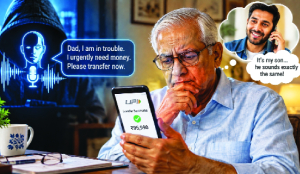
AI voice cloning is turning familiar voices into a dangerous new weapon for everyday fraud
The phone call sounded completely genuine. The caller sounded exactly like Ajoy, an acquaintance of a 67-year-old man in Kolkata.
There was an emergency, he was told. A relative had been admitted to a private hospital and urgently needed money.
The man believed the familiar voice. Within less than an hour, he transferred Rs 95,990.
Then he contacted the real Ajoy. He had never made the call.
The Kolkata incident, reported in August, is a warning about a new kind of fraud that is likely to become harder to detect: AI voice cloning. A scammer no longer needs to sound like a stranger. With a convincing copy of a familiar voice, the scam can begin with something that has traditionally made us feel safe: recognition.
For generations, a person’s voice has been one of our simplest signals of identity. We hear our child’s voice, our spouse’s voice or a close friend’s voice and rarely ask whether it is really them. AI is now challenging that assumption.
Voice cloning technology
Voice-cloning technology can generate speech that closely resembles a real person’s voice. A scammer can use it to create an urgent story: a child has met with an accident, a relative is in hospital, a friend needs money or a parent is stranded somewhere. The pressure is emotional, and that is precisely what makes the fraud effective.
There is no separate national Government figure yet for AI voice-cloning frauds. But the wider cyber-fraud numbers show the scale of the problem. The Government said India recorded 28.15 lakh cyber-fraud complaints and losses of Rs 22,495 crore in 2025. AI voice cloning is now explicitly being recognised as part of the emerging deepfake threat.
The Government is responding on several fronts. Amendments to the IT Rules in 2026 have strengthened requirements around AI-generated and synthetically created content, including labelling and traceability. The Indian Cyber Crime Coordination Centre (I4C) is also strengthening systems to identify suspicious accounts and stop fraudulent transfers.
There is a technology race under way as well. Under the IndiaAI Mission’s Safe and Trusted AI programme, projects include AI Vishleshak for audio-visual forgery detection and an IIT Kharagpur project for real-time voice — deepfake detection. In other words, AI is increasingly being used to fight AI.
Precautions one must take
The Government’s financial-fraud response is already significant. Its Citizen Financial Cyber Fraud Reporting and Management System had helped save more than Rs 11,158 crore across over 32.80 lakh complaints by June 30, 2026. The lesson is simple: reporting quickly can matter. The national cyber-fraud helpline is 1930.
But technology and Government systems cannot replace one important defence: our own behaviour.
The first rule should be simple: never transfer money merely because a familiar voice asks you to. Stop the conversation and call the person back on a number already saved in your phone. Do not use a number supplied by the caller. The safest response to an urgent voice call is to slow down and verify.
Families can go one step further. Parents, children and elderly family members can agree on a simple private code word for genuine emergencies. If someone calls claiming to be a family member and asks for money urgently, ask for that word. It is a small habit that could prevent a large loss.
Senior citizens beware
Senior citizens deserve particular attention. They are often targeted by fraudsters because an unexpected emergency involving a child or relative can trigger an immediate emotional response. Families should discuss voice-cloning scams with older members rather than assuming they will recognise one.
Children and teenagers should be taught the same lesson. A child could receive a call that sounds exactly like a parent saying, “I am in trouble. Send money” or “Give me your details.” Children should know that even a parent’s voice is not enough proof of identity. They should end the call and contact the parent or another trusted adult through a known number. There are a few other basic safeguards: do not share OTPs, PINs or banking details during an unexpected call; be cautious about publicly posting long voice recordings; and when something feels urgent, take a pause before acting.
‘Pause, verify, report’
The Government’s advice is equally simple: “Pause, Verify, Report.”
Ajoy’s case shows why that advice matters. The biggest danger of AI voice cloning may not be only the money we lose. It may be the trust we lose in the voices we know.
For generations, hearing someone was almost proof of who they were. In the age of AI, it may no longer be enough. We may have to verify who is speaking.
The author is an alumnus of IIM Ahmedabad and Professor of Practice at IILM University, Gurugram with an interest in AI, technology and strategy; Views presented are personal.