
When protests empty the streets, businesses pay the price
From the farmers’ agitation at Delhi’s borders to the anti-CAA sit-in at Shaheen Bagh, protests have repeatedly disrupted the movement of people and goods, leaving traders to calculate the cost of political mobilisation. During the farmers’ agitation in 2020-21, traders’ bodies estimated losses running into thousands of crores as border blockades slowed supplies to Delhi’s markets.
During the anti-CAA protests, businesses around Shaheen Bagh reported falling sales and prolonged disruption, with the road blockade affecting some 300 retail shops, showrooms, offices and restaurants. Now, as protests over the revision of electoral rolls bring barricades and security restrictions back to central Delhi, traders in Connaught Place face a familiar problem: fewer customers, uncertain access, and earnings that cannot be recovered once a day is lost.
The impact of the latest disruption became apparent on Tuesday, when Connaught Place’s commercial stretches attempted to return to routine after a day of protests and movement restrictions.
Outside Statesman House, the relative quiet offered little indication of the crowds that had gathered in central Delhi on Monday for the Opposition INDIA bloc’s march towards the Supreme Court.
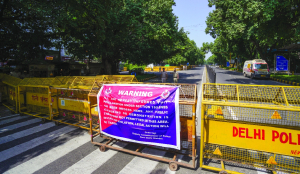
The demonstration, held amid the dispute over the Special Intensive Revision of electoral rolls and demands for Chief Election Commissioner (CEC) Gyanesh Kumar’s resignation, brought police barricades and movement restrictions across parts of the area.
For shopkeepers, however, the immediate concern was not the political argument but the customers who had stayed away. The timing has added to their concerns, with Diwali approaching and retailers hoping to benefit from seasonal purchases. At Kake Da Hotel, a staff member reported a noticeable fall in business on Monday. The protest and the uncertainty surrounding access to the market had kept customers away, the employee said.
The effect was also visible among people who depend on passing customers rather than established storefronts. Roadside vendors selling mobile-phone covers, socks and handkerchiefs were wary of discussing the protests. Some appeared concerned that speaking to a reporter might draw the attention of municipal officials or the police and lead to their goods being confiscated.
Their hesitation reflected another vulnerability in the commercial ecosystem around Connaught Place. Small vendors working from pavements have limited financial buffers and can lose a substantial part of their daily income when the flow of pedestrians declines. Unlike larger businesses, they may have little capacity to absorb repeated interruptions.
A sweet seller outside Statesman House described a similar problem. His stock of gulab jamun, rasgulla and halwa usually sells through by evening. Monday’s weak sales, however, left him with sweets that were no longer fresh enough to offer customers. He had to wait for a new batch to replenish his stock. Asked whether he considered the protest justified, the vendor redirected the question to a practical conclusion: whatever its political merits, the disruption hurt his business.
Brijesh Goyal of the Chamber of Trade and Industry estimated that the disruption had caused losses of around Rs 2,000 crore across Delhi over three days. The estimate covered a broad range of businesses, including shops, petrol pumps, hotels and restaurants, and could not be independently verified.
Goyal said the uncertainty over road access and public transport had discouraged people from visiting markets. When customers cannot be sure they will reach their destination without getting caught in traffic restrictions, many postpone shopping or avoid the journey altogether. The consequences extend beyond the businesses located immediately beside a protest route.
During the farmers’ agitation against the three central farm laws, blockades at Delhi’s Singhu, Tikri, Ghazipur and Chilla borders affected the movement of goods and people. In November 2020, reduced supplies of fruit and vegetables from Punjab, Haryana, Himachal Pradesh and Jammu and Kashmir affected wholesale markets in Delhi. Traders reported that arrivals at Azadpur Mandi had fallen by nearly half, while transport delays and higher freight costs pushed up wholesale prices for some seasonal produce.
The Confederation of All India Traders subsequently estimated in January 2021 that the agitation had caused business losses of around Rs 50,000 crore in Delhi-NCR. That figure was an estimate by the traders’ body rather than an independently audited assessment, but it reflected the scale of concern among businesses dependent on uninterrupted transport links.
The anti-CAA agitation also exposed the economic consequences of prolonged disruption. At Shaheen Bagh in early 2020, traders said sales fell as a road blockade restricted access to the local market. Reports at the time said around 300 retail shops, showrooms, offices and restaurants had remained closed or been affected by the disruption. Some traders estimated that losses across the market ran into crores, while businesses in other sectors reported fewer customers amid protests, violence and prohibitory orders in several cities.