
Vande Mataram case: Muralidhar objects to Solicitor General’s ‘Naxalite’ remark in Supreme Court
The Supreme Court on Tuesday sought the Centre’s response to Carnatic musician T M Krishna’s challenge against penal protection for Vande Mataram. The hearing also witnessed a sharp exchange over Solicitor General Tushar Mehta’s reference to “Naxalites”.
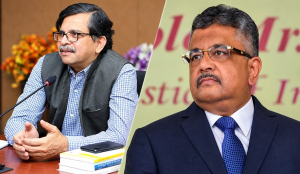
A bench comprising Chief Justice Surya Kant and Justices Joymalya Bagchi and V Mohana heard the petition. Senior advocate S Muralidhar appeared for Krishna.
The petition challenges the 2026 amendment to the Prevention of Insults to National Honour Act, 1971. It also questions Ministry of Home Affairs directions requiring all six stanzas of Vande Mataram to be sung at official functions.
The amended law provides imprisonment of up to three years, a fine, or both, for intentionally preventing the singing of the national anthem or national song. It also covers those who cause a disturbance at an assembly engaged in such singing.
Krishna has argued that the last four stanzas contain references to Hindu deities and devotional imagery. Compelling people to sing those portions would violate freedom of conscience, religious freedom and the secular character of the Constitution, his petition said.
The bench said it expected the principle laid down in the 1986 Bijoe Emmanuel versus State of Kerala judgment to govern the amended provision. That judgment protected schoolchildren who respectfully declined to sing the national anthem on grounds of conscience.
Justice Bagchi indicated that a person should not face criminal consequences merely for declining to sing on religious or conscientious grounds. The court said it would examine the penal provision in relation to Articles 25 and 26 of the Constitution.
The bench did not issue formal notice to the Centre at this stage. It nevertheless directed the government to respond to the challenge.
During the hearing, Muralidhar argued that the amendment had been enacted without adequate public discussion or the building of broader national consensus. He said such questions should develop through public opinion rather than a “top down approach”.
“Law-making is as per the Constitution. Law-making cannot be as per the Naxalites idea,” Mehta said while intervening.
Muralidhar demanded that the Solicitor General withdraw the expression. He said the remark did not behove a law officer and registered a strong protest before the bench.
Chief Justice Surya Kant said the court was examining the legal issue of constitutional interpretation. Justice Bagchi described the exchange as creating “unnecessary tension and emotion”.
Mehta maintained that he had referred to an ideology rather than labelled any individual. He declined to withdraw his comment and said he was “not sorry” for the remark.
Senior advocate Sanjay Hegde, who was present for another matter, intervened and said, “To have a mind of one’s own is not to be a Naxalite.”
Justice Bagchi said that even a person labelled a Naxalite would not lose constitutional rights. He later stressed that even people accused of terrorism were entitled to due process and a fair trial.
The bench said it had not taken note of the disputed comments and would confine itself to the constitutional questions raised in Krishna’s petition.