
US-Iran deal: A fragile yet welcome respite
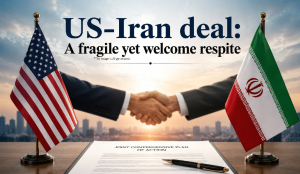
The peace agreement between the US and Tehran, if it endures, could be the most consequential diplomatic breakthroughs of this decade
The announcement by Pakistan Prime Minister Shehbaz Sharif - swiftly confirmed by US President Donald Trump — that Washington and Tehran have reached a peace agreement is indeed a great breakthrough, and the world can take a sigh of relief, but with a small caveat: it should hold. For the United States, this deal is a strategic win dressed up as a humanitarian one. Washington secures what it has long sought: a pathway to constraining Iran’s nuclear ambitions, the reopening of the Strait of Hormuz to toll-free commercial shipping, and a claim to regional peacekeeping without boots indefinitely on the ground. Trump, never shy about legacy-building, has a feather in his cap. For Iran, the gains are tangible and immediate. The maritime blockade imposed on the country will be lifted. Its reported $24 billion in frozen assets, at least half of which is to be released before final negotiations begin, represents a significant economic lifeline. Crucially, the draft memorandum reportedly excludes Iran’s missile programme and its support for resistance groups from the scope of future talks — a significant diplomatic preservation of the sovereignty Tehran has guarded. Here lies the central question. This is emphatically a memorandum of understanding, not a final peace treaty. Sixty days of nuclear negotiations lie ahead, and the track record of such frameworks counsels realism over euphoria. A deal that comes with a resumption clause is less a peace and more a ceasefire with paperwork. The devil, as always, will be in the implementation. The 14-article draft demands an ambitious $300 billion reconstruction commitment from the US and its allies — a figure that will face fierce scrutiny in Washington. Meanwhile, Israeli Prime Minister Netanyahu’s objections remind us that regional spoilers retain the power to destabilise even well-intentioned agreements. The Strait of Hormuz handles roughly a fifth of the world’s oil and gas trade. Its blockade had sent energy markets into anxiety spirals. Oil prices should ease, supply chains should breathe again, and the spectre of a wider regional conflagration should recede.
India has more skin in this game than most. As one of Iran’s historically significant trading partners and a major importer of Gulf energy, India had been quietly absorbing the shocks of the blockade. The reopening of the Strait directly stabilises India’s energy import costs at a time when the economy can ill afford inflationary fuel shocks. Equally significant is the Chabahar port project — India’s strategic gateway to Central Asia through Iran - which had been caught in the crossfire of sanctions and tensions. A more stable Iran means Chabahar can once again become the diplomatic and trade asset India always envisioned.
India’s large diaspora in the Gulf and its remittance flows also benefit from regional de-escalation. New Delhi, which has long practised strategic autonomy by maintaining ties with both Washington and Tehran, is now well positioned to deepen engagement with both sides. The June 19 signing in Switzerland will be a ceremony, not a conclusion. The world should welcome this agreement with open eyes: hopeful, but watchful.