
Unveiling ancient feminism: Challenging incursion into ancient Indian literature
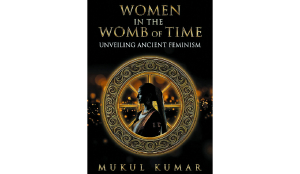
Title: Women in the Womb of Time: Unveiling Ancient Feminism
Author: Mukul Kumar
MRP: Rs 799
Publisher: BluOne Ink
Due to our cultural coding about women in ancient times, the negative statements about them in the Manusmriti and Kamasutra rise to the surface. However, it's important to know another side to such texts, which focuses on women’s economic wisdom and innate intellect. Mukul Kumar’s book Women in the Womb of Time, Unveiling Ancient Feminism is a bold and challenging incursion into ancient Indian literature, including the gaps, silences and misrepresentations that have surrounded the women figures in our long legacy. From this complex book, I wish to isolate three factors that have impressed me the most.
First that it is a male writer who is investigating feminism, both ancient and modern, with a deep sense of commitment to getting at the truth of the heritage. I say this because an unfortunate divide has occurred over time with feminism being identified with a shrill and aggressive mode of protest and masculinity has often been interpreted through the gender lens of physical form. Mukul Kumar has a far more nuanced and comprehensive view in discussing both women and men through well-known texts and arguing cogently that women in ancient India had a status of equality, dignity, and self-hood. He does this without denigrating the men or blaming society in any simplistic manner. For instance, when he speaks of a character such as Ahalya, he raises the question of ambiguity in the story, which traditionally blames Ahalya for infidelity, but does not see the deceit of Indra and the frustrating ascetic husband, Gautama. This is only one example of how Mukul successfully enters the intelligent and acute mind of women characters who have been marginalised or wrongly blamed for decisions they have taken.
My second point is an appreciation of Mukul Kumar’s scholarly, textual research. This impresses me as a recognition of a cultural legacy that originates in the Ardhanareeshwar concept that is the female and male conjoined and not separate, coexisting not competing, mutually supportive, and not disruptive. I agree with Mukul Kumar’s overall summation that feminism in India derives from an ancient legacy of gender equality, whereas the much later western feminist movement is grounded in oppositional gender viewpoints. The chapter on Manusmriti is a masterpiece as this is a controversial text where the grammar of Sanskrit has an important role to play. “In a feminist interpretation of Manusmriti, we have to take cognisance of both: the restrictions imposed on women and the recognition of their key rule in securing social and cosmic order.” (112). Mukul Kumar’s argument is thoroughly grounded on textual citations from the Manusmriti, clearly showing the contradictions that exist within the text. Another excellent analysis is of the Arthashastra, with some stunningly modern statements on state protection for the woman who is socially vulnerable. For instance, it is said, “Courtesans shall be under the protection of the state and court” (134). “A woman has the right to leave a husband who abuses her” (135). To understand how pertinent these directions are, even now, we just have to see the newspaper every day, and read the discussions on sex-workers and domestic violence. Both single as well as married women continue to be vulnerable and seek protection under law. These are small examples that I give of the deep analytical thesis presented by the author.
My third point is about the practical uses of this book on ancient feminism. At last, a contemporary scholar has undertaken a rational study of the early period within the large framework of not only the texts but also sculpture and numismatics or the study of coins, thereby widening the scope of reference whereby women are presented in a complex social system. Women are not just wives, daughters, mothers, and householders, but they also impact the economics and the sociology of their times. Moreover, by presenting them as change agents, Mukul Kumar elevates the status of women from blindly submissive creatures to intelligent people who direct the thinking of their contemporaries and the younger generation. Mukul is not denying the existence of patriarchy, but modifying our approach to it by showing the functioning of women within the scope of their circumstances as active participants in the history of India.
I conclude by appreciating the implied contrast that the book presents between Indian feminism and Western feminism, something that I have tried to instil in my classroom teaching and in my books. I return to the image that has always guided me and that is of the equal partnership of women and men as the ideal relationship from ancient India until now. By contrast, Western feminism is far more recent and derives from a competitive idea of man versus woman. Hence, the vocabulary and the critical stance is entirely different. This book brings the required gravity and scholarly underpinning to the conjectures about equality in the Indian tradition, and holds up the flag for the early emergence of Feminism in India.
Malashri Lal, is a retired Professor, English Department, University of Delhi. She is the recipeint of the Kalinga Fiction Award. Her honours include the prestigious ‘Maharani Gayatri Devi Award for Women’s Excellence’ and the SETU award of Excellence; Views presented are personal.