
Trump signs Iran truce in Versailles
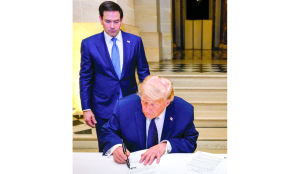
The agreement launches a 60-day diplomatic window to negotiate a comprehensive settlement
US President Donald Trump and Iranian President Masoud Pezeshkian on Wednesday formally signed an interim agreement aimed at ending months of conflict between the US, Israel and Iran, while opening a new phase of negotiations over Tehran’s nuclear programme.
The agreement, which takes immediate effect, provides for a permanent cessation of hostilities and establishes a 60-day framework for negotiations on a comprehensive settlement. Pakistani Prime Minister Shehbaz Sharif, who played a mediating role in the talks, announced that the accord became effective immediately upon signing by both leaders.
The deal marks a significant diplomatic breakthrough but has already triggered debate in Washington and among US allies, particularly Israel, as it offers Tehran substantial economic relief upfront while securing only limited immediate commitments in return.
Trump signed the agreement during a dinner with French President Emmanuel Macron at the Palace of Versailles, a venue associated with several historic international treaties. Video footage released by the White House showed Trump signing the document before handing it to Secretary of State Marco Rubio amid applause from attendees.
“This was not easy,” Trump remarked shortly before signing the accord.
In Tehran, President Pezeshkian signed the agreement on behalf of Iran. Images released by Iran’s State-run IRNA news agency showed him holding the signed document bearing the signatures of both leaders.
Although the full text of the accord has not been officially published, details released separately by US and Iranian officials indicate that the agreement largely restores conditions that existed before the outbreak of war.
Among its key provisions, the accord calls for the reopening of the Strait of Hormuz. The strait had been effectively closed during the conflict, triggering sharp increases in global energy prices and disrupting international trade.
The agreement allows unrestricted passage through the strait for at least two months and commits both sides to restoring maritime traffic to pre-war levels within 30 days. It also envisages the removal of naval mines and the lifting of a US blockade on Iranian ports.
In a major concession, Washington has agreed to issue waivers allowing Iran to resume oil exports without immediate sanctions restrictions. The move could significantly boost Iran’s economy, which earned more than $46 billion from oil exports in 2024 despite existing sanctions.
The accord further opens the possibility of broader sanctions relief, including the eventual lifting of US and United Nations sanctions linked to Iran’s weapons programmes and human rights record. However, officials indicated that such measures would depend on progress during the forthcoming nuclear negotiations.
In return, Iran has agreed to dilute portions of its stockpile of highly enriched uranium and resume talks over the future of its nuclear programme. The Islamic Republic continues to maintain that its nuclear activities are exclusively peaceful.
The agreement also includes provisions affirming Lebanon’s territorial integrity amid continuing tensions involving Israel and the Hezbollah militant group. However, conflicting interpretations of this clause have already emerged. Iran insists that Israel must withdraw from occupied Lebanese territory, while Israeli leaders have rejected any such obligation.
Trump described the accord as “very strong” but suggested that military action could resume if negotiations fail.
“It’s a memorandum of understanding, and if I don’t like it, we’ll go back to shooting at them, dropping bombs,” the President told reporters.
The interim agreement represents a notable shift from Trump’s earlier stance toward Iran. During his first term, Trump withdrew the United States from the 2015 Iran nuclear agreement, famously describing it as the “worst deal ever.”
Analysts note that the new arrangement appears to grant Iran broader economic benefits than those available under the 2015 accord, particularly through the early relaxation of oil sanctions and the prospect of extensive future sanctions relief.
The deal is also expected to face political scrutiny in Washington, where critics argue that granting oil waivers at the outset weakens a key source of American leverage. In Israel, the agreement is likely to intensify pressure on Prime Minister Benjamin Netanyahu, who has faced growing criticism over the conduct and outcomes of the conflict.
Another significant aspect of the accord involves a proposed international reconstruction effort for Iran. Officials familiar with the negotiations indicated that Gulf Arab states could potentially invest up to $300 billion in rebuilding damaged infrastructure, although such commitments would depend on future political and security developments.
For global markets, however, the reopening of the Strait of Hormuz is likely to be the most immediate and consequential outcome. The restoration of normal shipping traffic is expected to ease energy supply concerns and help stabilise oil prices after months of disruption.
With negotiations now entering a critical 60-day phase, the durability of the agreement will depend on whether Washington and Tehran can bridge longstanding differences over Iran’s nuclear ambitions, regional influence and future sanctions relief.