
Trump has put the world on one table — but who will pay the price?
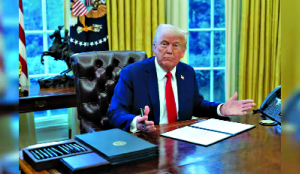
Wars, sanctions, oil, artificial intelligence, and trade are no longer separate files. Under Donald Trump, they are becoming bargaining chips on the same table. That may be the defining image of this year’s United Nations General Assembly. New York is once again hosting presidents and prime ministers against the backdrop of a world that is becoming harder to manage and even harder to predict. The Russia-Ukraine war continues. The confrontation between the United States and Iran has reshaped the security and energy calculations of the Middle East. Gaza and the West Bank remain unresolved.
The Strait of Hormuz has become a reminder that a narrow waterway can carry consequences for the entire global economy, in addition to the Bab Al-Mandab and the Red Sea fiasco. And behind all of this sits a much larger contest: who will shape the new world order of the next decade?
Trump believes pressure creates leverage. The question is whether pressure can produce order or simply accelerate fragmentation.
Trump’s America: Diplomacy with a price tag
There is a distinctive feature of Trump’s foreign policy: he rarely separates diplomacy from the question of what the United States gets in return. Tariffs are leverage. Sanctions are leverage. Energy is leverage.
Technology is leverage. Even alliances can become part of the negotiation. This makes Trump’s diplomacy transactional in character, but it also makes the calculation more complicated for everyone dealing with Washington.
A government may be a strategic partner of the United States and still disagree with Washington on energy, trade, or sanctions. India is a case in point. New Delhi has built a deep strategic relationship with Washington, but it also has major energy, economic, and security interests involving Russia, Iran, and the Gulf. For India, strategic partnership does not mean strategic dependence. That distinction may become one of the defining principles of the emerging world order.
The sanctions weapon is getting bigger
Washington’s latest sanctions legislation against Russia and Iran demonstrates how far economic statecraft has moved from being a secondary instrument to becoming a central weapon of foreign policy. The law signed by Trump gives the administration authority to impose tariffs of up to 100 per cent on major buyers of Russian oil and gas. It does not automatically impose such tariffs, but the power itself changes the negotiating environment. India and China are among the countries most exposed because of their purchases of Russian energy. The intended message is straightforward: if you trade with America’s strategic adversaries, Washington can make that trade more expensive. But there is another side to the equation.
Every time sanctions are expanded, countries have a greater incentive to build alternative payment mechanisms, diversify suppliers, develop new trading routes, and reduce their dependence on financial systems that can be politically weaponised. This does not mean that sanctions are ineffective. It means that sanctions can produce a second-order consequence: the gradual construction of a world designed to operate around them. And that is where the issue becomes much bigger than Russia or Iran. It becomes a question about the future of globalisation itself.
The price of energy is never just the price of energy
For India, this is particularly sensitive. India’s first responsibility is to its own economic security and its population of more than 1.45 billion. Affordable and reliable energy affects transportation, manufacturing, agriculture, inflation, and household costs. Therefore, when Washington increases pressure on Russian energy buyers, New Delhi cannot view the issue purely through the prism of geopolitics. It must also calculate the consequences for Indian consumers, industry, and economic growth. That is not an ideological position. It is economic statecraft. And India’s response reflects a broader reality: middle and emerging powers are no longer willing to accept that their strategic choices must automatically follow the preferences of the major powers.
When Trump and Chinese President Xi Jinping meet in Washington, the headlines will focus on tariffs and trade. But the real negotiations are much larger. Rare earth minerals. Semiconductors. Artificial intelligence. Taiwan. Iran. Agricultural purchases. Technology restrictions. Supply chains.
These are not separate subjects. They are interconnected pieces of the same competition between the world’s two largest powers. Reuters has identified trade, Taiwan, Iran, rare earths, and AI among the central issues surrounding the meeting. The United States wants to preserve its technological and strategic advantage. China wants to protect its economic space and technological ambitions. Neither side wants uncontrolled confrontation. But neither side appears prepared to surrender its core interests. That is why the Trump-Xi relationship is perhaps the clearest example of the new geopolitics: competition without complete separation; cooperation without trust; negotiation without surrender.
The next superpower contest may be fought inside a data centre
There was a time when geopolitical power was measured primarily by armies, aircraft carriers, and nuclear weapons. Today, there is another battlefield: the data centre. Supercomputing and artificial intelligence are becoming strategic resources. The competition is not simply about which country produces the most impressive chatbot or the most advanced model. It is about who controls the chips, computing capacity, electricity, data, research talent, capital, and industrial infrastructure required to scale AI.
The country that dominates this ecosystem will have an advantage not only in technology, but potentially in defence, finance, manufacturing, medicine, logistics, and information. AI is therefore no longer merely a technology race. It is a power race. And the danger is not only that machines become more intelligent. The danger is that governments become capable of making decisions faster than human institutions can understand their consequences.
The United Nations: One room, many worlds
The United Nations General Assembly remains the world’s largest diplomatic stage. But the world sitting inside that room is no longer the same world that created the post-1945 order. The United States remains a superpower. China is a global economic and technological giant. Russia retains significant military and geopolitical influence. India is emerging as an increasingly consequential economic and diplomatic power. The Gulf states are becoming more assertive actors in diplomacy, energy, and investment.
And the Global South is demanding greater representation in international decision-making.
The result is not yet a fully established multipolar world. It is something more complicated: a transition from one distribution of power to another, without agreement on what should replace it. The UN itself reflects this tension. The institution remains indispensable, but divisions among major powers frequently limit its ability to resolve conflicts. The question is therefore no longer simply whether the UN should survive. It is whether its institutions can adapt quickly enough to the world that is emerging.
India refuses to choose only one door
This is where India’s strategy becomes particularly significant. India does not want to choose between Washington and Moscow. It does not want to choose between the Gulf and Iran. It does not want to reduce its relationship with China to confrontation alone. The New Delhi BRICS Declaration itself emphasised multipolarity, greater representation for emerging and developing countries, opposition to unilateral coercive measures, stronger supply chains, and work on cross-border payment mechanisms. This is not necessarily an attempt to create a rival to the Western system. It is an attempt to create more room to manoeuvre within a changing system. That distinction is critical. India’s strategic autonomy is not about isolation. It is about options.
The world after the age of certainty
The greatest mistake would be to assume that the world is simply moving from American dominance to Chinese dominance. The reality is more complicated. Power is spreading. Technology is redistributing influence. Regional powers are becoming more assertive. Economic interdependence remains enormous, but political trust is declining. The result is a world in which countries may cooperate with one another on Monday, compete on Tuesday, and negotiate a new arrangement on Wednesday. This is not necessarily the end of globalisation. It may be the beginning of a different form of globalisation-one based less on unquestioned dependence and more on diversification, resilience, and strategic calculation.
Trump has put almost every major issue on the negotiating table: war, tariffs, sanctions, energy, technology, and alliances. But the world is not simply negotiating with Trump. The world is negotiating with itself. The United States is trying to preserve its leverage. China is expanding its strategic space. Russia is resisting isolation. Iran is trying to withstand pressure. The Gulf states are seeking security while diversifying their economies and diplomatic relationships. India is protecting strategic autonomy. And the Global South is demanding a larger voice in shaping the rules.
The old order is not dead. The new order is not yet born. We are living in the dangerous space between the two. And that leaves humanity with a question far more important than who wins the next tariff battle or who controls the next AI model: can the world’s great powers learn to manage their power before their power begins to manage them?
Because the 21st century may not be defined by who possesses the biggest army, the largest economy, or the smartest machine. It may ultimately be defined by who has the wisdom to know when power should be used-and when it should be restrained.