
Through avalanches and adversity, India breaks through the Himalayas
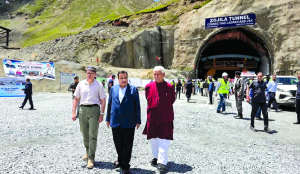
India on Tuesday achieved the breakthrough in the iconic Zojila Tunnel, one of its most ambitious and strategically vital infrastructure projects, marking the completion of 12 years of the Narendra Modi-led Union Government.
Union Minister for Road Transport and Highways Nitin Gadkari performed the breakthrough blasting of the main tunnel being constructed at an altitude of 11,578 feet above sea level, around 24 km from Sonamarg and 103 km from Srinagar, near the East Portal of the tunnel at Minimarg. Jammu and Kashmir Lieutenant Governor Manoj Sinha and Chief Minister Omar Abdullah were also present along with senior officers of the project executing agencies.
The breakthrough blasting of the main tunnel was conducted at an equidistance of 6.5 km, providing access to East Portal (east side) to West Portal (west side). Officials of the National Highways & Infrastructure Development Corporation Limited (NHIDCL) said the breakthrough is six months ahead of schedule. The tunnel from Baltal in the Ganderbal district of central Kashmir to Minimarg in Drass district of the Union Territory of Ladakh has an 18-km approach road.
The tunnel is likely to be thrown open to the public in February 2028, the officials said, adding that after the breakthrough, the civil works will take another seven to eight months before the electrical works will begin. The tunnel, 9.5 metre wide, 7.57 metre high and 13.153 km long, is a horseshoe-shaped single-tube, a two-lane road. Once operational, the tunnel would enhance both civilian and military mobility across the treacherous Zojila Pass, which is usually shut for traffic for three winter months due to heavy snowfall.
The 13 km-long, Asia’s longest tunnel, carved through the formidable Himalayas, will deliver reliable all-weather connectivity between Kashmir and Ladakh.
Once completed, it is set to slash travel time across the treacherous Zojila Pass from nearly three-and-a-half hours to just 20 minutes, improving connectivity, boosting economic activity and strengthening access to the border region.
The historic milestone was greeted with spontaneous celebrations by the team of engineers and workforce. Addressing the media, Gadkari said the project is a lifeline for the people of Ladakh and Jammu and Kashmir. He said 80 per cent of the workforce belongs to the region, and added that the project will provide all-weather connectivity to people of the Ladakh region to Srinagar.
Jammu and Kashmir Chief Minister Omar Abdullah congratulated the people of Ladakh for getting closer to the realisation of the dream of all-weather connectivity. He added that while one dream of the people of Ladakh is close to getting fulfilled, another — that of direct and regular air connectivity to Kargil — is yet to take shape and urged the Union Minister to use his influence to help fulfil the aspiration.
Megha Engineering and Infrastructure Limited (MEIL), the agency executing the project, used the New Austrian Tunnelling Method (NATM) to pierce through the Himalayas and navigate the fragile geology.
The entire project is 31 km long, including the approach road and bridges, stretching from Sonmarg to Minimarg.
MEIL won the project from the NHIDCL and began constructing the tunnel in October 2020.
Speaking further, Gadkari said that multiple rounds of bids were invited for the project. In the fifth round, the estimation for the project was delivered around Rs 12,000 crore but “we are building it at around Rs 7,000 crore. So we saved Rs 5,000 crore”.
MEIL is aiming to complete the project by 2028. However, it will continue to operate and maintain the tunnel for a period of five years after commissioning, officials said.
Besides being the longest tunnel project in Asia, Zojila is also among the world’s highest tunnel projects, the officials said.
Over the last five years, the site has witnessed five avalanche incidents, including a severe one in January 2023 when 172 workers stranded in the area were rescued by the Indian Army. Despite these challenges, the project has achieved 10 million safe man-hours, MEIL said.
Interacting with the media, an Iranian engineer, Yusuf, who represented ICT AIAPL, said, “I am from Iran. I am proud of it. I can say I am proud that about 80% of the project is already finished; the remaining 20% might take another two years or so to complete fully. Regardless, the breakthrough is a major event for the tunnel, and we are happy that, under the current system, we have managed to execute this project effectively. It will take roughly another two and a half years for the tunnel to become operational. However, in a dire emergency, especially if the Army needed to use it, it might be possible to utilise the tunnel for a short period, although under normal circumstances, it is not feasible to use it yet...”