
They clean India’s cities. Now waste workers are being recognised as climate allies
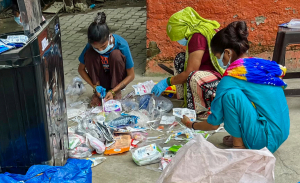
Long before the national capital wakes up, thousands of informal waste workers are already on the streets, collecting waste from homes, sorting it by hand and feeding materials back into the recycling chain.
For years, much of this work went unnoticed. But for some workers, a first bank account, regular savings, insurance and access to government schemes are slowly changing not just their financial security, but also how they see their work and themselves.
“Earlier, I spent every penny I earned on our immediate needs. But now, I can save and manage household expenses, including food and my children’s education,” said 48-year-old Joginder Kewat, a waste worker in Delhi.
Kewat is among more than 42,000 waste workers associated with Project Utthaan, an initiative supported by the United Nations Development Programme (UNDP) and partner foundations. The project seeks to recognise waste workers, or ‘Safai Mitras’, as environmental stewards and contributors to the circular economy.
From entitlements to stability
Kewat said he earned around Rs 100 to Rs 150 a day before joining the project and had little financial stability. That began to change after project workers visited his home, surveyed his circumstances and explained government schemes available to him.
“Now, I have a secure source of livelihood and earn more. This has made things easier for my family and me,” he said.
Rashida, 40, a waste-picker in Delhi, had a similar experience. She still sorts the waste collected by her husband, separating materials such as cloth, bottles and mattress material. But through the project, she learnt about government support and obtained an e-Shram card, a free LPG cylinder and other benefits.
“Through Project Utthaan, I learnt about some of the government support available to us. I still sort waste, but the work at Shakti Foundation has made things easier, and I am happy to be working there,” she said.
For 32-year-old Shabana, a waste worker and artist, access to documents and healthcare support brought a different kind of security. She said getting an Ayushman card and e-Shram card made it easier for her family to access healthcare without having to pay the full cost of treatment.
“Things are a little more stable for us now, and we have also started building a house in our village and are able to save a little. I feel proud of the work I do and of being able to contribute to my family,” she said.
Waste work as climate action
The project's focus extends beyond welfare benefits. At one of its upcycling centres in Delhi, discarded milk pouches are washed, dried and cut into long strips. The plastic is then woven with cotton thread on wooden frames to make handbags, wallets, plant holders and other products.
The work offers a glimpse of the circular economy in practice, with material that would otherwise be discarded being turned into something usable.
UNDP Resident Representative in India Angela Lusigi said the organisation's ‘Planet Starts With People’ campaign, launched on World Environment Day 2026, aims to place people such as waste workers at the centre of the climate conversation.
Waste workers sort and recycle material every day, she said, but are rarely recognised as climate leaders.
According to Ashish Chaturvedi, head of Action for Climate and Environment at UNDP India, lack of awareness and confidence, rather than eligibility, was often the biggest barrier for workers trying to access welfare schemes.
“We also saw a multiplier effect. When one person successfully accesses a scheme, neighbours follow, trust widens, and social protection carries forward on its own,” he said.
For Chaturvedi, the change is not only about the benefits workers receive. It is also about how they view themselves — not simply as people who keep cities clean, but as citizens with rights, entitlements and aspirations.