
The Shah Factor
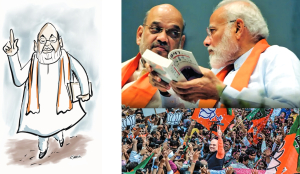
THE IMMEASURABLE REINCARNATION OF SARDAR PATEL, THE IRON MAN OF INDIA
Amit Shah is perhaps one of the most revered yet controversial figures in contemporary Indian politics. Known for his clarity of vision and unwavering commitment to his objectives, he has often attracted criticism for his distinctive working style. Yet, many of the decisions he has pursued have required a firm hand and strong resolve to achieve their intended goals. Inspired by his political ideal, Sardar Vallabhbhai Patel, Shah has sought to bring the same determination and administrative acumen to the Ministry of Home Affairs, earning an enviable reputation as a devoted follower of the Iron Man of India
October 22, 2018, marked a most fateful milestone in India’s long trackless journey. India’s Prime Minister Narendra Damodardas Modi proudly unveiled the “Statue of Unity” as a monumental ode to independent India’s first Home Minister Bharat Ratna Sardar Vallabhbhai Jhaverbhai Patel (popularly known as the “Iron Man of India”) on the solemn occasion of his 143rd birth anniversary at Kevadiya, ensconsed on the banks of the holy river Narmada, facing the sprawling concrete gravity Sardar Sarovar Dam (set in motion by Modi on 17th September, 2017 to commemorate his 67th birthday!), southeast of Vadodara. The steel and bronze cast statue, masterfully chiselled by the internationally acclaimed sculptor Padma Bhushan Ram Vanji Sutar, turned out to be a breathtaking engineering marvel that cost Rs 2,989 crores, weighed 130,000 tonnes and rose to a height of 182 metres, making it the tallest statue in the world bearing twice the height of New York’s iconic copper-clad Statue of Liberty! In his awe-inspiring speech, surcharged with unbridled emotion, Modi paid an effusive, glowing personal tribute to Sardar, “This statue is not only a token of respect for his strength and dedication, but is also an expression of New India’s new self-confidence.” The benign, unobtrusive presence of India’s longest serving 32nd Home Minister Amitbhai Anilchandra Shah, the second most powerful personage in the country who proudly dons the coveted mantle of the mighty Sardar and is hailed far and wide as his true reincarnation, lent a very special flavour to the august event. Not to be outdone by Modi’s historic inauguration, Shah unfurled an 11-foot-tall, 1,100 kg statue of Sardar on December 8, 2024, in Jodhpur. In his impassioned address, Shah asserted in ringing tones that Sardar was “a page of history to which history and the nation both failed to do justice…the truth cannot be suppressed and will eventually shine like the sun at the right time.”
Shah was propitiously born on October 22, 1964, at approximately 05:25 a.m. IST, into an affluent Gujarati family ensconced in Bombay (now Mumbai) when the astronomical skies were marked by a Full Moon in its Waning Gibbous phase, with about 97.8% illumination. His father, Anilchandra Shah, belonged to the prominent “Nagar Seth” family of Mansa, a quaint city belonging to a former princely state in Gandhinagar, and owned and operated a successful PVC pipe business. His mother Kusumben, was deeply rooted in Gandhian ideals and instilled in him a sense of fierce patriotism and strict discipline from a very early age. He spent his childhood in Mansa and studied in the prestigious Sheth C. M. High School in Mansa until the age of 16.
He is an ardent fan of cricket and also enjoys playing chess. He is an avid reader, with a particular interest in history, and a movie buff
Upon completion of his school education, his family shifted to Ahmedabad. Thereafter, he studied biochemistry at the premier CU Shah Science College in Ahmedabad. He graduated with a Bachelor’s of Science (B.Sc.) in biochemistry and then joined his father’s business, working simultaneously as a stockbroker and in co-operative banks in Ahmedabad.
Shah’s political indoctrination began at an impressionable age. At the age of 13, he pasted posters for Maniben Patel, the indefatigably Gandhian daughter of Sardar, in the 1977 general election in which she contested and won the Mehsana Lok Sabha seat. And at 16, he voluntarily joined the Rashtriya Swayamsevak Sangh (RSS), founded in Nagpur on September 27, 1925, by the noted physician Dr. Keshav Baliram Hedgewar. After joining the RSS, Shah got closely associated with the Akhil Bharatiya Vidyarthi Parishad (ABVP), the student wing of the Bharatiya Janata Party (BJP). He transitioned to the Bharatiya Janata Yuva Morcha, the BJP’s youth wing, in 1987. During these years, Shah actively participated in the Ram Janmabhoomi movement, which vigourously campaigned for a temple to be built on the site of the Babri Masjid, believed by Hindus worldwide to be the exact birthplace of Lord Rama, the seventh avatar of Lord Vishnu, aptly described by Swami Vivekananda as “the ancient idol of the heroic ages, the embodiment of truth, of morality..and, above all, the ideal king”. Shah also participated in the “Ekta Yatra”, a rally that commenced on December 11, 1991, to advance the cause of the movement. On December 6, 1992, the Babri Masjid ceased to exist. On November 19, 2019, a landmark judgement of the Hon’ble Supreme Court of India, entrusted the site exclusively to Hindus and directed the state to grant an alternate site in Ayodhya to Muslims. The grand, colossal Ram Mandir was later built on the hallowed site and formally inaugurated by Modi in a historic “Pran Pratishta” ceremony on January 22, 2024. Shah could not physically attend the event due to compelling reasons, but was present in spirit as he watched the live telecast from Ayodhya while offering prayers at the famed Sri Laxmi Narayan Temple (Birla Mandir) in New Delhi, inaugurated by Mahatma Gandhi on March 12, 1939.
In the 1990s, the BJP began to democratically wrest power from the Indian National Congress in Gujarat. Shah was the lynchpin during this era of state politics and helped broaden the party’s membership base. In 1997, Shah fought an election for the first time, winning a by-election from the Sarkhej constituency and becoming a member of the state’s legislative assembly. He retained his seat in the assembly elections of 1998, and the party formed a government led by Keshubhai Patel. Shah assumed office as the Vice President of the party in 1999.
In the 1990s, the BJP began to democratically wrest power from the Indian National Congress in Gujarat. Shah was the lynchpin during this era of state politics
On October 7, 2001, the BJP’s national leadership scrupulously replaced Patel as the Chief Minister of Gujarat with Modi. On February 27, 2002, the ill-fated S-6 coach of the Sabarmati Express carrying Hindu pilgrims was deliberately set on fire by a violent mob near the Godhra railway station, incinerating 59 innocent passengers, including a 16-day-old baby. This triggered widespread communal violence marked by destruction and bloodshed. On July 19, 2002, Modi voluntarily resigned as the Chief Minister purely on moral grounds. Snap assembly elections ensued in December 2002, and the BJP emerged triumphant again. Modi resumed his Chief Ministership, which he continued uninterruptedly for 12 years. On February 8, 2012, a Supreme Court-appointed Special Investigation Team (SIT) filed a closure report citing “no prosecutable evidence” against Modi in the Godhra upheaval. This clean chit was eventually upheld in a definitive June 24, 2022, Supreme Court ruling. After the 2002 elections, Shah was made a minister in the Modi government and held multiple portfolios, including the key department of home affairs.
On July 25, 2010, Shah was arrested by the Central Bureau of Investigation (CBI) and slapped with serious charges in the Sohrabuddin Sheikh case, at the vengeful instance of his vicious political rival, P. Chidambaram, the then Home Minister. Shah was given bail after three months in prison but was barred from entering Gujarat for two years.
On September 27, 2012, the Supreme Court allowed him to return to Gujarat, and he won the state assembly elections that year from the Naranpura constituency. On December 30, 2014, the Special CBI Court discharged him due to a lack of evidence. Shah was exonerated by the Supreme Court on August 1, 2016, when it dismissed a petition challenging his discharge. During these turbulent days of trial and testing for Shah, his long-standing and faithful “foul weather friend” Tushar Mehta, presently India’s redoubtable Solicitor General, stood behind him like a Rock of Gibraltar imbued with his razor-sharp intellect and incredible legal acumen!
On September 13, 2013, the BJP’s central leadership picked Modi as the Prime Ministerial candidate ahead of the 2014 general election. Following in the footsteps of Modi, Shah shifted his political locus from Gujarat to New Delhi. He was appointed General Secretary of the party on March 13, 2013, and given overall charge of the poll strategy for the “Gateway to Delhi” state of Uttar Pradesh. The BJP won the election with an outright majority of 282 seats. The victory was powered by the party’s unprecedented win in 71 of Uttar Pradesh’s 80 seats, thanks to Shah’s superlative mastery of electoral strategy and management. Modi became the Prime Minister on May 26, 2014, and Shah was elected the party’s National President on July 9, 2014. On August 19, 2017, Shah was elected to the Rajya Sabha. Two years later, he won the Lok Sabha seat from Gandhinagar. The BJP returned to power with an overwhelming mandate of 303 seats, and Modi remained unshackled as the Prime Minister. Shah had played a stellar strategic role in the BJP’s sweeping election juggernaut. On May 30, 2019, he was made the Home Minister in the second Modi government.
Shah retained the post in Modi’s third term after the BJP won the general election on June 4, 2024, and formed the government on June 9, 2024. As the Home Minister, Shah deftly oversaw two of the most far-reaching political changes made by the Modi government, viz. the abrogation of Article 370 of the Constitution, and an amendment to the Citizenship Act.
Article 370, an antiquated, superfluous provision that gave the Muslim majority state of Jammu & Kashmir special status and a high degree of internal autonomy, was effectively revoked on August 5, 2019. At the same time, Jammu & Kashmir was downgraded from statehood and reorganized into two distinct and separate union territories: Jammu & Kashmir and Ladakh. The Citizenship (Amendment) Act (CAA), passed by Parliament on December 11, 2019, provided a fast-tracked pathway to Indian citizenship to persecuted religious minorities from Afghanistan, Bangladesh and Pakistan.
I am highly emboldened to chronicle three singular achievements of Shah in recent times viz. his steadfastly emancipating India, after three years of sustained, intensive anti-Maoist operations, from the scourge of Naxalism that had plagued India since the armed ultra-left Naxalbari uprising in 1967 in April, 2026, his tireless striving that enabled the BJP to trounce the autocratic, corruption-ridden All India Trinamool Congress (AITC) party in the last assembly election in West Bengal under the valiant stewardship of Modi in a landslide mandate in May, 2026 that brought into its kitty a rich harvest of 208 assembly seats and his assiduously herculean effort in June, 2026 to secure India’s long porous borders with Pakistan and Bangladesh from illegal immigration.
Significantly, Shah, working in close unison with Modi, is dealing a death blow to the twin dangers of global terrorism and cross-border infiltration that hang heavily over our heads like the Sword of Damocles.
The relationship between Modi and Shah is an indefinable one. Their multifarious fans and admirers laud the duo as the “two wheels of a car” and compare them to the brothers Rama, representing the “Paramatma”, and Lakshmana, representing the “Jivatma”, in an utopian Ram Rajya. Modi and Shah are inextricably attached to each other and undoubtedly share an indestructible bond of affection, respect, trust and frankness akin to the special relationship that existed between the legendary Indian saint and mystic Ramakrishna Parmahansa Dev and his noble disciple Swami Vivekananda. Shah is popularly feted as a modern-day Chanakya because of his extraordinary skills as a political guru, master strategist and decisive administrator. He is an ardent fan of cricket and also enjoys playing chess. He is an avid reader, with a particular interest in history, and a movie buff. He also revels in music, with a particular appreciation for Indian classical music and regional folk genres. Shah and his devoted, spirited wife, Sonal Shah, have a son Jay Shah, who is a cricket administrator and businessman, and presently the Chairman of the International Cricket Council (ICC).
Shah’s invincible, ebullient spirit, unceasing vigilance, piercing perception, omnipotent gaze, delightful sense of humour and mesmerising oratorical skills give him a truly monolithic character. The Indian people are justly proud of him and are superbly confident of his unassailable courage and integrity and his tenacious adherence to noble grassroots principles and intense dedication to the path of high endeavour.
As the Home Minister, Shah deftly oversaw two of the most far-reaching political changes made by the Modi government, viz. the abrogation of Article 370 of the Constitution, and an amendment to the Citizenship Act
The author is an internationally reputed senior lawyer practising in the Supreme Court of India and various High Courts and Tribunals in India. He is an avid debater, public speaker, writer, broadcaster, telecaster, artist, painter, sculptor, music critic and filmmaker; Views presented are personal.