
The Russia embrace, recalibrated
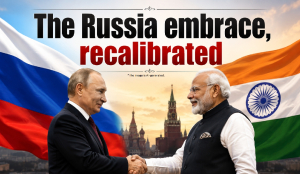
As the two leaders reaffirmed their commitment to a relationship tested by war and sanctions, India made clear that its ties with Moscow remain important
When Narendra Modi and Vladimir Putin embraced on the sidelines of the Shanghai Cooperation Organisation summit in Bishkek on August 31, it was the image both governments wanted the world to see: warm and familiar, unbothered by the past year’s turbulence.
Their bilateral meeting — the first face-to-face encounter since Putin’s visit to New Delhi last December — was brief by diplomatic standards, but its symbolism travelled further than its substance. Modi’s message was carefully calibrated. “We must move away from endless war towards an end to the war,” he told Putin, adding that “every day spent in war sets humanity back.” It was a restatement, four years on, of the line he delivered at Samarkand in 2022: “today’s era is not an era of war.” Putin, for his part, reached for language both sides have used since 2010, calling the relationship a “special and privileged strategic partnership,” and thanked Modi for his “personal attention” to it.
Modi used the occasion to invite Putin to New Delhi in September for the BRICS summit, keeping the calendar of contact dense even as the war in Ukraine grinds on. The meeting is being called significant less for what was announced than for what it confirmed: that Washington’s year-long campaign to prise India away from Moscow has not worked as intended. Donald Trump’s decision last August to push tariffs on Indian goods to 50 percent, explicitly citing its Russian crude purchases, was the most direct pressure an American president has applied to India’s Russia policy in decades.
Tariffs came down again in February after signals that Indian refiners would scale back, and imports did fall for much of the last fiscal year. But the rebound has been telling: Russian crude buys climbed again this spring, pushing bilateral trade up more than 50 percent for the quarter, oil doing almost all the work while Indian exports stay barely visible on Russia’s books. That imbalance is the honest picture of where the relationship stands today.
Two decades after Moscow was India’s default partner on everything from fighter jets to nuclear plants, the tie is now narrower and more transactional: discounted crude and fertiliser, spares and maintenance for a legacy defence inventory built around the S-400 and Soviet-era platforms, safer rupee-rouble payment channels to dodge sanctions, and a $100-billion trade target both sides keep restating without a credible path there. Where this heads will be decided as much in Washington and Beijing as in Moscow or Delhi.
India’s simultaneous thaw with Xi Jinping at the same summit — itself partly a by-product of Trump’s tariffs — gives New Delhi more room to treat Russia as one hedge among several, not a pillar.
Moscow, meanwhile, has grown steadily more dependent on Beijing, leaving it less able to reciprocate India’s balancing act than before. The Bishkek embrace was genuine enough. But it described a friendship being managed in a crowded field, not one being restored to the centre of India’s foreign policy.