
The rupee and the school bell
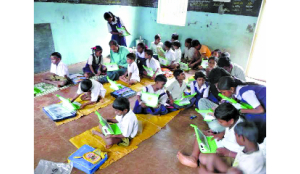
India has chosen to protect part of its tax revenue for education. Indeed, an important commitment. However, the latest parliamentary data invite a second question: once money is raised for education, does it reach the system at the time when schools can use it best?
On August 10, 2026, the Ministry of Education told the Lok Sabha that the education share of the Health and Education Cess was Rs 63,252.86 crore in 2024-25 and Rs 65,890.50 crore in 2025-26. It also reported utilisation of Rs 40,900 crore and Rs 48,049.09 crore through the Prarambhik Shiksha Kosh, and Rs 11,162.60 crore and Rs 10,314.31 crore through the Madhyamik and Uchchatar Shiksha Kosh.
These numbers need care. The gap between annual collections and utilisation cannot simply be called “unspent money”. Reserve funds can carry balances across years. A sound assessment requires the opening balance, fresh credits, withdrawals and closing balance. The real policy question is therefore not whether a single year’s figures match, but whether the full flow of money can be tracked from collection to eventual use.
It’s a long flow. Cess proceeds move through designated reserve funds; schemes receive budget support; States prepare annual plans; approvals are made; State contributions are matched; and releases follow after financial conditions are met. Under Samagra Shiksha, these include the pace of earlier expenditure, audited accounts, utilisation certificates and receipt of the State share. These are legitimate safeguards, not needless paperwork.
However, education has a feature that public finance cannot ignore — timing changes value. A textbook arriving after the first term is not equivalent to one available on the first day. A roof repaired after the rains does not undo classes already disrupted. A delayed payment can affect teachers, vendors or school services even if the account is eventually settled. This is why timeliness should be treated as part of financial performance, not as an administrative afterthought. Significantly, NEP 2020 itself recognised that education funds are often not spent in time at district and institutional levels and called for a “smooth, timely and appropriate flow of funds”. The argument, therefore, is not against existing policy; it is for carrying one of its own principles further.
Responsibility is shared. The Centre must make releases as predictable as possible. States must provide their matching share, submit accounts on time, improve procurement and avoid weak execution. A delayed transfer at one level can become an unspent balance at another. Looking only at the Centre or only at the States risks confusing where the bottleneck actually lies.
The federal setting makes this more important. The Sixteenth Finance Commission retained States’ share of the divisible pool at 41%, while purpose-specific cesses remain outside that pool. It also reported that States’ education expenditure was between 2.2 per cent and 2.5 per cent of GDP over 2011-12 to 2023-24. This should not be compared directly with NEP 2020’s 6 per cent goal, which refers to combined public investment by the Centre and the States. Adequate funding and efficient execution are different policy problems.
The case for better reconciliation is also practical. CAG’s 2025 Union Government audit found that Ministry of Finance figures for combined transfers to designated Health and Education Cess reserve funds did not match amounts reflected in the Union Government Finance Accounts for 2018-19 to 2023-24, and called for reconciliation. That is an accounting issue, not evidence of misuse.
Three practical improvements might strengthen the system without weakening accountability. First, publish one annual reconciliation showing cess collections, transfers to reserve funds, opening and closing balances, scheme allocations, releases and actual expenditure. Second, map major school expenditures to the academic calendar, so time-sensitive items are released before they lose part of their value. Third, create an early-warning dashboard identifying States or components at risk of missing release conditions, allowing problems to be corrected before they affect schools.
The World Bank has similarly noted that delayed fund releases, complex financial requirements and procurement problems can hold back books, teaching materials and other resources at school level. The lesson is modest but important: ‘budget execution is part of education policy, not merely an accounting exercise’. India does not need to choose between financial discipline and educational continuity. It needs both. Earmarking can protect the purpose of a rupee; good public finance must also protect its timing.
For a child, this distinction is simple. The value of education spending is realised not when money is collected, but when the teacher, textbook and classroom are available when learning is supposed to begin. After all, the school bell cannot wait for the treasury!
Debdulal Thakur is Professor and Director, Centre of Excellence (CoE) for Public Policy, Sustainability and ESG Advanced Research, Alliance University, Bengaluru. Shrabani Mukherjee is Professor, Department of Economics, Alliance University, Bengaluru; Views presented are personal.