
The Himalayas cannot carry unlimited development
In August 2025, a wall of mud and debris swept through Dharali in Uttarkashi. The cause: a moraine-dammed glacial lake, swollen by retreating ice and relentless monsoon rain, had burst its banks. Four lives were lost; fifty remained missing. It was not an anomaly. It was one installment in an accelerating pattern that demands a rethink of how India develops its mountains.
There is no denying the starkness of the figures. In the past two decades, glacial melting has nearly doubled in the Hindu Kush Himalaya region, with the area experiencing a 12 per cent decline in glacial cover between 1990 and 2020 (ICIMOD, 2026). There has been a 21 per cent decrease in glacial cover in the Ganga Basin, an icy shield that supports over 400 million lives. The Glacial Lakes Atlas of ISRO has reported 2,400 such glacial lakes, with 601 having doubled in size and are at risk of bursting into floods. Glacial retreat could cost the South Asian economy 6 per cent GDP growth till 2050 (ISRO, 2024). The Sikkim GLOF of 2023 provided an example of what such a path would be like. Permafrost erosion led to a landslide into South Lhonak Lake, producing a flood surge of 20 metres in height, which resulted in the destruction of the Teesta-III dam, with at least 90 fatalities and flooding 276 square kilometres of agricultural lands (Sattar et al., 2025). The intensity of precipitation further aggravates the situation. According to reports, Himachal Pradesh witnessed 46 instances of cloudburst during 2025, 10 of which took place in a day, causing `4,800 crore loss to the economy, resulting in a death toll of 448 people. As per the World Meteorological Organisation (WMO), 2024 was recorded as the hottest year globally, resulting in a loss of 450 billion tonnes of glacier ice (WMO, 2024). Intensity of rainfall has increased by 15-20 per cent in the Indian Himalayan region since the 1950s. Climate change is not the only factor influencing this phenomenon. Human actions have stretched far beyond what the environment can support. The tourists who visited Uttarakhand grew 61.79 per cent in five years and were up to 5.96 crore by 2023. In Himachal Pradesh, the growth in the number of tourists increased thrice between 2021 and 2024.
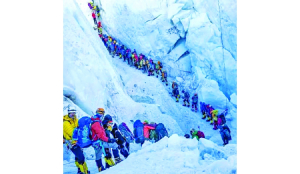
The Char Dham Yatra clearly defines the paradox. During the year 2025, more than 51 lakh pilgrims performed their worship at these shrines; however, 72 percent of these devotees made the pilgrimage in the first 60 days, causing extreme strain on the trails due to early-season pressure. It was estimated that the shrine of Kedarnath had disposed of around 2,324 tonnes of trash for the season 2024-2025. The Eastern Himalaya and India’s northeastern states harbour distinct and, in several respects, more acute pressures. This arc faces compounding stresses: hydropower proliferation, expanding road corridors, and the erosion of indigenous land-management systems that once stabilised fragile slopes. The state of Arunachal Pradesh alone has recognised hydroelectric projects amounting to over 10,000 MW on the Brahmaputra’s tributaries, whose combined hydrological impacts have been woefully insufficiently evaluated. Governance challenges specific to this area, including indigenous land claims, border issues, and limited capacities, make implementation of the policy difficult. The Sikkim GLOF that occurred in 2023 was not just a localised event. It was a wake-up call regarding development priorities.
The structural contradiction that lies at the core of such crises deserves to be addressed explicitly. The mountain states’ economic development strategy is based increasingly on generating income from tourism, pilgrim circuits, hydropower projects, and infrastructure-led constructions, despite the fact that their ecological carrying capacity is increasingly under strain. This poses a problem in terms of governance: the activities which generate income are those that cause disruption to the fragile ecosystem. Scholarly evidence confirms that while tourism-induced urbanisation in Uttarakhand provided employment for 35per cent of the youth each year, it resulted in agricultural production dropping by 19-55 per cent, and food shortages increasing to 65 per cent-95 per cent. When fiscal incentives push states toward expanding precisely those activities straining ecological capacity, voluntary restraint becomes structurally improbable. What is required is not merely better environmental compliance but a reorientation of mountain state fiscal models - one that recognises intact watersheds, standing forests, and stable slopes as quantifiable economic assets rather than obstacles to development. Indian government’s reaction to climate change is changing as well. Disaster Management (Amendment) Act, 2025 requires a National Disaster Database along with Urban Disaster Management Authorities (PIB, 2025). The state of Uttarakhand is changing its building regulations because of the newly assigned status of Seismic Zone VI. Finally, the “Right to be Free from Adverse Climate Effects” has been recognised, and carrying capacity assessments have been ordered in 12 Himalayan States and UTs.
However, signs will not be enough; carrying capacity evaluations need to be implemented as enforceable land use standards rather than merely as reports. The National Mission for Sustaining the Himalayan Ecosystem has been funding more than one hundred vulnerability assessments, but has been accused of institutional silos, making such research unattainable by the people. That the NMSHE had to withhold certain findings under the pretext of strategic sensitivity at the start of 2026 (Economic Times, 2026) should worry anyone familiar with the fact that mountains don’t care about classified reports. There are better solutions. The HUBS initiative brings natural solutions to water management and waste management in the hills, such as Nainital and Gangtok (NMHS, 2026). The Parvatmala initiative’s 1,200 km of cable car rides ensures that zero-footprint travel does not destabilise the slopes in any way. A 30-year-old effort to restore the hills in Uttarakhand has turned degraded lands into thriving biodiversity. The trouble with the Himalayan region does not lie in the fact that time is running out owing to only climate change. Time is running out owing to the way institutional responses to the changes have been reactionary, disorganised, and always lagging behind changes in the ecology.
These are living, geological formations, which are young, unstable, hydrological, and subject to extremes increasing at an even more rapid pace than was initially modeled. The dilemma that lies before India is one of civilisational adaptation, where economic aspiration is balanced with natural limits. The carrying capacity does not limit economic aspiration but, in fact, forms the cornerstone of any enduring process of development within such fragile mountain environments. It will not be a function of how fast roads, dams, and tourism belts are built, but rather of whether governance mechanisms have learned once again to live within ecological limits.
Umesh Raj is a Research Assistant at Pahlé India Foundation and Moloy Bora is a former IAS officer, specialising in public policy, urban governance, and local economic development in Northeast India; Views presented are personal.