
The future of tourism lies in partnership
If we can bring together political will, public investment, private enterprise and the participation of our people, tourism can become far more than an economic sector
Tourism has never been, and can never be, the enterprise of government alone.
Every journey undertaken by a traveller is sustained by an intricate ecosystem: governments and local authorities, airlines and transport providers, hotels and homestays, tour operators and guides, technology platforms and content creators, artisans and entrepreneurs-and, above all, the communities whose lives, traditions and landscapes give a destination its distinctive character.
The task of government, therefore, is not merely to promote destinations. It is to create the conditions in which this entire ecosystem can flourish.
India stands today at an important juncture in its tourism journey. The traveller of the present is increasingly seeking not merely monuments to be seen, but experiences to be remembered. Local food, living traditions, music, crafts, nature, homestays and encounters with communities are becoming as important as conventional sightseeing.
This transformation demands a corresponding transformation in the way we conceive tourism.
We must move from destinations to experiences, from isolated attractions to integrated ecosystems, and from government-led promotion to partnerships that bring together the capabilities of the public and private sectors and the energies of our people.
The experience of recent partnerships in Indian tourism illustrates the possibilities before us. The Ministry of Tourism has increasingly engaged with industry and other stakeholders to bring together capabilities in technology, mobility, hospitality, content and digital outreach. Such partnerships are valuable not merely because they extend the reach of Incredible India, but because they connect inspiration with access, and access with experience.
The example of Varanasi is particularly instructive. A destination can be presented not simply as a collection of monuments, but as a living cultural experience — combining the Ganga, classical music, heritage, Banarasi weaving, local communities and traditional hospitality.
This is the direction in which tourism must now evolve.
But partnerships alone cannot create a successful tourism economy. They must be underpinned by three essential foundations: political will, public investment and people’s participation.
The first is political will.
Tourism touches almost every dimension of public policy. A visitor’s experience of a destination is determined not merely by what he or she has come to see, but by the quality of roads, airports, railways, public transport, sanitation, safety, digital connectivity, urban planning, heritage conservation and local services.
Tourism, therefore, cannot remain confined within the administrative boundaries of a tourism department.
It requires a whole-of-government approach.
Transport, civil aviation, railways, culture, urban development, environment, skill development, commerce and digital technology must converge around a common understanding of what makes a destination successful.
Political will, in this context, means recognising tourism not as an ancillary economic activity, but as an instrument of employment, enterprise, cultural preservation, regional development and international engagement.
It also means having the courage to look beyond the most celebrated destinations and invest in those lesser-known places whose potential remains largely untapped.
The second indispensable element is public investment.
Tourism infrastructure is no longer confined to airports, highways and hotels. These remain essential, but the modern traveller also needs clean public spaces, well-maintained heritage precincts, interpretation centres, signage, pedestrian infrastructure, last-mile connectivity, digital information and trained personnel.
The quality of the experience begins long before a visitor enters a monument and continues long after he leaves it.
Public investment has another important function: it creates the conditions in which private investment becomes viable.
The question, therefore, should not be whether the government or the private sector ought to invest in tourism. The more meaningful question is how public investment can create the foundations upon which private capital, enterprise and innovation can build.
A well-connected destination attracts hotels.
A well-preserved heritage precinct attracts experiences.
A vibrant local economy attracts entrepreneurs.
And an ecosystem in which these elements reinforce one another creates sustainable tourism.
Yet there is a third element without which neither political will nor public investment can fulfil its promise: people’s participation.
The true custodians of a destination are its people.
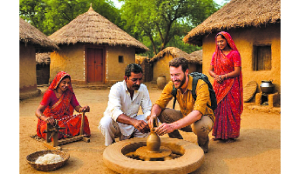
A village does not become attractive merely because it possesses a beautiful landscape. Its identity resides in its traditions, its cuisine, its crafts, its stories, its music and the manner in which its people welcome a visitor.
If tourism is to be genuinely inclusive, the local community must not merely be an object of tourism; it must become its principal participant and beneficiary.
Homestays, local cuisine, handicrafts, folk performances, community guides and locally managed experiences can transform tourism from an external economic activity into a source of local prosperity.
Recent initiatives to strengthen the digital capabilities of homestay hosts, give greater visibility to lesser-known destinations and connect unexplored villages with bookable homestays demonstrate the possibilities of this approach.
The objective must be to ensure that when a destination enters the imagination of the traveller, the economic opportunity created by that attention reaches the people who give the destination its identity. A young person in a village should be able to become a guide, entrepreneur, photographer or hospitality professional.
A woman-led enterprise should be able to take local food or handicrafts to a national and international market.
An artisan should be able to derive a dignified livelihood from the knowledge inherited from generations before him.
That is when tourism becomes an instrument of inclusive development.
There is, however, an important distinction between partnerships and partnership outcomes.
The signing of an agreement is only the beginning.
The real measure of success must be visible on the ground: Have destinations become more accessible? Have visitor experiences improved? Have local enterprises grown? Has employment increased? Have artisans and communities gained new markets? Has cultural heritage been preserved rather than merely consumed?
Partnerships must therefore be judged by the value they create, not merely by the number of agreements signed.
The future of Indian tourism will ultimately be built upon a web of such relationships: between the Centre and the States; between government and industry; between technology and tradition; between global platforms and local communities; and between public investment and private enterprise.
India possesses an extraordinary inheritance of civilisation, culture, nature and diversity. What we require now is the institutional imagination to connect that inheritance with the aspirations of a new generation of travellers and entrepreneurs.
The objective should not merely be to bring more tourists to India.
It should be to ensure that the opportunities created by tourism reach deeper into India.
The true measure of our success, therefore, will not be only the number of visitors who arrive at our shores, but the number of lives that are enriched by their arrival.
Tourism, at its finest, is an exchange: the traveller discovers a place, and the place discovers new possibilities through the traveller.
If we can bring together political will, public investment, private enterprise and the participation of our people, tourism can become far more than an economic sector.
It can become one of the great instruments through which India presents her civilisation to the world, strengthens her communities at home, creates livelihoods for her youth, preserves her cultural inheritance and opens new avenues of shared prosperity. The future of Indian tourism, in the final reckoning, will not be built by government alone. It will be built by partnership-and by the conviction that the prosperity created by tourism must belong, in meaningful measure, to the people and places that make India worth travelling to.
The writer is Union Minister for Culture & Tourism, Government of India; Views presented are personal.