
The evolution of Punjab’s railway infrastructure
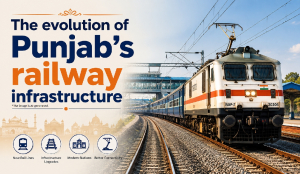
Railways have long been the lifeline of Punjab, connecting its farms to markets, industries to supply chains and millions of pilgrims and travellers to destinations of national importance. As mobility demands continue to grow, Indian Railways is responding with one of the most comprehensive infrastructure development programmes the state has witnessed in recent decades.
Through new rail corridors, modern station redevelopment and network augmentation, Punjab is steadily building a railway system that is faster, more efficient and better equipped to meet the aspirations of a rapidly growing economy.
The scale of investment reflects this renewed focus. The annual average railway budget allocation for Punjab has increased from Rs 225 crore during 2009-14 to Rs 5,673 crore in 2026-27, representing a remarkable 25-fold increase.
Complementing this enhanced financial commitment are infrastructure works worth over Rs 26,000 crore, covering new railway lines, doubling projects, station redevelopment and safety enhancement works across the state.
A major thrust of this transformation has been the completion of several capacity augmentation projects that have strengthened the state’s rail network. Notable completed works include the Rajpura-Bhatinda Doubling Project (173 km) at a cost of Rs 2,459 crore, the Jalandhar-Pathankot-Jammu Tawi Doubling Project (209 km) costing Rs 850 crore, Ambala-Dhapper-Chandigarh Doubling (45 km) worth Rs 339 crore, Mansa-Bhatinda Doubling (49 km), Jakhal-Mansa Doubling (45 km), Amritsar-Chheharta Doubling (7 km) and several strategically important bridge and doubling works, including the Kathua-Madhopur (Punjab) section with the Ravi Bridge. Collectively, these projects have enhanced line capacity, reduced congestion and enabled smoother train operations across the region.
The momentum continues through a robust pipeline of ongoing projects that promise to reshape Punjab’s connectivity landscape. Among the most significant is the Nangal Dam-Talwara-Mukerian New Line (123 km) with an investment of Rs 3,726 crore, alongside the Bhanupalli-Bilaspur-Beri New Line (63 km) valued at Rs 13,770 crore, one of the largest railway infrastructure projects in the region. Other key projects include the Qadian-Beas New Line (40 km), Ferozpur-Patti New Line (26 km), Rajpura-Mohali New Line (18 km), Rajpura Bypass Line (14 km), and doubling works on the Ludhiana-Kila Raipur and Ludhiana-Mullanpur sections. These projects are expected to improve regional accessibility, strengthen freight movement and create new growth corridors across Punjab.
Infrastructure expansion has also translated into measurable achievements across the railway network. Since 2014, approximately 400 kilometres of new railway tracks have been constructed, Punjab has achieved 100 per cent broad-gauge railway electrification, and over 400 flyovers and underpasses have been built to improve safety and operational efficiency.
Simultaneously, 30 railway stations are being redeveloped under the Amrit Bharat Station Scheme, creating modern, accessible and passenger-centric transport hubs that complement the State’s expanding rail network. Moreover, Punjab is now served by Vande Bharat Express and Amrit Bharat Express train services, bringing faster, more comfortable and technologically advanced rail travel to the State.
The impact of these infrastructure projects extends far beyond the railway network, touching almost every sector of Punjab’s economy.
As one of India’s leading agricultural states, Punjab depends on an efficient transport network to move food grains, fruits, vegetables and other agricultural produce swiftly to markets across the country. Enhanced railway capacity, additional lines and doubling projects enable faster freight movement, reduce transit bottlenecks and improve supply chain efficiency, ensuring that agricultural and industrial goods reach their destinations more reliably.
For Punjab’s manufacturing and industrial centres, including Ludhiana, Jalandhar, Mohali and Bathinda, strengthened rail connectivity supports the seamless movement of raw materials and finished products. Reduced congestion enhances operational efficiency, lowers transportation costs and improves the competitiveness of industries that contribute significantly to the state’s economy.
Improved rail infrastructure also strengthens connectivity with ports and major consumption centres, providing a vital boost to trade and logistics. Better connectivity also encourages balanced regional development by bringing smaller towns and emerging urban centres closer to economic opportunities.
Punjab’s tourism and pilgrimage sector is another major beneficiary. The state’s railway network serves as the primary gateway to some of India’s most revered spiritual and cultural destinations, including the Sri Harmandir Sahib (Golden Temple) in Amritsar, Anandpur Sahib, Durgiana Temple, Jallianwala Bagh, Wagah Border, Takhat Sri Damdama Sahib, Gobindgarh Fort, and the Sheesh Mahal in Patiala. Improved rail infrastructure makes these destinations more accessible, enriching the travel experience for millions of domestic and international visitors each year while generating greater demand for local hospitality, transport, handicrafts and other tourism-related services.
As Punjab advances towards a more connected and competitive future, its railway network is evolving into far more than a mode of transport. It is emerging as an enabler of economic resilience, social mobility and sustainable growth. Through sustained investment, strategic infrastructure development and a vision aligned with the state’s aspirations, Indian Railways is ensuring that Punjab’s rail network remains a powerful driver of prosperity for generations to come.
The author is a former Union Minister of State Railways and Food Processing Industries; Views presented are personal.