
The Architecture of Influence: Strategic Communication as an Instrument of Statecraft
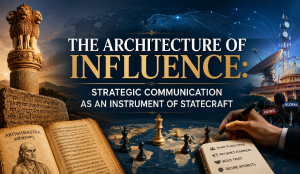
In an information-saturated world, the entity that controls the narrative often controls the outcome.
In the high-stakes arena of global geopolitics, the strength of a nation is often measured by its kinetic capabilities, such as its economic output, military hardware, and technological edge. However, there exists a more subtle yet equally potent dimension of national security known as strategic communication. Often misunderstood as mere public relations or propaganda, strategic communication is the deliberate use of words, images, and actions to shape perceptions and influence the behaviour of foreign audiences. It is a vital instrument of statecraft that operates on the premise that in an information-saturated world, the entity that controls the narrative often controls the outcome. While the tools of this trade have evolved from stone pillars to social media feeds, the underlying logic remains rooted in an antiquity that understood the power of the word long before the advent of the digital age.
The roots of strategic communication are deeply embedded in ancient political thought, perhaps most notably in Kautilya's Arthashastra. Composed over two millennia ago, this manual of governance treats communication not as a secondary function of the state but as its very foundation. Kautilya famously noted that royal edicts are the root of a king's authority, asserting that peace and war are ultimately determined by the quality and clarity of these communications. In this view, state relations are not merely transactions of goods or territory; they are shaped by mutual perception. If a nation is perceived as resolute, just, and powerful, its deterrence is strengthened without a shot being fired. Conversely, a failure to articulate intent can lead to miscalculation and conflict. For Kautilya, the actor who controls the story effectively controls the strategic environment in which they operate.
If Kautilya provided the theory, the Mauryan Emperor Ashoka provided a masterclass in execution. The Ashokan edicts, carved into rock surfaces and pillars across the subcontinent, represent perhaps the most sophisticated early example of a global communication strategy. The placement of these edicts was a calculated move in geospatial communication, as they were rarely hidden in the deep interior of the empire. Instead, they were positioned at frontiers, along busy trade routes, and at points where travellers moved between different cultural spheres. They were designed to be seen by the "other"-the foreign merchant, the travelling monk, and the neighbouring rival.
The sophistication of these edicts also lay in their linguistic targeting. In the heartland, the edicts were written in Prakrit using the Brahmi script, but in the northwestern frontiers, where the echoes of Alexander's conquests remained, the language shifted to Greek and Aramaic. This was not a simple translation; it was a deliberate attempt to speak to a community in its own cultural and linguistic register. The content emphasised universal values such as religious tolerance, welfare, and harmony. By projecting these values, Ashoka transformed the image of a vast military machine into a moral authority, understanding that a nation's soft power provides the necessary legitimacy for its hard power to operate effectively on the world stage.
This tradition of using physical monuments as narrative anchors continued through the Gupta Empire, as seen in the layered history of the Allahabad Pillar. This monument carries the inscriptions of Ashoka alongside the Prayag Prashasti, composed by the court poet Harishena to celebrate the conquests of the Emperor Samudragupta. Interestingly, Harishena held the title of Sandhi-vigrahika, or the Minister of War and Peace. This fusion of roles is telling, as the person responsible for the empire's military strategy was also the person responsible for its story. The Prashasti used sophisticated Sanskrit to frame Samudragupta not just as a conqueror but as a protector of the social order. By placing this narrative at a confluence of immense religious and cultural significance, the state ensured its message reached the widest possible domestic and foreign audience, building an architecture of influence through which the nation's intent was understood.
Modern strategic communication serves several critical functions for national security, starting with deterrence and signalling. In a complex global landscape, clear signalling of "red lines" and capabilities prevents the miscalculations that lead to accidental conflict. Furthermore, in an era of hybrid warfare, where adversaries use disinformation to weaken a nation from within, a robust communication framework is essential for maintaining domestic cohesion and projecting a factual account of events to the global community.
Beyond security, strategic communication is a pillar of economic diplomacy. A nation's economic prospects are increasingly tied to its global brand, and strategic outreach highlights a country's stability, technological prowess, and reliability as a partner. This directly influences foreign direct investment and the strength of trade alliances. During times of crisis or regional instability, the speed at which a nation tells its story determines the level of global support it receives. Proactive transparency ensures that the international community receives an accurate account of ground realities before a vacuum can be filled by hostile actors or misinformation.
The Arthashastra identifies six qualities for well-crafted state communication that serve as a gold standard for public diplomacy today. These include 'Arthakrama', or the proper sequence of ideas, and 'Sambandha', which ensures the message is relevant to the specific audience. 'Paripurnata' demands completeness to leave no room for ambiguity, while 'Madhurya' suggests a persuasiveness or sweetness that makes the message appealing. 'Audarya' refers to the grandeur and vision projected by the state, and 'Spastatva' ensures absolute clarity of intent. When these elements are combined, a nation's communication moves beyond mere information to become a tool of influence that can shape the international environment.
The current global landscape is defined by a contest of narratives where the outcome is rarely decided by facts alone. Whether it is a maritime dispute, a trade negotiation, or a security summit, the results are often dictated by who can frame the situation most effectively for a global audience. As nations navigate this complexity, they find that the art of storytelling is not a soft supplement to statecraft but a vital component of national security. The ancient masters understood that power is not just the ability to act but the ability to define the meaning of that action. In a world where information moves at the speed of light, the challenge for modern states is to tell their story faster, more accurately, and in a language that every shore understands, ensuring their voice is not just heard but believed.
In a world where information moves at the speed of light, the challenge for modern states is to tell their story faster, more accurately, and in a language that every shore understands, ensuring their voice is not just heard but believed.
Justice AK Sikri, Former Judge, Supreme Court of India; Views presented are personal. Tejusvi Shukla, Assistant Director (Research), Bharat Ki Soch Foundation; Views presented are personal.