
In Telangana, both the Congress and BRS throw stones at each other’s glass houses
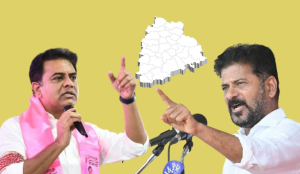
In Telangana’s argument over political wealth, each side has an inventory of the other’s assets. What the public needs is an account of its own.
Congress has been questioning the land and business interests of the Kalvakuntla family. The BRS has answered with allegations about Chief Minister Revanth Reddy’s family, challenges to joint inquiries and a defence of its own businesses. Neither side’s accusation settles the questions directed at each other.
These exchanges deserve to be followed in order. It paints a picture of how an argument about land became an argument about hotels, and then about hospitals and thousands of crores. Caught in the middle of this political mudslinging between the rich leaders and their political parties of Telangana are the voters.
From land to hotels
On September 16, during an Assembly discussion on Section 22-A of the Registration Act, Revanth alleged that K Chandrashekar Rao’s extended family held nearly 440 acres of assigned land. He also raised the question of 388 acres around KCR’s Erravelli farmhouse. These were the Chief Minister’s allegations, not any adjudicated findings about ownership or illegal acquisition.
The BRS countered with questions about Revanth’s family holdings and demands for an inquiry into both families. That demand deserves to be taken seriously. It cannot, however, substitute for an answer about the properties already under scrutiny.
On September 19, Congress representatives took the confrontation to the Janwada farmhouse linked to KTR. They alleged irregularities and demanded an investigation into the property. The party’s Farmhouse Files campaign gave the dispute a visible setting beyond the Assembly, with properties themselves becoming sites of political confrontation.
Apart from the Congress campaign, there was also an administrative process. The Congress government on September 25, constituted a committee under GO 134 to examine 16 specified land issues. These included matters linked to KCR, KTR, Harish Rao and other political figures. One must keep in mind that a committee examining an allegation is not a committee proving it.
Then Revanth went to Sircilla, KTR’s constituency, on September 30. At a public meeting, he alleged that KTR had converted people’s votes into personal wealth. He questioned the ownership of Deccan Serai, AtHome serviced apartments and hotels around Hitec City, alongside properties and investments he attributed to the family.
The attack was directed at the contrast between a representative’s fortunes and those of his constituency. Revanth asked why the lives of Sircilla’s people had not changed substantially while the family’s fortunes had changed dramatically. He raised weavers’ suicides and migration, and challenged KTR to release a white paper on the family’s assets.
Revanth had put KTR’s businesses alongside the hardships of the people who elected him. KTR’s answer would have to address both the allegation of wrongdoing and that political contrast.
A defence that became another opening
On October 1, at a joining programme at Telangana Bhavan, KTR said he had started a hotel in 2006 with money earned while working in the United States. One hotel had become three, he said, and he cited disclosures in his 2009 election affidavit. He challenged Revanth to an inquiry by a sitting judge into both sides’ assets.
“Is doing business wrong?” KTR asked. He also said that greater attention to the business could have left him with ten hotels, and thanked Revanth for the publicity.
There is nothing inherently unlawful about a politician owning a hotel. KTR’s account also placed the business’s beginnings before the BRS came to power. Whether the disclosures and subsequent acquisitions support his defence is a question for records, not a verdict that follows from the number of hotels.
Politically, however, KTR was answering a narrower question than the one Revanth had raised. A defence of the right to conduct business does not, by itself, answer whether public office helped that business grow.
On October 3, BRS spokesperson Manne Krishank held a press conference at Telangana Bhavan. He alleged that Revanth’s family had amassed assets and business interests worth more than Rs 50,000 crore in two years. He demanded an Enforcement Directorate investigation.
Krishank also alleged that Rs 13,000 crore in unaccounted money had been converted into legitimate funds through a Medicover-related deal. He demanded scrutiny of alleged links involving Maxbien Pharma, Medicover and people connected to the Chief Minister’s family. These remain his allegations.
The counterattack put Revanth’s family businesses under the same political spotlight.
It did not resolve the allegations about the BRS leadership.
Nor would disproving a BRS allegation absolve Congress, they have an obligation to explain any independently substantiated concern about its own leaders.
What the public is owed
This is where the glass houses become useful to both parties. Each can point to the other’s windows while asking the public to stop looking through its own. The exchange can damage both reputations without establishing which allegations are true.
It would be easy to conclude that both parties must therefore be right about each other. That would give political accusations the status of evidence. Wealth alone does not establish disproportionate assets, and a party spokesperson cannot establish benami ownership by naming a business.
I began with a question about how many disproportionate-assets cases exist against these leaders. The material checked for this piece does not establish a reliable count. Cases about other alleged offences, or disproportionate-assets cases against unrelated officials, cannot fill that gap.
The state government has powers that an opposition press conference does not. If its allegations warrant action, the public should be able to follow what is investigated and what is established. Announcing a committee cannot be the last word, just as demanding an ED probe cannot be the BRS’s last word.
Both sides should be held to the demands they make of each other. Disclose the relevant records, answer questions about ownership and acquisition, and submit allegations to scrutiny that can produce findings.
A larger accusation against an opponent is not a smaller obligation to explain oneself.
The people watching this exchange do not have to choose which family’s wealth they are allowed to question. Neither party earns a certificate of honesty by describing the other as corrupt. Both still owe answers about their own glass houses.