
Stallone at 80 reflects on 50 years of 'Rocky': 'I am a lucky dog'
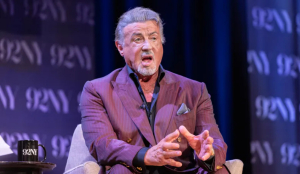
Fifty years after Sylvester Stallone turned a modest story about an unknown boxer into one of Hollywood's most enduring success stories, he still sees something of himself in Rocky Balboa.
But there is one thing he no longer calls himself: an underdog.
"It would be so disingenuous to say you're an underdog, as he said from his penthouse," Stallone said in a recent interview from a high floor of a luxury Manhattan hotel. "Yeah. Come on. I am a lucky dog."
Stallone, who turned 80 in July, has spent five decades building blockbuster franchises including "Rocky", "Rambo" and "The Expendables", generating billions of dollars along the way. He continues to work, starring as mobster Dwight "The General" Manfredi in Paramount+'s "Tulsa King".
Now, he is looking back at the unlikely beginnings of that career in his memoir "Steps", published Tuesday, and in the upcoming film "I Play Rocky", a fictionalised and semi-authorised account of how he made the 1976 classic.
Directed by Peter Farrelly and starring Anthony Ippolito as Stallone, "I Play Rocky" arrives in theatres less than two months after the memoir. Stallone spoke with Farrelly about the film but was otherwise uninvolved in its making.
The timing has brought Stallone back to the period when he was a struggling actor and writer who persuaded United Artists to back his story about a journeyman boxer given a shot at the heavyweight championship. He also insisted on playing the lead despite having limited acting experience.
"Rocky" went on to win the best picture Oscar, beating films including "Taxi Driver" and "All the President's Men". Stallone's journey from struggling actor in Philadelphia to the Oscars stage became part of the film's mythology, mirroring Rocky's rise from obscurity.
In "Steps", Stallone writes about a difficult childhood, describing himself as an unplanned and unwanted child who faced discouragement for much of his early life. Even during the making of "Rocky", he feared that each day on set could be his last.
Stallone said revisiting those memories for the book was difficult.
"I spent 50 years burying that stuff," he said, comparing the process to becoming "your own spiritual archaeologist". But he did not want the memoir to become an account of self-pity.
Instead, he wanted to understand how insecurity had shaped him.
"If everything was really nice, maybe I wouldn't be here," he said. "If I didn't have that insecurity which drives us. You know, insecurity is a great motivator."
That drive remains evident in his working life. Stallone said that even though filming for "Tulsa King" is still a month away, he gets up at 5 a.m. to study his dialogue.
"I don't have to do my dialogue for another month before we start 'Tulsa King.' I'm up every morning at 5:00 o'clock, studying until literally it's like breathing," he said. "Now, that's probably insecurity, but that's the way I approach it."
He has also been struck by the way "Rocky" continues to reach audiences who were not born when the film was released.
Stallone said he rarely watches the movie in its entirety anymore. Instead, he encounters clips online, including on TikTok, posted by young people.
"They're not relating to me. It's that character," he said.
The enduring connection between Rocky and younger audiences, he added, is perhaps the greatest reward he received from the film.
"I didn't ever expect it to be in more than one or two theaters," Stallone said. "So all this is a tsunami of good luck."
He believes the film connected with something beyond what he himself created.
"It ('Rocky') tapped into something that I cannot take credit for," he said.
The success of "Rocky" also remains central to how Stallone views his career. He said writing the memoir was ultimately about explaining how what he calls a "minor miracle" came together.
"I thought, What am I known for? Pulling off this minor miracle in 1976, which falls under the heading of inspiration," he said.
That story is now being retold on screen in "I Play Rocky", something Stallone finds almost surreal.
"How strange is this? A movie about me being in a movie," he said.
He praised Ippolito's performance and said he was surprised by how much he liked Farrelly's approach.
"I never in a million years had any confidence this would work," Stallone said.
Farrelly convinced him that the story could resonate because, unlike "Rocky", it was real.
"Rocky is fiction, this is real," Stallone recalled Farrelly telling him. "And that's what people are holding on to."
The film's arrival nearly 50 years after "Rocky" has added to the strangeness for Stallone.
"They usually do this when you're dead and gone," he said. "It's 50 years almost to the day when it came out and if he gets nominated ... It's so surreal."
Despite his reluctance to be defined by politics, Stallone has also spoken publicly on political issues. He received a Kennedy Center honour last year, presented by President Donald Trump, who had previously named Stallone, Jon Voight and Mel Gibson as his "ambassadors" from Hollywood.
Stallone has praised Trump, calling him "the second George Washington", while also contributing to both Republican and Democratic candidates and calling for stronger gun control laws.
He has condemned war, including the Iran War, saying it amounts to sending people into a "meat grinder" while the military-industrial complex profits.
"I do believe that you have to defend yourself. But to go on the offensive?" he said, adding that he would rather not be known as a political figure.
"I love the common architecture of trying to just survive. That's noble," Stallone said. "To be a politician, that's a different animal."
For Stallone, the enduring appeal of Rocky may lie precisely in that struggle — the effort to keep going despite insecurity, setbacks and uncertainty.
And five decades after the character's improbable rise, the man who created him says he no longer needs to claim the underdog label.
He considers himself something simpler: lucky.