
Supreme Court Declines New Directions on Hate Speech, Says Existing Laws Are Adequate
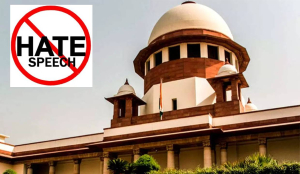
The Supreme Court of India on Wednesday declined to issue additional directions to curb hate speech, stating that the existing legal framework is sufficient and that the issue lies in enforcement rather than the absence of laws.
A Bench comprising Justice Vikram Nath and Justice Sandeep Mehta dismissed contempt petitions alleging non-compliance with its 2023 directions on hate speech cases.
The Court emphasised that creating new criminal offences falls strictly within the domain of the legislature. It observed that while constitutional courts can interpret laws and safeguard fundamental rights, they cannot legislate or compel Parliament and state legislatures to enact new provisions.
Highlighting existing remedies, the Bench noted that legal mechanisms under the Code of Criminal Procedure (CrPC) and the Bharatiya Nagarik Suraksha Sanhita (BNSS), 2023, already provide a comprehensive framework to address such offences. It reiterated that police are duty-bound to register FIRs in cognisable offences, and aggrieved individuals can approach senior police officials or magistrates if action is not taken.
The Court clarified that there is no legislative vacuum on hate speech and that concerns stem from gaps in implementation. It also underlined that prior sanction requirements apply only at the stage of cognisance and not during the registration of FIRs or preliminary investigations.
While refusing to issue further directions, the Bench acknowledged the serious impact of hate speech on social harmony and constitutional values. It urged legislative authorities to consider whether additional legal or policy measures may be required in light of evolving challenges.
The case stems from a series of petitions filed since 2020 over alleged hate speech in media broadcasts, social platforms, and religious gatherings, including controversies such as the “UPSC Jihad” programme and “Dharam Sansad” events.
In 2023, the apex court had directed all States and Union Territories to proactively register cases in instances of hate speech, even without formal complaints. The latest ruling came after petitions claimed these directions were not being effectively implemented.