
The campus is political again: how South India's young leaders are recasting political discourse
A medical entrance exam, a law university convocation, a recruitment test, a campus land dispute. On the surface, these are separate stories but politically, they are beginning to look like variations of the same one.
Across India, education has once again moved from the margins of political debate to its centre. In South India, a generation of younger leaders is increasingly meeting that mobilisation on its own terrain, speaking about examinations, jobs, campus autonomy, institutional accountability and the right of students to question authority.
The NEET protests brought these anxieties into the national political mainstream. What began as anger over examination irregularities spread to streets, campuses and Parliament, with students questioning not just one exam but the credibility of India's examination system. Even after the Union education minister's resignation, protests continued, with students and academics broadening their demands to education reform and social justice and such expansions matter.
For a generation facing economic insecurity and rising living costs, education is not merely a welfare issue. It is one of the primary routes to social mobility, but also where inequality is felt most sharply, rights are contested and political consciousness is formed. When that system appears unfair or unreliable, personal frustration can quickly turn into political mobilisation. And South India's younger political class appears particularly attuned to that shift.
KTR and the politics of questioning
Students at the National Academy of Legal Studies and Research objected to Chief Justice of India Surya Kant being invited as chief guest for their convocation, citing his conduct and remarks surrounding the NEET protests. The dispute escalated after the Bar Council of India moved against the graduating batch before withdrawing the measure.
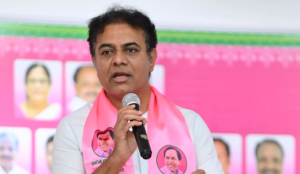
K T Rama Rao entered the debate at precisely the point where the question had shifted from the original dispute to whether students should be allowed to dissent. His argument was deliberately broader: young people have the right to question authority and stand up when they believe their dignity has been attacked. Those in power, he said, should answer students rather than suppress them.
It echoes a strand visible elsewhere in KTR's politics, from the Kancha Gachibowli land dispute involving University of Hyderabad students to his interventions on student and recruitment issues.
Tamil Nadu: when education becomes federal politics
Tamil Nadu shows how education can become a question of federal power. The state's opposition to NEET predates the current protests, with Dalit student S Anita’s suicide in 2017 sparking the Anti-NEET movement. But the latest mobilisation has given the issue a new generation of political relevance.
Vijay's Tamilaga Vettri Kazhagam (TVK) has demanded NEET's abolition and argued for greater state control over education. The DMK has reiterated its long-standing opposition to the exam. The political argument is no longer simply “NEET versus no NEET.” It is about who designs the examination, who controls access to professional education and whether a national system produces equal opportunity for students from marginal social and economic backgrounds.
Vijay's position is particularly significant because his politics has now moved from campaign rhetoric to government. Having built part of his political appeal around youth and student concerns, he now faces the harder question: can solidarity become policy?
Lokesh and the politics of delivery
Nara Lokesh, one of the Telugu Desam Party's (TDP) younger leaders, has taken a distinctly managerial approach to education as a minister. His department's draft rules for private coaching centres, introduced in February, proposed a five-hour daily cap, fee transparency, refunds for students who withdraw, restrictions on advertising ranks and mandatory attention to student safety and mental health.
The government has also pushed a 100-day academic programme in government schools, with the state's Class 10 pass rate rising to 85.25% in 2026 from 81.1% the previous year. But the approach has also exposed the political risks of owning the education portfolio. In July, opposition parties demanded a probe into alleged irregularities in the state's DSC teacher recruitment process, while questions have also been raised over alleged manipulation of sports-quota appointments
Annamalai and the youth mobilisation model
K Annamalai offers a different model of youth politics aimed at making young voters the carriers of a political movement. His 200-day En Mann, En Makkal padayatra was built around direct outreach across Tamil Nadu, with his campaign repeatedly targeting school and college students, first-time voters and job-seekers. During 2024 Lok Sabha Elections, his campaign managers identified young voters as his core constituency, while Annamalai used his own profile as a young, professionally educated former IPS officer to pitch an alternative to Tamil Nadu's established political leadership.
That strategy has continued beyond electoral campaigning. In July 2026, after leaving the BJP, Annamalai's new ‘We The Leaders movement’ positioned youth leadership, education and employment among its core concerns. At its first conference, he said 54% of those who had joined the organisation were below 40, and announced plans to train 1.5 lakh people at the APJ Abdul Kalam Centre for Ethics and Politics by 2027.
The South Indian pattern & The harder test
KTR, Vijay, Lokesh and Annamalai are far from an ideological bloc, but they are responding to the same emerging constituency: a digitally connected, politically conscious generation that sees education as central to social mobility and is quick to scrutinise institutions, opportunities and outcomes.
That is changing the role of young leaders, who must engage not only with protests but with the policy questions behind them. Yet this politics carries its own test: solidarity is easy in opposition; governing is harder. Vijay and Lokesh must now deliver on education in government, while KTR's support for student dissent will ultimately be measured by how his party responds when it holds power.
Can leaders who speak about questioning authority tolerate questions when the authority is theirs? Can politicians who campaign against examination failures build systems that do not fail? And can education remain a political priority after the protest banners come down?
For now, something important has already changed. Education subjects- from examinations, recruitment, access to education for the marginalised, campus autonomy, right to dissent, student dignity to institutional accountability, are back in India's political bloodstream. And South India's younger political leaders are discovering that the campus may be one of the most consequential places from which to speak to the next generation.