
Solar charging stations: Cuba’s answer to gas shortages and blackouts
Yudelaimys Barrero Munoz used to spend up to three hours on the side of a highway under the blazing sun, waving money at drivers as she attempted to hitch a ride from Cienfuegos, Cuba to Santa Clara, where she buys supplies to resell and support her husband and two children.
The 43-mile (70-kilometer) trip was impossible to make on her husband’s bicycle — at one time the family’s only mode of transportation — and later, with a rechargeable, three-wheeled vehicle whose battery didn’t have the capacity for the round trip.
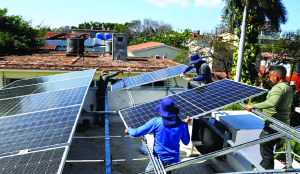
Then, in early April, a local business owner opened what is believed to be Cuba’s first solar-powered charging station — and it was free. Cubans soon flocked to the solar station — or “solinera” as it’s known in Cuba - recharging everything from electric vehicles to UV nail lamps. The Cuban Government has stepped up the installation of solar panels in hospitals and other public places and established solar farms in the face of chronic blackouts and in recent months, a severe gas shortage stemming from a US energy blockade. Renewable energy now accounts for some 10 per cent of the island’s electricity, up from 3.6per cent in 2024, but distribution remains limited, and few Cubans can afford such a system.
Globally, just over 30 per cent of electricity generation comes from renewable energies like solar, wind and hydropower, according to energy think tank Ember.
Because there is little gas for cars these days, Cubans are traveling miles to the Santa Clara solar station on rechargeable motorcycles and three-wheeled vehicles. Others walk to the station.
They haul cellphones with nearly depleted batteries, rice cookers, pressure cookers — an endless array of gadgets, appliances and vehicles that need power. “They have solved many problems for many people,” Barrero Munoz said. She and her husband, along with their children, ages 3 and 4, drive regularly to Santa Clara now that they can charge their three-wheeled vehicle at the solar station.”If it hadn’t been for this, I wouldn’t have been able to keep selling,” she said.
Barrero Munoz now buys rice, sugar, hot dogs, mortadella, soap, shampoo, deodorant and other items regardless of their weight, because it all goes into the vehicle instead of the two bags and a backpack she used to haul when she was forced to hitch a ride.
“I have more clients because I have more merchandise,” she said with a smile.
A historic city where life is less frantic. Cars are largely absent on the highway from Havana to Santa Clara; horse-drawn carts are a more common sight in rural areas, where, inevitably, crises in Cuba hit harder. With nearly a quarter of a million people, Santa Clara is one of Cuba’s most populous cities, best known as the city of “Marta and El Che.”
El Che — Ernesto Guevara de la Serna — led a key battle during Cuba’s 1959 Revolution in Santa Clara, where his remains are housed in a mausoleum.
It is also the town of Marta de los Angeles Gonzalez Abreu y Arencibia, a well-known philanthropist who supported Santa Clara and Cuba’s push for independence. Santa Clara is home to people like Danailys Arbolaez Perez, a 32-year-old mother of two who sells sandwiches, coffee, beer and cigarettes out of her home. It is a short walk away from the solar station.