
Skilling vital in India’s goal of becoming AI solutions capital, says IT Secretary
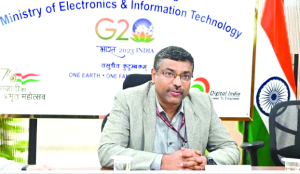
Reorienting and readying skills for the AI era will be key to India’s ambition of harnessing its STEM talent and becoming the artificial intelligence solutions capital of the world, IT Secretary S Krishnan said on Thursday.
Speaking at the CII GCC Business Summit, Krishnan noted that the deployment of AI in enterprises is still lagging across the world, not just in India, presenting an opportunity for GCCs here to play a critical role.
Artificial intelligence (AI) presents an opportunity to transition beyond routine work, with automation expected to handle lower-order functions while humans focus on higher-value roles, he said.
Krishnan said the government’s approach towards AI has been “extremely positive” with an “optimistic outlook” right from the start.
He said India should aim to become the world’s hub for AI applications and solutions by leveraging its talent to drive enterprise adoption of the technology.
While investments in AI infrastructure and foundation models are accelerating globally, deployment across enterprises remains limited, creating a key opportunity for Global Capability Centres (GCCs) in India. “...The deployment of AI in enterprises is still lagging, not just in India but across the world. And that is truly where I think GCCs in India will come in and play that critical role...higher-level functions in various segments of the domain need to be moved and shifted to, and that’s the function that a GCC needs to perform,” he said.
Global Capability Centres refer to captive hubs of multinational companies that provide technology, engineering, research and business services from India.
Krishnan further said a human interface will be required in rolling out AI applications and solutions.
“...that is a role which will still be valid and relevant,” Krishnan said.
Stressing the importance of redesigning training programmes across educational institutions and companies to prepare the workforce for the AI era, Krishnan said the government is working with industry bodies on targeted skilling initiatives.
“How do you reorient skills in a new AI world, and that I think will be a critical element of whether we are able to succeed as a country which will leverage AI and our strength in terms of STEM (Science, Technology, Engineering, and Mathematics) human resources to truly become what we set out to become...the AI solution capital of the world,” he pointed out.
Krishnan said the centre and states have introduced a slew of reforms - from tax clarity to labour code measures and easier business norms - to encourage the establishment of Global Capability Centres.
Most long-pending industry concerns have been addressed, and that time has now come to assess whether the measures have accelerated GCC growth and whether AI-related concerns are affecting momentum, he added.
“I think it’s time to start measuring the kind of impact that these changes have had, and what have been the outcomes.
“Since so much was promised as an outcome of some of these changes, I think it’s important to start measuring what exactly has happened as a result of this, and whether the momentum of establishing GCCs has really picked up, and if not, is the concern about AI something which is worrying us,” according to Krishnan.
WhatsApp’s reply on ‘username’ notice due today: IT Secretary
New Delhi: Meta-owned WhatsApp’s response to the government notice on the ‘username’ feature is due on Thursday, IT Secretary S Krishnan said.
Last Wednesday, the Centre issued a notice to Meta questioning the proposed username feature on WhatsApp, flagging concerns that it could materially increase online fraud, phishing, digital arrest scams, and impersonation attacks.
The username feature essentially allows people on the messaging platform to communicate without sharing their phone numbers. The government had also directed the platform not to launch the feature until consultations on the issue are completed “to the satisfaction of the Government”.
Subsequently, WhatsApp had sought some more time to submit its response on the ‘username’ feature and had assured the government that it would not roll it out in India until discussions are complete.
“Today is the day when the reply is due,” Krishnan said on the sidelines of the CII GCC Business Summit, when asked about WhatsApp’s response to the ‘username’ feature.
On whether two other messaging platforms, Telegram and Signal, reverted on the notices sent to them on the ‘username’ feature, Krishnan said: “There is still a little more time, so the replies have not yet been received...we will examine this issue”.
Last Friday, a team from Meta met officials in the IT Ministry following the notice summoning them.
In the notice, the government asked Meta to explain why action shouldn’t be initiated under the IT Act and rules over WhatsApp’s new feature that may increase cybercrimes.
It also reminded Meta that WhatsApp, as a significant social media intermediary, is bound by due diligence obligations under the IT Act and rules.
A WhatsApp spokesperson, last week, said that the ability to use a username is not yet live and will roll out slowly later this year.
“To protect against impersonation, we’ve held the highest-profile names - think public figures, government entities, celebrities, verified Meta accounts - so they can only ever be claimed by their legitimate owners and lookalike derivatives of known names are held as well,” the spokesperson had said.
Users still require a phone number to use WhatsApp, the company had said and added that it has built multiple layers of defence against scams into usernames.
“Other users need to know the exact username to message you. We will limit how many new people an account can contact, block repeated attempts to guess someone’s username key, and have systems to detect and remove activity showing common impersonation and abuse patterns,” the company had said.
WhatsApp will show whether a first-time sender is a new account, contact, mutual group member or from another country before users respond.
“When the feature becomes available, and someone sends a message for the first time via your username, we will show you if they’re a new account, if they’re your contact, if you have groups in common, and if they’re based in a different country, so you can decide whether to respond,” WhatsApp had said.
After sending a notice to WhatsApp, the IT Ministry had shot off notices to Telegram and Signal too, raising questions on their existing username feature and asking how the platforms are addressing concerns related to fraud and impersonation risks. While WhatsApp has 50 crore users in India, Telegram’s reach is a fraction of that.
Notably, over the last few days, Meta and Telegram have also faced regulatory scrutiny on other issues.
While the government issued a stern notice on Meta on child sexual abuse material in Instagram ads on Saturday, Telegram was served a notice directing it to crack down on the “widespread dissemination” of pirated films, OTT content and other audio-visual material through its platform.