
SC seeks Centre's reply on Kapil Sibal's plea on interpretation of anti-defection law
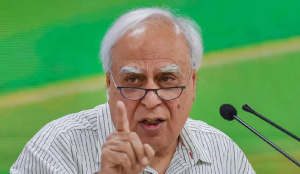
The Supreme Court on Monday, July 26, agreed to hear a plea filed by senior advocate Kapil Sibal seeking reconsideration of the Tenth Schedule of the Constitution's interpretation that allows MLAs and MPs to avoid disqualification under the anti-defection law by claiming a merger with another political party.
A bench of Justices P S Narasimha and Alok Aradhe, which issued a notice to the Centre, observed that there are several issues involved which are required to be taken by Parliament.
The plea comes against the backdrop of MPs from AAP, Trinamool Congress and the Shiv Sena (UBT) joining the ruling BJP and other political parties recently by invoking the merger provisions under the Tenth Schedule.
Sibal, an Independent Rajya Sabha MP, said that this issue has "huge repercussions on our polity" as a minority party can become majority while a majority can become a minority due to the provision.
The bench said that the Tenth Schedule, meant for the lawmakers, was passed by Parliament and it is for them to devise a mechanism.
"These are issues typically to be raised on the floor of the House; if not, then before a political party. The Tenth Schedule was intended to regulate a mechanism. We have been seeing it. There are several other issues involved," Justice Narasimha said.
Sibal alleged that a complete fraud is being played upon.
Justice Narasimha told him, "Who made it? It's the making of the members of Parliament; it is for the legislators to decide. Anyway, we will issue notice and tag the matter."
Sibal said there is a similar matter related to defection of MLAs from Goa pending before the court.
The bench then tagged the plea along with the Goa matter.
Sibal has filed the plea in his personal capacity and sought interpretation of the law.
On July 22, he had sought an urgent listing of his plea, saying it relates to the issue of whether the composition of Parliament can change in the fashion in which it is happening in this country and the interpretation of the Tenth Schedule Paragraph 4 in that context.
"This public interest litigation (PIL) is filed under Article 32 of the Constitution of India, seeking a declaration that Para 4 of the Tenth Schedule to the Constitution does not imply that two-thirds of the legislative party can avoid disqualification by any 'deemed merger', when the majority of the political party has not merged or made any attempts to merge with another political party," his plea said.
It further said that this interpretation allows legislators or groups of legislators to switch from the political party upon whose symbol they have been elected and become members of a different, existing political party without the disqualification that is prescribed for defectors under the Tenth Schedule.
Sibal sought direction to read down Para 4 of the Tenth Schedule of the Constitution to avoid an interpretation that is in serious violation of the basic structure of the Constitution insofar as it has enabled in practice a political culture of encouraging "wholesale defections", "unprincipled breaking up of political parties" and "horse trading" that leads to overturning the democratic mandate by "illegitimate means".
"This is destructive of democratic accountability and integrity and has made a mockery of the purpose of the remainder of the Tenth Schedule -- it has become clear over time that this interpretation makes sure that the exception has eaten the rule. As an enabler of large-scale corruption and the perversion of the rule of law, the interpretation must be held to be incorrect," the senior advocate's plea said.
Sibal said he seeks judicial protection of the basic structure of the Constitution by the reading down of a provision that permits large-scale defections that seriously impair elections and the integrity of representative party-based democracy.
"The Tenth Schedule has been manifestly unsuccessful in its bid to end defections and protect electoral integrity due to the exceptions in the Tenth Schedule that have eaten the rule in its entirety.
"In the last decade or so alone, there has been a cascade of political defections that have been engineered in legislative assemblies across the country and even in Parliament," his plea said.
Sibal said that the menace is only increasing in scale and scope and state governments in Goa, Arunachal Pradesh, Karnataka, Andhra Pradesh, Madhya Pradesh and Maharashtra have been toppled or stopped from being formed due to large-scale defections from members who were elected on one party's symbol but immediately after election or a after a short duration, shifted parties and were richly rewarded for the same by the new dispensation.
"In the last few years, the BSP, Congress, Shiv Sena, the NCP and others have all been split or merged in assemblies or in Parliament to alter, by shenanigans, the will of the people as expressed in free elections," he said.
Sibal further said although the anti-defection exception for party splits was deleted in 2003, the deemed merger provision in Para 4(2) has enabled the same result as the split.
"In fact, this is worse than splits because it allows the members to dictate terms to avoid disqualification without any decision on the merger by any authority that meaningfully represents the political party," he said.
(With Inputs from PTI)