
SBI’s total business may double to Rs 200 lakh cr by 75th foundation year in 2030, says chairman
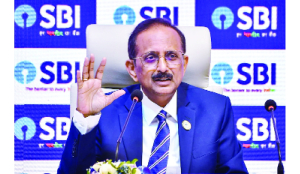
State Bank of India’s total business could potentially double to around Rs 200 lakh crore by 2030, when the bank celebrates its platinum jubilee, given the current growth trajectory, Chairman CS Setty said.
SBI came into existence on July 1, 1955, through an Act of Parliament, which, among other things, provided for the transfer of the undertaking of the Imperial Bank of India.
The country’s biggest lender crossed the landmark of Rs 100 lakh crore total business, which is an aggregate of total loans and advances in the second quarter of the last financial year. This further increased to Rs 110.01 lakh crore at the end of June 2026.
Whether the bank had set a specific target for its platinum jubilee year, Setty said there was no formal milestone, but the bank’s growth trajectory could take its total business to Rs 170-180 lakh crore and potentially as high as Rs 200 lakh crore by 2030.
“We don’t have any milestone, but if you take the current growth rate, I think we should be around Rs 170-180 lakh crore, or maybe reaching Rs 200 lakh crore. That would be another important milestone,” he told PTI in an interview.
Setty said the scale of SBI’s operations is closely linked to the performance of the Indian economy.
“For a bank of our size, scale is imminent, and it is fully intertwined with what is happening in the Indian economy,” he said.
He noted that if the Indian economy continues to grow at 7-8 per cent, SBI’s balance sheet has the potential to expand around 11-12 per cent annually. “If the Indian economy grows at 7-8 per cent and our balance sheet has a potential to grow at 11-12 per cent, it means again, coming to my favourite theme, that every six years SBI’s balance sheet gets doubled. So I think it’s potentially possible by 2030 we may have Rs 200 lakh crore overall business,” he said.
Setty further said SBI has Vision 2030, which focuses on ensuring that all bank’s activities benefit or address the requirements of four key stakeholders — customers, employees, shareholders, and the government and regulators, including the Reserve Bank of India (RBI).
“We are working on the requirements of all these four stakeholders. When we benchmark ourselves against the best globally, we should be able to measure up to the best standards in each of these areas,” he said.
For customers, he said, the focus is on improving service and experience. For employees, SBI aims to simplify processes, improve productivity and create an environment where they feel satisfied and can deliver their best.