
Sawan: The sacred flavours of the monsoon
Some seasons announce themselves through abundance. Sawan arrives through patience and restraint. As rain darkens the earth and draws the scent of wet soil into homes, the sacred month asks the devotee to slow down and turn eating into an act of attention. In North India, Sawan begins on Thursday, July 30, 2026, under the Purnimanta lunar calendar. Across much of western and southern India, the corresponding month begins on August 13 under the Amanta system. It is not a single feast day with one prescribed menu, but a month-long discipline shaped by worship, fasting, pilgrimage, agriculture and rain. More than celebration, Sawan teaches patience. Its cuisine reveals how Indian households learned to respond to rain not by withdrawing from food, but by making food more thoughtful.
The month carries different names as it travels through India’s languages and calendars. Its classical Sanskrit form is Shravana. Across much of Hindi-speaking North India, it is commonly called Sawan or Saavan. Maharashtra and Gujarat generally use Shravan, while Shravana is familiar in Karnataka, Andhra Pradesh and Telangana. In Bengal it is known as Srabon, in Odisha as Srabana, and in Assam as Xaun or Saon. Tamil tradition observes the corresponding seasonal period through Avani, although its solar calendar does not align exactly with the lunar month followed elsewhere. These differences show how one sacred season has been absorbed into many regional cultures.
The relationship between rain, food and the sacred reaches deep into India’s civilisational memory. In the Rigveda, Parjanya is praised as the life-giving power of rain whose arrival makes plants rise and food spring forth for living beings. The Taittiriya Upanishad later gives food an explicitly spiritual dignity, teaching that food must not be despised and presenting annam as fundamental to life itself. The familiar idea of “Annam Brahma” asks the eater to recognise food as part of the order sustaining creation. Later Puranic and devotional traditions placed Sawan especially under the grace of Shiva. The month recalls the Samudra Manthan, when Shiva consumed halahala to protect the worlds, and the tapasya of Parvati, whose devotion became a model of patience, resolve and sacred union. Jalabhishek, Sawan Somwar fasts and the Kanwar pilgrimage arise within this world of sacrifice and surrender.
Seasonal health traditions added another layer. Ayurveda’s ritu-charya, or seasonal regimen, treats Varsha Ritu as a period when humidity, irregular weather and weakened digestive strength require moderation. The Charaka Samhita advises attention to food and digestion during the rains, favouring preparations that are warm, digestible and appropriately seasoned. Religious vrata and Ayurvedic guidance are distinct traditions, yet they meet naturally in Sawan. The fast limits indulgence, while the season favours moderate quantities and freshly cooked food. Ginger is traditionally used to answer the sluggishness associated with damp weather, sesame is regarded as warming, coconut as cooling, jaggery restores quick energy after restraint, and ghee is used sparingly for nourishment and satiety. Sawan cuisine is therefore a seasonal dialogue between climate, agriculture, health and devotion.
Even the ritual ingredients carry meanings beyond taste. The three leaflets of bilva are often understood as recalling Shiva’s trident, his three eyes or the three gunas. Milk is commonly associated with purity and cooling surrender, curd with fertility and abundance, honey with the harmony of different essences, and jaggery with sweetness in human relationships. Turmeric, especially important in the monsoon kitchens of the western coast, signifies auspiciousness, fertility and protection. Such meanings vary, but they reveal why an offering is never merely decorative. Its physical character, seasonal place and symbolic value belong together.
This logic also explains why ordinary grains disappear from many fasting kitchens. Wheat, rice and common pulses may be set aside as part of religious discipline, while ingredients placed in a different ritual category take their place. Rajgira, or amaranth, is a seed rather than a cereal grain. Kuttu is buckwheat, singhara flour is made from water chestnut, and sama is barnyard millet. They allow the devotee to eat within the boundaries of the vrata and produce a cuisine with techniques of its own.
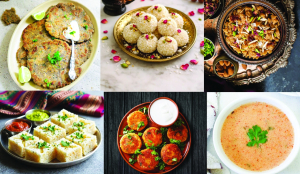
A North Indian Sawan Somwar meal may begin with Singhare ki Kadhi, in which water chestnut flour is whisked into fresh curd, seasoned with cumin, ginger, green chilli and rock salt, and simmered until smooth. Some families avoid curd during the rains, while others accept it fresh and thoroughly cooked. Kele aur Singhade ki Tikki combines boiled raw banana with water chestnut flour and mild spices before the patties are shallow-cooked until crisp outside and tender within. A third savoury option, Sama ke Chawal ka Dhokla, uses soaked barnyard millet and curd to create a light, steamed preparation after a fast. Where fermented foods are avoided, the batter may be rested only briefly and raised with lemon or fruit salt.
The sweet side of the northern vrat kitchen is equally distinctive. Rajgira Sheera is made by roasting amaranth flour slowly in ghee before adding warm milk or water, jaggery and cardamom. Its dense, nutty texture makes a small portion satisfying after a day of restraint. Ramdana Laddoo uses popped amaranth bound with warm jaggery syrup, turning a fasting ingredient into a sweet that can be offered, stored and shared. In Mithila, where Madhushravani is observed by newly married women through a disciplined cycle of worship connected with Gauri and serpent deities, Makhana Kheer gives the region’s own ingredient a ceremonial place. Fox nuts are roasted in ghee, simmered in milk and scented with cardamom for the restrained meal after worship.
As Sawan moves westward, faral becomes more elaborate. Gujarat’s Farali Pattice encloses coconut, roasted peanuts, raisins and green chilli inside a mashed potato shell, which is shallow-fried until golden and served with vrat-friendly chutney. Maharashtra’s Rajgira Thalipeeth combines amaranth flour with boiled potato, peanut powder, cumin and chilli before it is patted by hand and cooked on a griddle. Both provide energy and texture while preserving the discipline of the fast. Maharashtra’s Shravan is also marked by Mangala Gauri Tuesdays, when worship, songs and traditional games bring newly married women and their families together. Here the table moves from fasting to ritual celebration. Puran Poli wraps a filling of chana dal, jaggery, cardamom and nutmeg inside soft wheat dough, while Ukadiche Modak encloses coconut and jaggery within steamed rice flour shells. Shrikhand, made by straining curd and blending it with sugar, saffron and cardamom, cools the meal. These are not strict vrat foods, because Sawan does not impose one rule on every day. It moves between private restraint and communal joy, proving that discipline and festivity can belong to the same sacred month.
In Rajasthan and neighbouring regions, Hariyali Teej gives the monsoon one of its most recognisable sweets in Ghevar. A thin batter is poured into hot ghee so that it forms a crisp, honeycombed disc, which is then lightly soaked in syrup and sometimes crowned with rabri and nuts. Ghevar travels from maternal homes to married daughters, carrying affection across households. Its delicate structure absorbs sweetness without losing form, much like Sawan itself, which receives the abundance of rain while asking the individual to remain inwardly steady.
Uttarakhand offers another expression of this relationship through Shravan Harela. Families sow seeds before the festival and cut the young shoots as symbols of fertility, renewal and a hoped-for harvest. Clay images of Shiva and Parvati may be worshipped, bringing divine union into direct conversation with soil and seed. Harela is less a feast than an agricultural prayer, and its significance strengthens the central truth of Sawan cuisine: before food reaches the plate, it begins as rain, earth, patience and cultivation.
Along the Konkan coast and in Karnataka, fresh turmeric and colocasia leaves shape the monsoon table. Patholi, also called patoleo or eeradye, is made by spreading soaked rice paste over a turmeric leaf, adding coconut and jaggery, folding the leaf and steaming the parcel. When opened, the rice layer carries the leaf’s deep monsoon fragrance. Its savoury companion, Patrode, layers colocasia leaves with a spiced rice and lentil paste before they are rolled, steamed and sliced into spirals. Karnataka’s Nag Panchami traditions add Khara Kadubu, a steamed rice flour dumpling filled with seasoned lentils and coconut, and Tambittu, in which roasted grain or lentil flour is combined with jaggery, coconut and ghee. These dishes preserve hand skills that cannot survive through written recipes alone.
Farther south, Shravana and Varalakshmi Vrat create another rich offering tradition. In Andhra Pradesh and Telangana, Poornam Boorelu encloses a chana dal and jaggery filling inside a rice and urad batter before the spheres are fried until golden. Karnataka’s Bele Holige, or obbattu, rolls a similar filling within a thin flatbread and serves it warm with ghee. Tamil homes prepare Sweet Kozhukattai, steamed rice flour dumplings filled with coconut and jaggery. The savoury side appears in Kosambari, made with soaked moong dal, cucumber, coconut and lime, and in Guggillu or Sundal, where cooked legumes are tempered with mustard seeds, curry leaves and fresh coconut. These preparations are offered before they are shared, turning prosperity from private possession into collective blessing.
Toward the month’s close, the western coast celebrates Narali Purnima, when fishing communities offer coconuts to the sea before returning to maritime work. Narali Bhaat carries that gratitude into the home. Rice is cooked with coconut, jaggery, cardamom, cloves and ghee until the grains are fragrant and lightly coated. The coconut becomes more than an ingredient. It is an offering to the waters, a prayer for safety and a reminder that livelihood remains dependent upon nature’s permission.
Sawan also travels through acts of service. During the Shrawani Mela, kanwariyas collect Ganga water at Sultanganj in Bihar and walk to Baidyanath Dham in Deoghar, Jharkhand, observing austerity along the route. Community kitchens, fruit, water and simple sattvik meals sustain the pilgrimage, turning nourishment into seva. In Kashmir, the Amarnath Yatra similarly reveals a cuisine of hospitality through langars that feed pilgrims in difficult terrain. Here the sacred meal is defined not by rarity, but by the willingness to cook for an unknown traveller.
The beverages of Sawan remain closely tied to ritual and recovery. Panchamrit, prepared from milk, curd, ghee, honey and sugar, gathers several symbolic ingredients into one offering before it is received as prasad. Kesar Badam Milk restores energy gently after a fast, while cumin and ginger-scented Taak accompanies western Indian meals where household custom permits buttermilk. Southern offerings may include Panakam, a jaggery drink sharpened with dry ginger and cardamom. Tender coconut water, lemon water with rock salt and diluted fruit drinks also appear according to the rules of the vrat. The purpose is restoration without excess while preserving the stillness of the day.
Sawan is therefore not a single regional menu or an uninterrupted festival. It is patience made visible through food. It asks the household to recognise the rain praised since Vedic times, the sacred dignity of annam, the discipline of the vrata, the seasonal wisdom of ritu-charya and the labour hidden inside every ingredient. A water chestnut kadhi, an amaranth laddoo, a turmeric-leaf sweet, a lentil-filled dumpling, coconut rice and ghevar can all belong to the same civilisational story without surrendering their regional identities.
To carry Sawan forward, we must preserve more than its dates and dietary practices. We must ensure that future generations understand why grains are set aside, how jaggery binds popped amaranth, how rice paste is spread across a turmeric leaf, how a kadubu is folded, why seeds are sown for Harela and why naivedyam is offered before anyone eats. These traditions will survive only when families continue to cook them, explain their meaning and invite younger generations into the kitchen. A custom remembered only through photographs eventually becomes nostalgia, but a custom prepared, offered and shared remains alive. The truest tribute to Sawan is to ensure that its sacred flavours, its spirit of patience and its reverence for the monsoon continue to pass from one pair of hands to the next.
The writer is Secretary, Cuisine India Society; Views presented are personal.