
Russia’s election: Putin wins, but succession looms
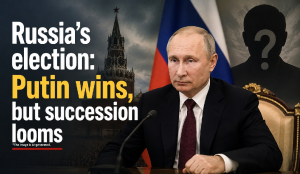
Vladimir Putin’s party has won with a record majority, but the big question hanging over his political system is: how will power be transferred when he leaves the Kremlin?
United Russia has won again. With nearly all ballots counted, Vladimir Putin’s party polled 57.83 per cent, up from 49.8 per cent in 2021, and is set for about 355 of the 450 Duma seats, up from 324.
That is a two-thirds constitutional majority and the biggest haul in the party’s history. Turnout was 59.3 per cent. Putin had cast the vote as a test of support for the war in Ukraine. The Kremlin will now call the result an answer. It was not an election in any sense that matters. A real election is a contest whose outcome is unknown until the votes are counted. This one was settled before polling opened.
In August, the Supreme Court struck the liberal Yabloko party’s national list off the ballot, removing the only registered party that openly opposed the war. All ten parties left standing back it. Golos, Russia’s only independent election monitor, shut down in 2025 after its co-chair, Grigory Melkonyants, was jailed for five years. OSCE observers were not invited. Voting stretched over three days, with electronic ballots in 33 regions, and Yabloko reported detained observers and Moscow voters being refused paper ballots. Polls were also run in occupied Ukrainian territory, which the EU has called a sham.
The Communists took 13.81 per cent, the LDPR 8.98 and New People 7.96. On paper, that is pluralism. In practice, these parties vote with United Russia on the big questions. They exist to make the ballot look crowded, not to offer a different government. That is how democracy works in Russia: the forms are kept and the substance is removed.
The missing ingredient is uncertainty. The Duma does not check the presidency; it stamps its decisions. Putin is not even a member of United Russia, which lets him stand above the machine he runs.
Now, what happens when he goes? Putin turns 74 next month. His term runs to 2030, and the 2020 constitutional changes let him stay until 2036, when he would be 83. No rival has been allowed to grow, so there is no obvious heir. The constitution makes Prime Minister Mikhail Mishustin the interim president, yet security-elite insiders see him as an outsider. Names such as Alexei Dyumin, the Security Council secretary and former bodyguard, keep circulating.
The pool is small, drawn from men who share Putin’s background and his fears. The new supermajority is succession insurance. A Duma this pliant can bless whatever the inner circle agrees, from a handpicked heir to a rewritten rulebook. The danger is not a democratic transition. It is a scramble between clans when the arbiter leaves, in a country strained by a war now in its fifth year, whose voters have never been asked to choose.
India, whose defence and energy ties with Moscow run deep, cannot treat this as somebody else’s problem. Personalised systems are most fragile at the moment they change hands. Delhi should deal with Moscow’s institutions today and plan for the day the man at the top is gone.