
Preventive healthcare: Bridging last mile in medical attention
India’s healthcare narrative is usually told through numbers on infrastructure: hospitals built, cards issued, beds added. Schemes such as the Ayushman Bharat Pradhan Mantri Jan Arogya Yojana (AB PM-JAY), the network of Ayushman Arogya Mandirs, and the National Programme for Prevention and Control of Non-Communicable Diseases (NP-NCD) have expanded access at a scale few countries have matched. As the Ministry of Health and Family Welfare informed Parliament in July 2026, more than 44.73 crore Ayushman Cards have been issued, enabling over 12.69 crore cashless hospital admissions. Nearly 1.86 lakh Ayushman Arogya Mandirs now serve as points of first contact closer to where people live.
However, a hospital bed or a health card is of limited use if people are unaware of it, or do not access it in time. This is the harder half of the equation, and it is being tested in a village called Maseet, in Tapukara.
Rural India, more broadly, continues to grapple with a similar set of constraints: a shortage of doctors and specialists in villages, longer distances to a functioning facility, uneven health literacy, and a tendency to seek treatment only once an illness becomes difficult to ignore. The construction of hospitals addresses one part of this problem; the remainder depends on persuading people of the value of preventive care before a health issue becomes acute.
A region outpacing its health habits
Tapukara lies within the Bhiwadi–Khushkhera–Tapukara Industrial Belt, one of North India’s largest manufacturing clusters, comprising more than 5,000 industrial units. It falls within Khairthal–Tijara, a district formed only in 2023, where public institutions are still adapting to the pace of economic growth around them. The region is also part of the wider Mewat area, which has long trailed on several health, nutrition, and education indicators.
Employment opportunities have expanded faster than health-seeking habits have changed — a pattern observed across much of rural India, and not unique to this region. Many families here continue to consult a doctor only after an illness has progressed, rather than before.
State-level data illustrates why these matters. According to the National Family Health Survey (NFHS-5), 54.7% of women in Rajasthan aged 15–49 are anaemic, as are 71.5% of children aged 6–59 months. Hypertension and diabetes are also becoming more prevalent.
A complementary intervention
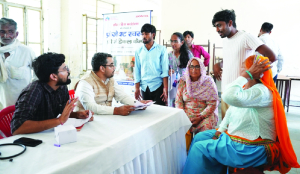
It is this gap that Project Swasth was designed to address. Launched in July 2026 in Maseet village, the initiative is implemented by the Sharda Welfare Foundation (SWF), with support from the Honda India Foundation (HIF) and in partnership with the Gram Panchayat, Maseet.
Dinesh, the village head of Maseet, said, “For years, people here have been travelling to places like Bhiwadi or Jaipur for routine check-ups or further treatment. Families have long been demanding that such a camp be organised within the village itself.”
Thanks to the involvement of the Honda India Foundation and the Sharda Welfare Foundation, that demand has now been addressed.
A comparable pattern is often observed in Indian cities, where the arrival of an established hospital group tends to lift the standard of the surrounding health ecosystem. The first community health camp offered an early indication of the scale of unmet need. The screening results were notable. Blood pressure checks found elevated readings in 21% of participants, while blood sugar screening flagged another 29%.
Community attitudes toward health
Access alone does not fully account for the low uptake of preventive care in villages such as Maseet; behaviour plays a role as well. In many rural settings, symptoms are managed at home for a period before a doctor is consulted, and routine screening for conditions such as hypertension or diabetes — which often present no symptoms until damage has occurred — is not yet part of everyday practice.
Project Swasth works through the Gram Panchayat and door-to-door outreach to build familiarity with the idea of a routine check-up, rather than one prompted only by the appearance of symptoms.
Facilitating access to entitlements
The project also assists families in accessing benefits to which they are often already entitled but do not use. This includes enrolment and e-KYC support under Ayushman Bharat, along with outreach for the AyushmanVay Vandana Card, which provides free health coverage of up to Rs 5 lakh a year to senior citizens aged 70 and above, regardless of income.
A model beyond one village
For the residents of Tapukara, the intent behind the project is a sustained one — not a single health camp followed by withdrawal, but a partner expected to return, follow up, and assist them in navigating a system that can otherwise appear distant and confusing.
Rishabh Gupta, Managing Director of the Sharda Welfare Foundation, said, “What we have seen on the ground is that infrastructure has grown much faster than people’s habit of using it. That is the gap we are trying to close, not only in Tapukara but wherever we work. Through Project Swasth, we intend to remain engaged with this region over the long term, rather than conducting a few camps and moving on.”
That intent, however, still has to be borne out: one camp, however well attended, constitutes an early indicator rather than an established track record. In a region still establishing itself as a new district, whether this becomes a long-term presence, or recedes after the initial effort, will matter more than the launch itself.
Rishabh Gupta, Managing Director of the Sharda Welfare Foundation, said, “What we have seen on the ground is that infrastructure has grown much faster than people’s habit of using it. That is the gap we are trying to close, not only in Tapukara but wherever we work. Through Project Swasth, we intend to remain engaged with this region over the long term, rather than conducting a few camps and moving on.”
This pattern is evident across much of India: healthcare infrastructure is expanding at a faster pace than its utilisation by communities. Bridging this gap requires sustained local engagement, genuine partnerships with local institutions, and trust between communities and the public health system.
As India’s primary healthcare architecture continues to expand, the next phase of reform may depend less on the number of facilities established and more on how effectively communities are connected to them. Greater convergence between government programmes, local institutions, and grassroots initiatives could strengthen health literacy, expand screening for anaemia and non-communicable diseases, and reinforce referral pathways.
The success of India’s health reforms will ultimately be measured not only by the number of hospitals built or cards issued, but by whether communities are sufficiently informed and equipped to make use of what is already available to them.
The writer is associated with the Sharda Welfare Foundation, which implements Project Swasth in Khairthal–Tijara district, Rajasthan, with support from the Honda India Foundation; Views presented are personal.