
Parliament passes anti-paper leak amendment bill with stricter punishment
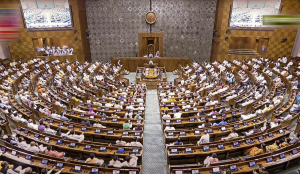
Parliament on Thursday passed a bill to amend the anti-paper leak law to introduce stricter punishments, with the government expressing its commitment to go the extra mile to safeguard the interests of students, who are the country's future.
The Public Examination (Prevention of Unfair Means) Amendment Bill, 2026, was cleared in the Rajya Sabha with a voice vote amid a walkout by several Opposition parties of the India bloc. The Lok Sabha had passed the Bill on Wednesday.
According to the Bill, individuals involved in paper leaks or unfair means in exams will get jail terms for a minimum of five years and a maximum of 10 years, and a fine of up to Rs 50 lakh.
For organised crimes, the Bill proposes a minimum sentence of seven years and a fine not less than Rs 10 crore.
Soon after the Congress-led Opposition staged a walkout before the minister's reply, leader of the house JP Nadda accused them of being "irresponsible" and having no respect for parliamentary proceedings, parliamentary democracy or decorum.
Replying to a seven-hour discussion on the Bill, Union Minister of State for Personnel, Public Grievances and Pensions Jitendra Singh criticised the Opposition for not properly reading the provisions of the Bill, which have been very diligently worked out.
He also attacked the Congress and other opposition parties for staging a walkout just before he started replying to the debate.
"The issue is so vast and so serious here, that it cannot be left to government alone. The government is already doing its way; it will continue to do so. We call for cooperation from all sections of society...we are open to receive suggestions.
"We are proceeding with an open mind. We are not only ready to walk the talk, but we are in fact ready to walk an extra mile," Singh said.
He accused the Opposition of being irresponsible by walking out and said, "It is unfortunate that many of the members who are most vociferous in raising objections have chosen to walk out when their issues were to be responded to".
The minister claimed that the Bill is comprehensive and it not only covers the issue of paper leaks but also takes a holistic view of the examination reform process.
The Bill does not cover the NTA alone; it also covers other examinations, including those conducted by the UPSC, SSC and banks, Singh said.
Referring to members' charge that the Radhakrishnan committee report has not been implemented, the minister said, in fact, 76 per cent of the panel recommendations have already been implemented.
He also took on the Leader of Opposition Mallikarjun Kharge on his claims that 152 leaks have happened, saying the LoP has not mentioned paper leaks in Punjab and Karnataka, which are not ruled by the NDA.
On the suggestion to abolish the NTA, Singh pointed out that more paper leaks have happened through state-level agencies, the state public service commissions, through state service boards and not necessarily through NTA.
The minister claimed that 15 years ago, "our youth were looking to leave the country. But, today, many of them are looking to come back now".
Singh also listed a host of measures taken by the government in not just providing job opportunities to the youth but also creating an atmosphere to promote the culture of entrepreneurship and self-employment opportunities.
He also listed out steps taken to increase seats in medical colleges and said the government has "made earnest efforts to liberate medical education from management quota".
The amendment bill seeks to empower all the state governments and Union Territories administrations to designate any court of session to be a special fast-track court to try offences under the proposed law.
It also provides that the proceedings in such courts are continued on a day-to-day basis and the trial is completed within three months from the date of filing of the charge sheet.
The Bill also empowers the central government to constitute a special task force for investigation of any offence.
The 2024 law was brought in when the government faced raging paper leak controversies. Before this legislation, there was no specific substantive law to deal with unfair means adopted or offences committed by various entities involved in the conduct of public examinations by the central government and its agencies.
Earlier, participating in the debate, members of several Opposition parties attacked the government over the police action against the agitating students and no accountability fixed for it, even as ruling party members claimed the BJP regime was sensitive to the issues raised by students.