
Old clothes donation kiosks to open at 10 Metro stations
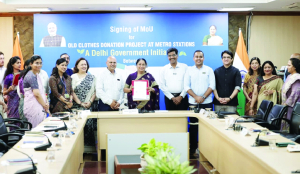
The Delhi Metro Rail Corporation, the DMRC Ladies Welfare Organisation, the Delhi Government’s State Urban Livelihood Mission, and textile recycling organisations Clothes Box Foundation and Respun signed a MoU in the presence of Chief Minister Rekha Gupta on Tuesday.
The MoU was signed to launch the old clothes donation project, with Arpan Kendras to be set up at 10 major Metro stations in the first phase, where citizens can donate unused clothes from 7 am to 7 pm, with the centres operated by women from Self-Help Groups who will also upcycle the collected garments into bags, decorative items, and other products.
The ten Metro stations where Arpan Kendras will be launched in the first few days are Shahdara, Dr Baba Saheb Ambedkar Hospital, Malviya Nagar, Hauz Khas, Dwarka, Mohan Estate, Lajpat Nagar, Mayur Vihar Phase-1, Punjabi Bagh West, and Shalimar Bagh. DMRC Managing Director Dr Vikas Kumar and representatives of the partner organisations were present at the MoU signing.
The collected clothes will be sorted into categories. Garments that can still be used will be upcycled by Self-Help Group women into bags, garments, and other products. Clothes that are completely unusable will be recycled into new yarn, fabric, and raw materials. Clothes used for religious rituals and sacred materials will be respectfully reused and recycled to honour donors’ sentiments.
The DLWO will coordinate among all partner organisations. DMRC will provide the infrastructure and kiosks at stations. Clothes Box Foundation and Respun will manage segregation, recycling, and upcycling of collected material. SHG women under SULM will handle day-to-day operations and receive specialised training in textile upcycling to help them become financially self-reliant. A portion of donated clothes will be made available to them for upcycling, and products made through this process will also be sold at the kiosks, creating a circular economy model within the Metro station network.
The donation process has been designed to be digital. Citizens visiting an Arpan Kendra scan a QR code at the kiosk, enter their name, mobile number, and details of the clothes being donated, after which SHG women inspect and verify the items, and the donor immediately receives a digital certificate along with a shareable message for social media. Each donation will be digitally mapped to the respective Metro station, enabling real-time tracking. A centralised admin dashboard will allow authorised officials to monitor donations across all centres.
The Chief Minister said the initiative would not only reduce textile waste but also encourage citizens to be active partners in building a cleaner and more sustainable city. She said the Government is developing separate solutions for different categories of waste and expressed confidence that if scientific and systematic solutions are developed for every type of waste, Delhi can be freed from many complex waste-related challenges. The 10 Arpan Kendras are the first phase, and the initiative will eventually be expanded across all parts of Delhi.
India generates significant volumes of textile waste annually, with old garments frequently ending up in landfills because no accessible, organised collection and recycling infrastructure exists for households. Placing collection points at Metro stations, which collectively serve millions of daily commuters, is designed to bring textile donation within easy reach of a very large urban population.