
Oil tankers use new route through Hormuz despite Iranian threats
Several tankers made their way out of the Strait of Hormuz on Thursday using a new route promoted by a UN maritime agency. Iran has threatened vessels using the path, which runs along the coast of Oman.
The opening of an alternative passage through the vital waterway would relieve pressure on the world economy and remove Iran’s main source of leverage in ongoing peace talks with the United States. US Secretary of State Marco Rubio, on a visit to the Gulf to reassure American allies, said Washington was committed to the new route.
Traffic through the strait has increased but is still well below prewar levels. Oil on Thursday briefly dipped below its last prewar price of just under $73 per barrel, a sign that the market believes the situation is improving.
The two sides are still debating terms of an interim peace deal — from getting ships through the narrow mouth of the Persian Gulf to the future of Iran’s stockpile of highly enriched uranium.
Under the memorandum of understanding signed last week, the US and Iran agreed to a 60-day period to iron out the details. As talks are held behind closed doors, US President Donald Trump and Iranian leaders have seemed to negotiate in public, trading threats and claiming concessions the other side denies.
The flare-up of fighting in Lebanon between Israel and Iranian-backed Hezbollah militants has meanwhile threatened the wider truce. Israel’s first airstrike on Lebanon since a ceasefire took effect over the weekend killed two people on Wednesday, according to Lebanon’s state-run news agency.
The oil tankers, led by the Stoic Warrior vessel, sailed along the coast of the United Arab Emirates and then Oman early Thursday, passing by Oman’s Musandam Peninsula fairly close to the shore. The route was laid out by Oman and the International Maritime Organisation, a UN agency.
North of the route is the Traffic Separation Scheme corridor, in the center of the strait, where ships had moved through freely before the war, transporting about a fifth of all the world’s oil and natural gas.
Iran said it mined that passage after the US and Israel attacked it on Feb. 28, and at least one mine has been sighted there. Though some ships had been getting out of the strait, with US military support, the UN agency’s effort is the latest to free trapped vessels. The shipping company Maersk said its container ship, the Maersk Baltimore, and another chartered vessel had also made it out of the strait on Thursday.
Last week, 125 vessels crossed the strait, up from 33 the week before, according to marine data and analysis firm Lloyd’s List Intelligence.
According to S& P Global, Wednesday saw 78 transits, the most since the war began. Among the vessels were 10 crude oil tankers, including five outbound large carriers that can carry up to 2 million barrels of oil.
Still, that daily total is below the average of 130 or more from before the war.
“Opportunistic operators - and there are many of them - emboldened by the lower transit risk, or at least the perceived lower transit risk, have begun chasing the backlog of trapped cargoes that built up during the conflict,” said Richard Meade, editor-in-chief at Lloyd’s List.
The naval arm of the Revolutionary Guard, apparently reacting to the new shipping route and increased traffic, issued a warning Thursday, carried by Iran’s state-run IRNA news agency.
No tolls on ships: US
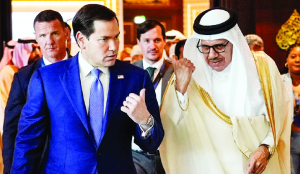
Dubai: Rubio met with foreign ministers from the six-nation Gulf Cooperation Council to assure them that their interests would be protected in any agreement with Iran. Those countries, including major energy producers reliant on the Strait of Hormuz for exports, came under attack by Iran after the start of the war.
“There is no part in this deal that’s undertaken that in any way undermines the security, the stability or the prosperity of any of our partners in the Gulf region,” Rubio said at the meeting in Bahrain, home to the US Navy’s 5th Fleet. He later told journalists the US and Gulf allies would ensure there would be no fees charged on ships moving through the strait. He also criticized Iran’s hard-liners for going “on their official media and making all kinds of pronouncements” that he described as not true.
He said the US wanted to make sure the Oman route continued for ships to transit the strait. “If that stops, then we’re going to have a problem,” Rubio said.