
NSA Doval heads to Beijing for border talks
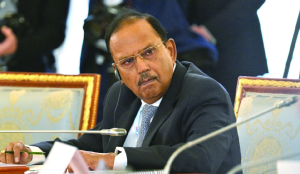
National Security Advisor Ajit Doval is scheduled to arrive in Beijing on Monday for the 25th round of India-China Special Representatives (SR) talks on the boundary question, with his Chinese counterpart and Foreign Minister Wang Yi. The two are the designated SR for the boundary negotiations mechanism, established in 2003 to seek a comprehensive settlement to the 3,488-km-long India-China border dispute.
While the mechanism has not succeeded in resolving the long-standing boundary dispute, officials on both sides view the structured dialogue as an important channel for managing tensions and addressing issues affecting bilateral relations.
The upcoming talks assume significance as they come ahead of the expected visit of Chinese President Xi Jinping to India for the BRICS summit in New Delhi on September 12-13.
There has been no official confirmation of Xi’s visit so far. However, officials on both sides are optimistic about his participation. If the visit goes ahead, it could provide an opportunity for Xi and Prime Minister Narendra Modi to meet on the sidelines of the summit and discuss measures to further stabilise and strengthen bilateral ties.
The two leaders last met in August last year on the sidelines of the Shanghai Cooperation Organisation summit in Tianjin.
Ahead of the Doval-Wang meeting, External Affairs Minister S Jaishankar on Saturday stressed that peace and tranquillity along the border areas remain a prerequisite for improving relations between India and China.
His remarks came amid reports of increased Chinese military activity and aggressive posturing in Arunachal Pradesh’s Upper Subansiri region in recent weeks.
“We went through a particularly bad patch between the summer of 2020 and the autumn of 2024, and that was primarily an outcome of the situation in the border areas,” Jaishankar said at the <Economic Times></i> World Leaders Forum in New Delhi.
“At the end of the day, peace and tranquillity in the border areas is a prerequisite for good relations, and the state of the border, to a very large measure, naturally would determine the state of the relations,” he said.
China has maintained that the situation along the border is currently stable. Chinese Foreign Ministry spokesperson Guo Jiakun said on August 12 that the China-India border situation was “generally stable at the moment”.
Guo also said that the two countries had held the 36th meeting of the Working Mechanism for Consultation and Coordination on China-India Border Affairs.
According to him, both sides agreed to maintain communication through diplomatic and military channels and jointly safeguard peace and tranquillity in the border areas.
India, meanwhile, has repeatedly underlined the importance of maintaining peace along the Line of Actual Control (LAC).
External Affairs Ministry spokesperson Randhir Jaiswal said on August 11 that India regards matters concerning the border areas with China as “most serious” and that maintaining peace and tranquillity along the LAC is of “utmost importance”.
He also asserted that the situation along the frontier would determine the overall trajectory of India-China relations.
The latest round of tensions comes against the backdrop of continuing differences over Arunachal Pradesh. New Delhi has rejected China’s objections to India’s decision to formally identify 27 places and geographical features in the state by their standard names.
India has repeatedly maintained that Arunachal Pradesh is an “inalienable and integral” part of the country and that such naming exercises by China cannot alter that reality.
China claims Arunachal Pradesh as part of what it calls South Tibet and has, since 2017, periodically issued its own names for locations in the Indian state.
New Delhi has dismissed the Chinese move as “vain and preposterous”, maintaining that such actions cannot change the fact that Arunachal Pradesh “was, is, and will” remain an integral part of India.
Against this backdrop, the Doval-Wang talks are expected to focus on maintaining stability along the LAC and sustaining the broader dialogue on the boundary issue, while the two countries seek to consolidate a gradual improvement in bilateral ties following the tensions that erupted after the 2020 border crisis.