
Monsoon turns most polluted in 7 years as average AQI hits 105
Delhi’s monsoon this year turned out to be its most polluted in seven years, with the average AQI between July and September climbing to 105, the highest for the period since 2019, according to an analysis of official data. The monsoon lasted for about 84 days between July and September, and during the period the city recorded one “good” AQI day, 49 “satisfactory” days, 39 “moderate” days and two “poor” days.
The average AQI during July-September stood at 105 this year, just below the 2019 average of 106, according to the Centre for Research on Energy and Clean Air (CREA) analysis of official data. Among the two major particulate pollutants, PM10 was the more prominent pollutant this year. Its average concentration stood at 108 micrograms per cubic metre, the highest since 2019, when it was 109 micrograms per cubic metre. PM2.5 averaged 37 micrograms per cubic metre this year, the same as in 2024 and the highest since then, though it remained below the 39 recorded in 2023 and 40 in 2019.
The average AQI during July-September was 91 in both 2024 and 2025, 103 in 2023, 95 in 2022, 99 in 2021 and 88 in 2020. The rise in PM10 was particularly notable compared with recent years. The average stood at 88 micrograms per cubic metre in 2025, 87 in 2024, 105 in 2023, 92 in 2022, 98 in 2021 and 85 in 2020. The PM2.5 average, meanwhile, was 32 micrograms per cubic metre in 2025, 37 in 2024, 39 in 2023, 36 in 2022, 37 in 2021 and 35 in 2020.
The monsoon arrived over Delhi on July 2, five days after its normal onset date of June 27, marking the first July onset in five years. It withdrew on September 23, two days earlier than its normal withdrawal date of September 25. In 2019, the monsoon had arrived on July 5 and withdrawn on October 10, lasting 97 days, considerably longer than this year. In 2019, Delhi recorded two “good” days, 51 “satisfactory” days, 34 “moderate” days, four “poor” days and one “very poor” day during the July to September period.
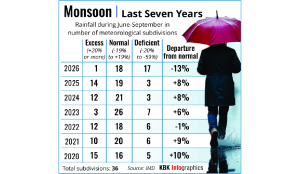
Despite the shorter monsoon, Delhi received 728.6 mm of rainfall during the season against the normal 629.7 mm, an excess of nearly 16 per cent. An IMD official had earlier told PTI that no major rainfall record was broken this year despite the rainfall being above normal, noting that Delhi had received more than 900 mm of rainfall in each of the previous two years.
A separate study by the Centre for Science and Environment (CSE), which analysed this year’s monsoon from June to August, found that pollution relief during rainy spells was often short-lived, with PM2.5 levels rising sharply again once the rain stopped.
CSE’s analysis tracked six isolated monsoon rainfall events, defined as rain days preceded by at least one dry day and followed by three consecutive dry days. Before rain, average baseline PM2.5 stood at 40.6 micrograms per cubic metre. During active rainfall, wet scavenging pushed this down to 32.7, a 19.5% drop.
Within 24 hours of the rain stopping, PM2.5 rebounded to 36.2, a 10.7 per cent rise from the washout level. By 48 hours, levels climbed to 45.1, a 37.9 per cent surge, ending 11.1 per cent higher than the pre-rain baseline. “While monsoon rains bring temporary relief, they only mask the underlying crisis.
The fact that even heavy rainfall failed to bring consistent ‘Good’ air quality, and that pollution rebounded within 48 hours during dry spells, shows that our baseline emissions remain dangerously high. As we enter winter, we are starting from a baseline where continuous, elevated emissions will inevitably trigger severe seasonal spikes,” said Anumita Roychowdhury, Executive Director, Research and Advocacy, CSE.
“Moderate” air quality remained the single largest category through the monsoon, covering 57.6 per cent of days, or 53 out of 92. A “Moderate” reading corresponds to PM2.5 levels of 61 to 90 micrograms per cubic metre, well above the national 24-hour safe limit of 60.
Comparing seasons, Delhi’s average PM2.5 dropped from 60.2 in summer (April-May) to 40.2 during monsoon (June-August), a 33.2 per cent decline, while “Poor” days fell sharply from 17 in summer to just three during monsoon
The study also found that the monsoon pollution story was not limited to particulate matter. As PM2.5 levels fell, gaseous pollutants emerged as prominent contributors to the daily AQI on several days.
Ground-level ozone was the prominent pollutant on 20 per cent of monsoon days, nitrogen dioxide on 10 per cent of the days and carbon monoxide on seven per cent.