
Middle East war is bigger than ‘Iran-vs-America’
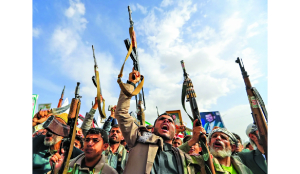
The most revealing developments in the Middle East are no longer occurring along the conventional Iran-United States (with Israel) axis. They are unfolding in Yemen, Iraq, Saudi Arabia and the maritime chokepoints interconnecting them. The recent Houthi takeover of a strategically located Yemeni island, their persistent attacks on shipping, and the reported drone attack on Saudi Arabia launched from southern Iraq point towards a conflict considerably more complex than the familiar narrative of “Iran-versus-America”, with Israel in tow. Iran undoubtedly occupies a central position in the region’s network of armed allies and partners. Houthis in Yemen and Iran-aligned militias in Iraq are not identical organisations, nor are they simply puppets controlled from Tehran. Each has its own domestic interests and political objectives. Yet they operate within an ideological and strategic ecosystem in which Iran’s revolutionary worldview, Shia political mobilisation, and opposition to the American-backed regional order have created durable relationships.
The significance of the Houthi advance lies in its geography. Control around the Bab el-Mandeb (maritime gateway connecting the Red Sea with the Gulf of Aden) gives the Houthis leverage over one of the world’s critical commercial arteries. Their ability to threaten shipping is no longer merely an extension of Yemen’s civil war. It provides an Iran-aligned movement with the capacity to impose costs on Western powers, Israel and, crucially, Saudi Arabia without Iran itself having to fight every battle directly.
More revealing still is what has happened on Saudi Arabia’s northern flank. Recent drone attacks against Saudi Arabia have reportedly been launched from Iraqi territory, including the southern province of Maysan. The geography matters. Southern Iraq is the country’s predominantly Shia heartland and part of the wider area where Iran-aligned political and armed groups have accumulated substantial influence. Iraqi authorities’ response, including the dismissal of a military commander following the attacks, underscores the seriousness of the development.
This should not, however, be interpreted as equating Iraq’s Shia population with Iran-aligned militancy. Iraq’s Shia communities are politically diverse, and Iraqi nationalism has often competed with Iranian influence. The significance lies in the armed organisations operating from a region where Tehran has developed considerable strategic relationships. The resulting geography is striking.
Saudi Arabia is potentially being pressured from both ends of the Arabian Peninsula - by the Houthis from Yemen and the Red Sea to the south, and by Iran-aligned armed networks operating from Iraq to the north. Iran itself sits across the Gulf. What appear to be separate theatres therefore begin to resemble elements of a wider strategic architecture of sectarian dimension. Saudi Arabia is not merely an American ally caught in an Iranian war. It is the principal Sunni Arab power confronting an increasingly assertive Iranian regional order. The rivalry between Riyadh and Tehran has always involved more than oil, territory and strategic influence. It also reflects competing political and religious identities - a Sunni Arab order dominated by established states and monarchies on one side, and an Iranian-led ecosystem of Shia or Shia-aligned movements on the other. Yemen illustrates this convergence particularly well. The Houthis emerged from Yemen’s Zaydi Shia tradition and have developed close military and strategic ties with Iran. But reducing them to Iranian proxies is equally simplistic. Their rise is rooted in Yemen’s own political grievances, social divisions and civil war. Iran has provided military capabilities and strategic support; it did not manufacture every grievance sustaining the movement.
The same logic applies in Iraq. Iran does not need to command every militia or dictate every decision. It benefits from relationships with groups whose interests sometimes converge with its own: opposition to American military presence, hostility towards Israel, resistance to Saudi influence and the pursuit of greater political power within Iraq. Such relationships provide Tehran with strategic depth without requiring direct Iranian intervention in every theatre.
That is why describing these organisations merely as “proxies” can obscure more than it clarifies. They possess independent interests and local constituencies. Their relationship with Tehran is better understood as converging interests between autonomous movements and a regional power. The Middle East is therefore witnessing several wars increasingly sharing the same battlefield.
The danger of the simplistic “Iran-versus-America” narrative is that it encourages policymakers to search for a bilateral solution to a fundamentally regional problem. Even if Washington and Tehran theoretically reached an accommodation, the underlying rivalries in Yemen, Iraq, Lebanon and the Gulf would not necessarily disappear. The larger question is not simply whether Iran can withstand the United States and Israel. It is whether the Sunni Arab states can prevent an increasingly interconnected network of Iran-aligned movements from Iraq to Yemen from converting geographical fragmentation into strategic encirclement.
The map is telling a story that the headlines often miss. The Middle East is not simply a chessboard on which Washington and Tehran are moving pieces. It is a region where local conflicts, sectarian identities, state rivalries and great-power competition are increasingly converging. That is the deeper story emerging from the Red Sea, the Gulf and southern Iraq. It is more complicated than “Iran-versus-America”. And it may prove far more enduring.
The writer is a former Lieutenant Governor of the Andaman and Nicobar Islands and Puducherry, and a military veteran; Views presented are personal.