
Meeting of National Level Policy Implementation and Monitoring Committee held in New Delhi
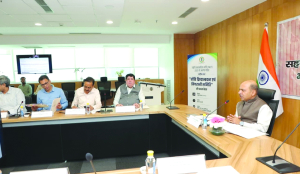
To strengthen and modernise the cooperative sector, the first meeting of the National Level Policy Implementation and Monitoring Committee constituted under the National Cooperation Policy-2025 was held on Tuesday at Atal Akshay Urja Bhawan, New Delhi.
The meeting was chaired by Dr Ashish Kumar Bhutani, Secretary, Ministry of Cooperation & Chairperson of the Committee. The Committee deliberated on the roadmap for the effective implementation of the National Cooperation Policy-2025, with special focus on institutional strengthening, coordinated action by Central Ministries, Departments, States and Union Territories, and National Federation/Cooperatives for digital transformation, capacity building, membership expansion and cooperative-led inclusive and sustainable economic development.
The meeting was attended by Dilip Sanghani, Chairman, IFFCO; Siddharth Jain, Additional Secretary, Ministry of Cooperation; Anand Kumar Jha, Raman Kumar and Shiv Pal Singh, Joint Secretaries, Ministry of Cooperation; Vice-Chancellor, “Tribhuvan” Sahkari University, Chairman, NABARD; and senior officers from various Central Ministries, national cooperative federations, cooperative institutions, States and Union Territories Governments.
Addressing the Committee, Dr. Bhutani called upon all stakeholders to work together to take the objectives of the National Cooperation Policy-2025 to the grassroots level. He said that strong, transparent and modern cooperative institutions will provide new energy to the rural economy and make a significant contribution to the goal of Viksit Bharat @2047.
He underlined that the National Cooperation Policy-2025 provides a comprehensive framework to make cooperatives transparent, technology-enabled, professionally managed and member-centric economic institutions.
During its deliberations, the Committee discussed the six strategic pillars of the National Cooperation Policy-2025, namely strengthening the foundation of the cooperative sector, making cooperatives vibrant and competitive, preparing cooperatives for the future, expanding inclusiveness and outreach, enhancing the role of cooperatives in new and emerging sectors, and connecting the younger generation with cooperative development.
The Committee also discussed a coordinated action plan with various Ministries and Departments, including the Ministry of Panchayati Raj, Ministry of Rural Development, Department of Fisheries, Department of Animal Husbandry and Dairying, Ministry of Food Processing Industries, Department of Agriculture and Farmers Welfare, and other related Departments.
Key initiatives reviewed during the meeting included the development of Primary Agricultural Credit Societies as multipurpose service centres, the development of model cooperative villages in every district, ensuring cooperative outreach up to all Panchayats, expansion of dairy and fishery cooperatives, promotion of ERP-based management systems, data-driven decision-making and strengthening of cyber security in the cooperative sector.
The Committee also reviewed the progress of major initiatives undertaken to strengthen the cooperative ecosystem, including the development of the National Cooperative Database, computerisation of PACS, establishment of “Tribhuvan” Sahkari University, and formation of national-level cooperative institutions such as National Cooperative Exports Limited, National Cooperative Organics Limited and Bharatiya Beej Sahakari Samiti Limited.
Special emphasis was laid on expanding cooperative membership, increasing the economic contribution of cooperative institutions, ensuring greater participation of women, youth and small farmers, and linking cooperative enterprises with new markets. The National Cooperation Policy seeks to work towards expanding cooperative membership to 50 crore by 2035 and enhancing the contribution of the cooperative sector by three times in the national economy.
The meeting also discussed innovation in cooperatives, promotion of startup culture, skill development and creation of young leadership in the cooperative sector. The role of “Tribhuvan” Sahkari University in institutionalising cooperative education, training, research and capacity building was also reviewed.
To accelerate digital transformation in the cooperative sector, emphasis was placed on strengthening the National Cooperative Database, cooperative ranking framework, digital platforms and data-based monitoring mechanisms.
The Committee underlined that the successful implementation of the National Cooperation Policy-2025 will be ensured through a Whole-of-Government approach, with active participation of the Centre, States, cooperative institutions and all stakeholders.