
Marvels of India - Sabha and Samiti
Vedic Origin
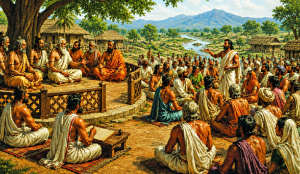
As early as roughly 1500 BCE, ancient Bharat had institutionalised collective governance through two remarkable assemblies: the Sabha and the Samiti. The term Sabha occurs eight times in the Rigveda and 17 times in the Atharvaveda. The Atharvaveda exalted both these institutions by calling them the two daughters of Sage Prajapati, i.e., a theologically significant honour affirming their sacred centrality to public life.
Role and Function
The Samiti represented a larger, broad folk assembly open to the general population for public deliberation. The Sabha functioned as a smaller, exclusive assembly composed of village elders, nobles and elites that primarily handled judicial cases, administrative guidance and pastoral affairs. Together, they ensured both popular participation and expert institutional guidance.
Balance in Governance
They demonstrate the existence of consultative traditions in early Indian society, suggesting that political authority was moderated through discussion and collective participation, allowing members to get involved in decision-making processes.
Living Legacy
They provided a platform for freedom of speech, debate and critique, thereby presenting a picture of ancient Indian democratic elements that resonates with Bharat's constitutional ethos to this day.