
'No NRC, no Census' : What's behind Manipur's citizenship demand
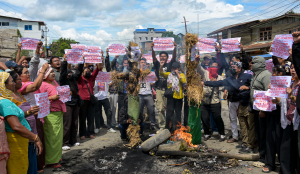
Protests over the National Register of Citizens (NRC) have intensified in Manipur, with demonstrators demanding that the register be updated before the ongoing Census exercise.
A 48-hour general strike called by the Campaign for Just and Fair Delimitation (JFD) ended Wednesday with rallies, road blockades and effigy-burnings of CM Khemchand Singh, home minister Govindas Konthoujam in several valley districts.
Protesters raised slogans including "No NRC, No Census". They also demanded that the Census not be conducted until internally displaced people return to their native places.
The JFD has announced a boycott of state and central government offices from Thursday. Essential services, including water, power and medical services, will be exempted.
The agitation comes as Manipur remains deeply divided after more than three years of ethnic conflict between the Meitei and Kuki-Zo communities.
So, what exactly is the NRC demand? Why has it become such a contentious issue in Manipur? And how is it connected to the state's wider conflict?
What is the NRC?
The National Register of Citizens is a register of Indian citizens. The legal framework for maintaining such a register comes from Section 14A of the Citizenship Act, 1955. The provision allows the Central government to compulsorily register citizens and maintain a National Register of Indian Citizens. The Citizenship (Registration of Citizens and Issue of National Identity Cards) Rules, 2003 provide the framework for the registration process.
An NRC is therefore different from a Census.
The Census is a population-counting exercise. Census 2027 is being conducted in two phases. The first covers house listing and housing information. The second, scheduled for February 2027, will collect demographic and socioeconomic information about individuals. Caste will also be enumerated in the second phase, a first such exercise since Independence.
An NRC, by contrast, is concerned with determining who is an Indian citizen. This distinction is at the heart of the current protests.
Why do protesters want NRC before the Census?
JFD and other groups supporting the demand argue that Manipur's population has changed significantly because of migration and alleged illegal immigration.
They want citizenship to be verified before the state's population is officially counted.
The demand has particular urgency in Manipur because of the state's long-running concerns over migration across its border with Myanmar.
But the claim that large numbers of people have entered Manipur illegally remains contested. There is also a crucial distinction between undocumented migrants and Indian citizens belonging to communities that have historically lived on both sides of the India-Myanmar border.
The issue is highly sensitive because the Kuki-Zo communities of Manipur have ethnic ties with Chin communities in Myanmar. During the conflict, Meitei organisations and political leaders have repeatedly alleged that illegal immigration from Myanmar has altered Manipur's demographic balance. Kuki groups have rejected the portrayal of the community as a whole through the lens of illegal immigration.
The Observer Research Foundation has noted that demands for an NRC and government efforts to identify illegal immigrants have generated fear among Kukis, while Meitei groups have raised concerns over alleged demographic changes.
The NRC demand did not begin with the 2023 conflict
The demand predates the current ethnic violence. In August 2022, the Manipur Assembly adopted resolutions seeking the establishment of a State Population Commission and the implementation of an NRC. The Assembly's own records list the Aug 5, 2022 resolution on the "Establishment of State Population Commission and NRC". In March 2024, the Assembly passed another resolution seeking implementation of the NRC.
The Manipur Assembly's official resolution list records both resolutions.
The State Population Commission was subsequently established in February 2023. According to its administrative report, the commission was created in pursuance of the 2022 Assembly resolution and a state Cabinet decision.
The commission's report says the demand for updating the NRC arose amid concerns over the state's "skewed demographic profile".
Why does 1951 matter?
One of the most contentious questions is the base year. Several civil society organisations have demanded that 1951 be used as the base year for determining who qualifies as an indigenous resident.
The argument goes back to the first post-Independence population exercise. The first NRC was prepared in 1951 after the Census of that year. It was not subsequently updated across India. Assam later became the only state where the NRC was updated on a large scale, following the Assam Accord and a Supreme Court-monitored exercise.
In Manipur, however, there is disagreement over what should constitute the relevant cut-off. In June 2022, the state Cabinet adopted 1961 as the base year for determining "native" status for the Inner Line Permit system.
Civil society groups pushing for an NRC have continued to demand 1951 instead. The Indian Express reported in 2024 that the Cabinet's 1961 decision differed from the 1951 cut-off sought by groups that had led the ILP movement.
The issue has also entered Parliament. In March 2025, BJP Rajya Sabha MP Leishemba Sanajaoba demanded that an NRC with 1951 as the base year be conducted before delimitation, arguing that demographic changes had altered the state's electoral balance.
How does the Inner Line Permit fit into this?
The NRC debate is closely linked to Manipur's long-running demand to protect indigenous communities from migration. After sustained protests, the Union government extended the Inner Line Permit system to Manipur in December 2019. It came into effect on Jan. 1, 2020.
The ILP regulates the entry of people from outside the state. It is not a citizenship register.The two systems therefore overlap politically but serve different legal purposes.
How did the NRC become tied to the Manipur conflict?
The present conflict between the Meitei and Kuki-Zo communities began in May 2023 after years of tension over land, political representation, affirmative action, migration and access to resources.
A Manipur High Court order directing the state government to consider the Meitei community's demand for Scheduled Tribe status became an immediate trigger for protests by tribal organisations. The protests were followed by widespread ethnic violence.
The Institute for Defence Studies and Analyses has described the violence as the result of several overlapping tensions, including the ST demand, anger over government policies, eviction drives and concerns over illegal migration.
The NRC issue became more prominent during the conflict. The Meitei community, which is concentrated in the Imphal Valley, has raised concerns that migration from Myanmar has changed the state's demographic balance.
Kuki-Zo groups, many of whom live in the hill districts bordering Myanmar, have opposed narratives that equate their community with illegal immigrants. The allegations of illegal immigration had existed for years but became much more politically prominent after the outbreak of violence.
It is also worth noting that the Union government began the process of identifying alleged illegal immigrants from Myanmar in the early months of the conflict itself.
Why is the Census now the trigger?
India's last such exercise was conducted in 2011. The 2021 Census was postponed during the COVID-19 pandemic.
The government has now begun the first phase of Census 2027. The exercise involves house listing and housing information, followed by population enumeration in February 2027. The Centre has said the Census will be conducted digitally for the first time.
In Manipur, civil society groups demanding an NRC want the citizenship question addressed before the population is officially enumerated.
That is why the slogan has become "No NRC, No Census".
The demand is also connected to another politically sensitive issue: delimitation.
Groups supporting the NRC argue that electoral constituencies should not be redrawn on the basis of a population count until alleged illegal immigration is addressed.
This argument gained national attention in March 2025 when BJP MP Leishemba Sanajaoba raised the issue in the Rajya Sabha. He argued that an increase in villages in some hill districts showed demographic changes and demanded an NRC before delimitation.
Those figures and their interpretation have been disputed, and an increase in villages by itself does not establish illegal immigration.
What is happening now?
The latest agitation is being led by the Campaign for Just and Fair Delimitation. During the 48-hour strike, protesters in Imphal East, Imphal West, Bishnupur and Thoubal districts blocked roads and disrupted movement.
At Khurai Lamlong, protesters burnt effigies of Chief Minister Y Khemchand Singh and Home Minister Govindas Konthoujam. A Census training programme for supervisors, enumerators and field trainers was also cancelled in Thoubal district.
The Council of Teachers' Associations said teachers assigned to Census duties were facing "embarrassment, humiliation and different forms of obstacles" while attending training. The JFD has now announced a boycott of government offices.
The state government has said it supports the public demand for an NRC but has urged protesters to choose forms of agitation other than a bandh.
The larger question: citizenship, identity and a fractured state
The NRC debate cannot be separated from the larger political crisis in Manipur. The state is emerging from more than three years of ethnic violence between Meitei and Kuki-Zo communities. More than 200 people have been killed and thousands displaced since May 2023.
President's Rule was imposed in February 2025 after then Chief Minister N Biren Singh resigned. It was lifted in February 2026, when Y Khemchand Singh took oath as chief minister. The Centre only revoked President's Rule on Feb. 4, 2026.
The new government includes deputy chief ministers from the Kuki-Zo and Naga communities, an attempt to bring different ethnic groups into the state's political structure.
For supporters, the NRC is a mechanism to protect Manipur's indigenous population and address what they describe as demographic change. For many in the Kuki-Zo community, the same demand raises fears of being treated as outsiders in a state where they have lived for generations.
(Inputs from PTI)