
Japan seeks record 8.9 trillion yen defence budget, plans drone, AI, missile push
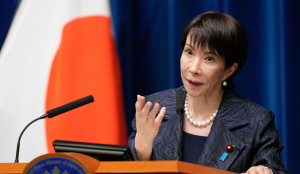
Japan is planning a major overhaul of its defence capabilities, with drones, artificial intelligence, long-range missiles and other emerging technologies at the centre of an 8.9 trillion yen ($55.6 billion) budget request for the next fiscal year, the Defence Ministry said Monday.
The preliminary request is only slightly higher than the 8.8 trillion yen ($55 billion) sought for the current fiscal year. The final defence budget is expected to be significantly larger, with additional details to be announced later this year after Prime Minister Sanae Takaichi's government approves its new security and defence strategy.
The planned measures are aimed at adapting Japan's military to changing forms of warfare, particularly lessons from the use of drones in the war in Ukraine.
The Defence Ministry said it wanted to "drastically strengthen its deterrence and response capability by transforming its defence capability" to meet the demands of new warfare.
Under a five-year defence strategy adopted in 2022, Japan has doubled defence spending to about 2 per cent of its gross domestic product as it seeks to strengthen the offensive role of its Self-Defence Forces and counter China's growing military assertiveness.
China has criticised Japan's military expansion as "new militarism."
Attack drones, long-range and hypersonic missiles
The Defence Ministry is seeking to develop and mass-produce relatively inexpensive uncrewed weapons, saying they could reduce costs and casualties while helping create a more efficient air defence network.
It plans to combine attack drones with long-range missiles to strengthen Japan's counterstrike capability. For the fiscal year beginning in April 2027, the ministry is seeking an unspecified amount to acquire unmanned attack drones capable of being launched from above or underwater.
Officials also see uncrewed weapons as a way to address Japan's shrinking pool of military personnel as the country's population ages and declines.
However, experts have warned that developing drones entirely within Japan could prove difficult because the country's commercial drone market is heavily dependent on imports from China.
Japan has in recent years strengthened its southwestern region with longer-range missiles and interceptors. The ministry is now seeking to further expand its counterstrike capabilities by developing hypersonic missiles that can be launched from submarines.
AI to play bigger role in defence command
Artificial intelligence is another major component of Japan's planned defence transformation.
The ministry intends to introduce an integrated AI platform for command and control that can speed up and improve decision-making, including battlefield assessments and target selection.
Officials said Japan is considering using existing foreign AI technologies, including those developed in the United States, while simultaneously developing domestic systems. A combination of foreign and Japanese technologies is also being considered.
The ministry plans to create a next-generation platform called an "AI orchestrator", designed to integrate multiple AI systems and enable their autonomous selection and operation.
It also plans to establish a "Defence Ministry cloud" to facilitate the secure transmission of highly sensitive information and maintain stable communications networks during emergencies and disasters.
The ministry has not disclosed the expected cost of these measures.
State support planned for defence industry
The government also wants to strengthen Japan's defence industry and prevent disruptions to the supply of military equipment.
Defence officials said maintaining deterrence requires a stable and sustainable production base, particularly as companies withdrawing from the sector could create shortages.
The ministry has therefore requested an unspecified amount to establish a state-owned, contractor-operated system under which the government would acquire factories and outsource their operation to private companies.
The budget request also includes funding to support defence-related research and development, as well as restructuring efforts by companies to improve production capacity and efficiency.
Major defence suppliers including Mitsubishi Heavy Industries, Kawasaki Heavy Industries and IHI Corp. have seen their profits rise as Japan expands military spending and arms exports.
However, Japan's defence industry remains constrained by constitutional limits that restrict the use of force to self-defence.
Dozens of companies have left the sector over the past several decades, citing low profits, uncertain business prospects and concerns about reputational damage from producing weapons, particularly lethal ones.
Japan's latest defence plans are intended to address those industrial weaknesses while rapidly expanding its ability to respond to emerging forms of warfare.
(With inputs from PTI)