
Jantar Mantar: End of an era for Delhi’s heart of dissent
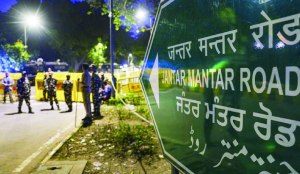
For several decades, Jantar Mantar has been synonymous with protests in the national Capital, a place where farmers, students, workers and political organisations have gathered to raise their demands. From Anna Hazare’s hunger strike to the Nirbhaya protests and the agitation over the NEET paper leak, the site has witnessed powerful expressions of public dissent.
Ironically, Jantar Mantar’s towering instruments, designed to track time and the movement of celestial bodies, have made it a place to gauge the times and the shifting tides of public sentiment. Now that Delhi Police has de-notified it as a designated protest site, the landmark risks losing its relevance as a space where people can make themselves heard.
However, Delhi’s address for protests has not always been Jantar Mantar. Before it emerged as a prominent hub for demonstrations, the sprawling lawns around India Gate and the Boat Club, close to Parliament and the Government’s principal offices, were among the capital’s most important spaces for political mobilisation.
Protesters also camped behind the Red Fort for days on end, awaiting the seat of power to wake up to their demands. In October 1988, farmer leader Mahendra Singh Tikait led a massive gathering of farmers at the Boat Club lawns. Thousands of farmers, accompanied by their cattle, occupied the area for days, putting pressure on the then Rajiv Gandhi Government to address their demands.
The agitation brought the issue of who could protest, and where, into sharper focus. The scale of the gathering, its proximity to key government establishments and concerns over security and public order prompted authorities to reconsider the use of the Boat Club as a protest venue.
Restrictions on demonstrations followed, and by 1993, Jantar Mantar emerged as an alternative site. Jantar Mantar offered a location close enough to the seat of power for protesters to draw the attention of the Government, while being more manageable than the expansive Boat Club lawns.
The Supreme Court, in its July 2018 judgment in Mazdoor Kisan Shakti Sangathan vs Union of India, traced the changing locations of protests in Delhi, from Ramlila Maidan to the Boat Club, and eventually to Jantar Mantar.
It noted that police had shifted demonstrations from the Boat Club because they were obstructing traffic. Police designated Jantar Mantar for gatherings of up to 5,000 people, while larger demonstrations were to be held at Ramlila Maidan.
When the administration designated Jantar Mantar as the new official protest zone, the first demonstration was recorded there in 1993. This historic beginning was led by Ashish Sood, then president of the Delhi University Students’ Union (DUSU). He, along with his comrades, launched the first protest on the Jantar Mantar Road against an administrative decision and anti-student policies of the Central Government. Since that one student movement, the ground has become a permanent venue for raising voices against anti-people policies.
Over the years, Jantar Mantar became a focal point for political parties, student groups, trade unions, farmers, activists and ordinary citizens. Demonstrations on issues ranging from corruption and women’s safety to education and electoral reforms and farmers’ demands made the stretch of road a familiar site of public mobilisation.
On April 5, 2011, Hazare began a five-day hunger strike demanding a stronger Jan Lokpal Bill to tackle corruption. The agitation gained momentum as the government agreed to constitute a joint drafting committee comprising ministers and civil society representatives to prepare the proposed legislation. Hazare ended his fast on April 9, turning the protest into one of the most prominent mass movements of the period and establishing Jantar Mantar as a focal point for public campaigns demanding political accountability.
In December 2012, the site and its surroundings became an important location for demonstrations following the brutal gangrape of a woman in a moving bus in the capital. The woman, who came to be known as Nirbhaya, died of her injuries, triggering widespread outrage across the country. Thousands of protesters, particularly young people, took to the streets demanding justice for the victim and stronger laws to protect women.
In 2014, protests also followed the death of Nido Tania, a student from Arunachal Pradesh who was allegedly assaulted in southeast Delhi. The incident sparked anger over racial discrimination and violence against people from the Northeast, with demonstrators demanding justice and measures to prevent such attacks.
Jantar Mantar continued to provide a platform to groups whose concerns struggled to gain sustained attention. In 2017, Tamil Nadu farmers staged a 41-day protest to highlight agrarian distress, seeking relief from mounting debts, drought-related losses and other problems affecting their livelihoods.
The site became the focal point of demonstrations surrounding a high-profile sporting controversy in 2023, when prominent wrestlers, including Olympic medallists, staged a sit-in against then Wrestling Federation of India chief Brij Bhushan Sharan Singh. The wrestlers accused him of sexually harassing women athletes, demanding arrest and action.