
India fastest-growing major economy: ITC Chief
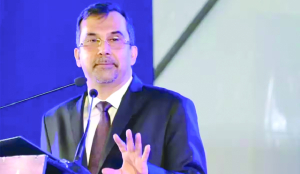
India’s multidimensional policy interventions have enabled the country to emerge as the fastest-growing major economy in the world even as global volatility becomes “systemic” rather than sporadic, said ITC Chairman and Managing Director Sanjiv Puri.
Addressing shareholders at the company’s Annual General Meeting (AGM) on Thursday, Puri said the crisis in West Asia has had a severe impact on the global economy, and that recent global developments only reinforce the view that turbulence today is systemic rather than sporadic.
“The prolonged uncertainty arising from the West Asia crisis has severely impacted the global economy, threatening energy security and trade. Indeed, the multitude of events in the recent past only reinforce the fact that global volatility is no more sporadic; it is now systemic,” he said.
Against this backdrop, Puri said, the Prime Minister’s vision for an Aatmanirbhar Bharat and a Viksit Bharat has taken even greater significance, spurring multidimensional policy interventions that have helped India emerge as the fastest-growing major economy in the world.
“It has inspired multidimensional interventions enabling India to emerge as the fastest-growing major economy in the world,” he said.
“The far-reaching measures announced in successive Budgets have provided strong foundations to unleash growth. India’s ascent is not merely about outpacing other large economies,” Puri added.
It has demonstrated that a nation of continental scale, democratic depth and extraordinary diversity can drive momentum with stability, pursue reform with inclusion, and convert aspiration into resilient growth.
Recalling his remarks from last year, when he had described the prevailing environment as an era of “TURN” — marked by Turbulence, Uncertainty and Rapid change — Puri said this reality has become even more pronounced as deeper structural shifts reshape the future of nations, societies and businesses. He said the situation calls for novel strategies to help enterprises reimagine their approach to the future.
However, Puri also added that as India ascends on the global stage, Indian businesses must reimagine their strategies not only to navigate the TURN but also to seize the emerging opportunities.
In his speech, Puri highlighted that, despite the challenging operating environment, ITC had delivered positive results over the medium term. Its “net Segment Revenue, currently at over Rs 83,300 crore, grew at a CAGR of 10.7 per cent and EBITDA at 9.7 per cent over the last 5 years,” he said, adding now “non-cigarette businesses constitute nearly two-thirds of net segment revenue.”
Moreover, over the last five years, ITC has distributed nearly Rs 85,000 crore to shareholders by way of dividends.
“Foreign exchange earnings of the ITC Group over the last 5 years aggregated nearly USS 6.5 billion, of which agri exports constitute over 60 per cent,” demonstrating ITC’s contribution to the rural economy, he said.
Its FMCG business, which was around Rs 14,720 crore in FY21, now has crossed the Rs 24,200 crore mark in FY26, with sustained improvement in profitability.
“ITC has ranked consistently amongst the Top 3 Indian corporates in the private sector in terms of Contribution to the Exchequer. Over the last five years, over 76 per cent of its Value-Added amounting to Rs 2,30,000 crore accrued to the exchequer,” he said.
Over the investments, Puri said it has already proposed a medium-term capex of Rs 20,000 crore for the Group in areas that have a multiplier impact.
“Close on the heels of 8 recently commissioned facilities, 6 new projects are in the pipeline,” he said.
ITC’s Bharat Built Manufacturing architecture has created world-class national assets across FMCG, Paperboards & Packaging, and export-oriented value-added Agri Processing.