
Immigration Crisis: The Open Sky and the Guarded Gate
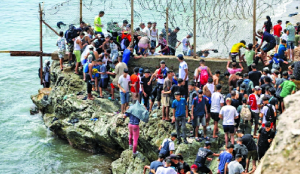
The human being did not evolve to stay fixed to one patch of soil. Movement is prakriti; it is natural, older than any border ever drawn on a map. You will watch a migratory bird cross a continent and feel something lift in you, but let the same instinct arrive on two legs, with a bag over its shoulder, and the feeling curdles into suspicion, even derision. Why the difference? Why not ban the birds too, and scold them for arriving uninvited at this lake or that field? They come because that is how prakriti moves, and you are not meant to remain confined to the village you were born in.
Late in July, some sixty thousand people threw themselves at the fence between Morocco and the small Spanish enclave of Ceuta, and more than seventy died in the crossing. The scenes were read everywhere as a siege. A siege is the easy word for it, but the wrong one. Within days, nearly all of the sixty thousand had turned around and walked back into Morocco of their own accord; fewer than two thousand remained. An invasion does not go home. What crossed that fence was not an army and not even a settlement; it was a surge of hope answering a rumour. Spain had announced a scheme to regularise migrants already living in the country, more than a million people applied to it, and trafficking networks promptly went to work, twisting a court ruling into a story that a door had swung open. Sixty thousand human beings moved on a promise that somebody had manufactured in order to sell it to them. So what is actually pressing at that fence? An instinct older than any nation, harnessed by salesmen, running up against one of the newest things human beings have made, the border. For almost the whole of human history there was no such thing to meet. Passports were not generally required to cross a frontier until the First World War, and the familiar booklet was standardised only in 1920, at a conference of the League of Nations. Those who built the pyramids and those who filled Ellis Island moved without one. The fence is barely a century old. Walking is as old as the species.
Everyone reading this is a migrant. Trace any people far enough back and you find travellers. The United States is almost entirely a country of arrivals. Wave after wave of movement and mingling over thousands of years gave the Indian subcontinent its present shape. Across the whole earth today there are around three hundred and four million international migrants, close to one in twenty-seven human beings, a figure that has almost doubled since 1990. Movement is not the aberration. Nature wants you to move, and it is society, not nature, that places on you the burden of staying loyal to your little ancestral farmland. But inside that one word, migration, two very different things are hiding, and the whole confusion comes from refusing to separate them.
Migratory Birds and Migratory Men
A movement can rise from the natural centre, and a movement can rise from the centre of delusion, and the same person carries both. Consider the student who leaves for the US or a European country to do a doctorate his own country cannot yet satisfactorily offer him. That going is clean. He wants to learn, and the knowledge lives there, so he goes. Five years later the doctorate is finished, there is real work waiting for him at home in a place that badly needs precisely what he has learned, and now he says: no, the cars are cheaper here, the salaries better, I have one life and I must look after my lifestyle. That staying is a different thing altogether. Nothing natural moves him now; the ego has taken the wheel and calls its demand prudence.
The ego works the other way just as easily. Before he ever left, another voice in him might have said: I must not go to Europe at all, I will be spoiled there, the drink and the women will ruin me, so I will just complete a sub-standard doctorate from a little college in the town next to my village. Here the ego is not chasing consumption; it is blocking a movement that should have happened. This is the thing to hold on to, that the ego can block the right movement and can also cause the wrong one. The problem is never the moving or the staying in itself; the problem is who is doing it.
So the question to put to any migration is not where it is going but what it is going for. Go in the hope of bread and butter, and that is fine; you will find bread. If your soil has failed and the rain will not come again, if the work has vanished and your children are thin, then cross, and cross without apology. That is not weakness, it is life protecting itself. Go instead in the hope of fulfilment, believing that the missing thing in you is waiting on the other side of a border, and you will return empty-handed. No place, no object of the ego can complete you. The ego that felt hollow in Bombay will feel hollow in Boston; it has merely changed its backdrop. India knows both these movements inside its own families. The country that receives the largest remittances on earth is the same country whose young men are led jungle by jungle, container by container, down what they themselves call the dunki route, towards borders they have been promised will complete them.
These physical reasons are real, and they are multiplying. At the end of 2024 more than a hundred and twenty-three million people were counted as forcibly displaced by war and persecution, and close to three in five of them never crossed an international border at all. They were pushed from one part of their own country to another. The Mediterranean, meanwhile, has quietly become the deadliest border on earth; the drowned and the missing of the last decade alone are counted in the tens of thousands. Climate change will widen all of it enormously. By the World Bank's own projection, as many as two hundred and sixteen million people could be driven to move within their countries by 2050, forty million of them in South Asia alone, not because they dreamed of a better lifestyle but because a place stopped receiving rain. Who is foolish enough to sit still in a dying land for the sake of sentiment? And here a circle has to be spoken plainly, because everybody prefers to leave it unspoken. The lifestyle the ego chases across one border is the very engine drying the land behind another. The consumption that glitters at the destination is what fails the rain at the origin. The rich world's way of living manufactures the desperation that then arrives at its gates, and the arriving is called a crisis while the manufacturing is called growth. Money tells the same sober story. Migrants sent around six hundred and eighty-five billion dollars home to poorer countries in 2024, more than all foreign investment and foreign aid put together, with India the largest recipient at a hundred and twenty-nine billion. This is not the traffic of invaders; it is bread, earned far from home and carried back.
The Puppy and the Thief
It is raining hard, and a small puppy that has lost its mother is scratching at your door, crying to be let in out of the water. That is one kind of arrival. And there is another: the burglar, working the same door in the same rain, who is there out of desire, because your house holds things he means to take. The first deserves sanctuary, so open the door. Shut it against the second. Anyone can see that these are not the same creature.
Yet around every border two loud camps form, and both refuse the distinction. One says that if you let the puppy in you must let the thief in too, throw the doors open to everyone and call it compassion. The other says that since the thief exists you should bar the puppy as well, seal the doors against everyone and call it security. Both are lazy in the same way. Both would rather hold a blanket rule than do the patient, thankless work of telling one arrival from another. A country is not obliged to admit plunderers, but it should not be permitted to turn away the drowning either. It has to sieve and test, to look hard at the person actually standing in front of it. The filtering will always be imperfect. A fair filter, applied with honesty, still lets some through it should have stopped and stops some it should have let pass. Even so, imperfect filtering is far better than either blanket, because a blanket is only a refusal to look.
And the two camps share one further blindness. Both keep staring at the door, and neither asks who sent the crowd to it. There is a third figure in this story, neither puppy nor thief: the one who operates the gate for profit or for leverage. The smuggler who manufactures a rumour and retails it to the desperate, as was done at Ceuta. The state that loosens its side of the fence when it wants a concession from its neighbour; in 2021, in the middle of a diplomatic quarrel, more than eight thousand people poured into this same enclave in a couple of days while the guards on one side simply looked away, and Spain called it blackmail. Puppies and thieves alike are moved across the board by hands that stay clean and dry. Sometimes the thief is not at the door at all. He is the one who dispatched the queue to it.
A harder question sits underneath all this. Who decides whether an arrival is a puppy or a thief, and why is deciding so difficult? The difficulty is not out there at the border; it is inside you. You cannot tell the puppy from the thief in the world because you have never learned to tell them apart in yourself. In your own inner life the thief constantly poses as the puppy, greed dressed as need, the wish to consume wearing the face of the wish to live. And the real puppy in you, some clean and simple longing, is often mistaken for a thief and turned away. A person who cannot run this sorting within will always fumble it without, and reach, in frustration, for the blanket. This is why an immigration policy is never just a policy but a confession of what the person who made it is like inside.
But seeing the difference is only half the work. You can see it perfectly and still filter badly, because the filter will only ever be as honest as the person holding it. What turns clear sight into clean action is intent. Where the intent is honest, the sieve will be honest, and what comes through it can change a country's fortune. When the Jews fled Nazi Germany they did not arrive as invaders; they arrived as the drowning. By 1944 more than a hundred and thirty-three thousand German Jewish emigres had reached America, and in the fields they worked in, patenting rose by nearly a third after 1933. Among them, Szilard, Wigner, Bethe and von Neumann joined the core of the effort that ended the war, and it was Einstein's letter that set that effort in motion. The countries that opened the door did not perform charity. They received a gift they are still living off; so many countries are, in truth, powered by the immigrants they took in. That pattern holds today. Close to three in five of America's billion-dollar companies were founded or co-founded by immigrants, and the single largest source of those founders is India.
It works the same way in reverse. In 1972 Idi Amin gave Uganda's Asians ninety days to leave and seized what they had built. The shops and mills passed to men who did not know how to run them, and an economy that had leaned on one small minority slid into ruin. Roughly twenty-seven thousand of the expelled reached Britain with a suitcase each. Leicester, which had once advertised in the papers begging them not to come, now counts them among the makers of the city. A country can throw away its own good fortune and call the act patriotism.
Every host society keeps a list of who is to be feared at the gate, and the list keeps being proven wrong. The menace always has a face, and the face always changes: the Irishman who would swamp America, then the Chinese labourer shut out by an entire federal act in 1882. Britain managed the trick in reverse, inviting Caribbean workers to rebuild it after the war and then meeting the nurses and drivers who staffed its hospitals and buses with lodging-house doors closed against them, and with signs that a whole generation remembers reading: no blacks, no Irish, no dogs. Each feared arrival became, a generation on, part of the citizenry.
And what is this fear, examined honestly? The host who trembles that his culture will be diluted is holding culture the way the ego holds everything, as a possession, one more object filed under mine. But a culture is not a possession; it is a living thing, and living things are not diluted by meeting, they are fed by it. A living culture does not fear the guest. Only conditioning defended as identity fears the guest. This subcontinent is itself the proof: the civilisation that absorbed the most, wave upon wave of peoples and tongues and gods, is the one that has remained most stubbornly itself. The fear at the gate is not protecting the culture. It is protecting the ego that has made a flag of the culture. The puppy you let in out of the rain can grow into the greyhound that one day saves your life. Block the thief, certainly. But be very slow to call the puppy a thief, because the day you shut that door you also shut out everything the puppy would have brought.
The Theme Is Jungle
Say the door has been opened rightly, the puppy taken in. What follows is rarely a quarrel about numbers or crime; it is about culture. They must fit in, the argument runs; they must learn the language of the place and its ways, or they should not be let in. There is a real point buried here, and also a real danger, and once again the two have to be separated.
The point is plain and practical. If you move to a country for good, not for a month but for the rest of your life, learn its language. What is the objection? What harm can a new language do you? Why not learn it? To refuse it is to make trouble for yourself and for everyone around you. Think of any organisation with its own discipline, one a person joins only to announce that he will not attend its meetings or do the common work, while still expecting to belong. This is not hegemony being forced on him; it is simply what belonging to that place requires, and the choice to come was his in the first place. A dress code at an office, a theme announced for a party, the uniform worn in an army: none of these is an assault on your existence. If the host says the theme is jungle, you do not arrive in a three-piece suit and stand there insisting you are not an animal; you either enter into the evening or you decline the invitation. What you may not do is accept the invitation and then spoil it.
There is a matching discipline the host owes the guest. To be a little powerless, to have arrived with less, does not turn a person into your property. If you tell me, as I enter your country, please learn the language, that is reasonable, and I should. If you tell me to change my name, or my religion, or to cover my head to your taste, you have crossed from the practical into the domineering, and now the problem is yours, not mine. Learn the language, and that is fair; give up your name and your faith under duress, and that is not. The immigrant has his own form of this overreach, when he insists on broadcasting every visible sign of the place he left, loudly and permanently, as a flag planted in a country that is now his home. Is that not a kind of optical aggression, aimed at the people already living there? On both sides the same restraint is being asked. The guest shows sensitivity; the host refuses to bully. Do that, and a real relationship becomes possible.
I have never liked the words integration and assimilation; both carry a faint smell of conversion, of one side dissolving into the other. What the situation actually asks for is something quieter and harder. Not an ideal, not an ideology, but the day-by-day judgement to tell the practical from the imperious, on both sides of the door. Discretion.
Underneath the whole argument sits an assertion people make without examining it, that a human being has a right to move to whichever country he pleases, that others have merely got hold of a richer piece of real estate and are keeping him out of it. This has to be said plainly. There is no such general right. The law of nations keeps exactly one narrow shelter open, for the persecuted and the drowning, and that shelter must stand; the puppy's claim is real, and no decent order may brick it up. But a claim of survival is not a licence of preference. Beyond that shelter, everybody has the opportunity, given the way the world of nations is arranged. Apply, qualify, walk the long legal road from visa to residence to citizenship. There is no right to stroll uninvited into another country, no more than there is a right to stroll uninvited into a stranger's wedding and take a seat at the feast. Try it, and you will be shown out.
If you truly want migration to be a right, the price is exact: you must dissolve the order of nations itself, rub every boundary off the map, and let each person live and move wherever the wind takes them. Say that, and mean it, and I will stand with you. But then there can be no nationalism or patriotism, no line anywhere that is yours to defend. And here the question turns homeward, where it always had to. Before you erase the boundaries from the map, have you erased them from your heart?
The ego lives and breeds only in boundaries. You cannot demand an open world while running a closed one inside your own chest. The moment you say this is my family, these few are mine and the rest are not, you have drawn a border and posted a guard on it. A person partitioned within, sorting the world without end into mine and not-mine, cannot fairly ask the map to hold no partitions. The fences at Ceuta are the fences in the human heart, made large and lit up for everyone to see. This subcontinent knows the proof in its own body. In 1947 Cyril Radcliffe, a barrister who had never set foot in the country, was given five weeks to draw a line across it, and somewhere between twelve and twenty million people were torn from the only homes they had known, the largest mass migration in modern history. The line on the map only traced a line already drawn in the heart. Mine and not-mine had hardened inside people long before the ink was put to paper. As long as the interior stays divided, the exterior will keep matching it, fence for fence.
This discretion I have been speaking of has an older name in this land: viveka, the discrimination between the real and the unreal, the lasting and the passing. The faculty that learns to tell the true from the flattering within is the only faculty that can tell the puppy from the thief without. That is why the sorting keeps failing at the world's borders; it was never practised at its source. So walk the legal road, not merely because it is the law, but because the border you are standing at is the one thing still pointing you back to the border you have never crossed. Nothing here promises a settled world or a solved crisis; the filter will stay imperfect and will have to be renewed every single day, and discretion is a direction to keep walking in, never a destination you reach and can then forget. The gate you keep guarding against the stranger is, when everything else is stripped away, your own. Whether it opens is not, in the end, a question of policy but of who you take yourself to be.
Acharya Prashant is a philosopher and author whose work centres on self-inquiry and its application to contemporary life; Views presented are personal.