
From birthplace to Kirti Mandir memorial: Two adjoining spaces telling Gandhi’s story
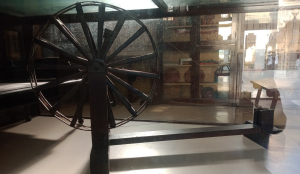
Ahmedabad, Oct 2 (PTI) A modest room where Mohandas Karamchand Gandhi was born in 1869 and the adjacent Kirti Mandir, built decades later in his memory in Gujarat’s Porbandar, offer visitors a glimpse into different chapters of Mahatma Gandhi’s life and legacy.
Chief Minister Bhupendra Patel on Friday paid floral tributes to Mahatma Gandhi at Kirti Mandir in Porbandar, where an all-religion prayer meet was organised on the occasion of his 157th birth anniversary.
“Gandhi’s actual birthplace is part of an ancestral haveli where his family lived. The house, which had 22 rooms, was purchased in 1777 by Gandhi’s great-grandfather Harjivadas Gandhi and later expanded by his grandfather Uttamchand Gandhi,” said Porbandar Sub-Divisional Magistrate S A Jadav.
Both Uttamchand Gandhi and Mahatma Gandhi’s father, Karamchand Gandhi, served as Diwans of the erstwhile Porbandar State, said Jadav, who officially serves as the member secretary of the Kirti Mandir Management Committee.
It was in this family home that Mohandas Karamchand Gandhi was born on October 2, 1869, Jadav said.
“The room marked with a ‘swastik’, where Gandhi was born, is today preserved as part of the birthplace complex,” according to the official.
Jadav said the idea of building a memorial emerged in 1945, when Porbandar’s Maharaja Natwarsinhji and businessman Nanji Kalidas Mehta met Gandhi, who was staying near the Aga Khan Palace in Pune, and sought his permission to construct a memorial near his birthplace.
According to the official, Gandhi gave permission to build a memorial, but did not want it to become a place of worship.
“He did not want to become God and had said that there should be no incense sticks or lamps but a donation box for the welfare of Harijans (Dalits),” Jadav said.
The building was designed to reflect some of Gandhi’s core ideas, including “Sarva Dharma Sambhav” (equal respect for all religions).
Its secular architecture incorporates symbols associated with different faiths, including a Buddhist pagoda, a Hindu Swastik, Islamic latticework, Jain artistic elements and features reflecting Christian architecture.
Gandhi wanted his thoughts to spread. The Kirti Mandir compound has 26 marble pillars with his thoughts carved and written on them, he said.
Construction of the memorial began in 1945 but was still incomplete when Gandhi was assassinated on January 30, 1948.
Sardar Vallabhbhai Patel inaugurated the Kirti Mandir memorial on May 27, 1950, he said.
The building’s design also carries a numerical reference to Gandhi’s life. Since Gandhi lived for 79 years, the main structure of Kirti Mandir is 79 feet high, while 79 earthen lamps are placed on its top as a symbolic tribute to his life, the official said.
While the original house preserves the physical space associated with Gandhi’s birth, Kirti Mandir represents the attempt to preserve the ideas and philosophy that came to define his public life.
The original birthplace is currently under the Archaeological Survey of India and has been declared a national monument, while the state takes care of the memorial through the Kirti Mandir Management Committee.
Prime Minister Narendra Modi has carried forward the objective of Gandhi’s equal respect for all religions through the mantra of “Sabka Saath, Sabka Vikas, Sabka Vishwas and Sabka Prayas”, said an official release quoting CM Patel after the prayer meet in Porbandar.
The country is moving towards taking development and basic facilities to villages and the poor, with the welfare of the deprived, distressed, exploited and the last person at the centre, he said.
The resolve of an Atmanirbhar Bharat, combined with Gandhi’s idea of self-rule, is becoming a modern expression of the nation’s development, Patel said.
He added that Modi’s leadership has made the Swachh Bharat Mission a people’s movement by expanding the idea of cleanliness given by Gandhi.
From children to the elderly, citizens are becoming volunteers and “Swachhagrahis” for cleanliness, he said.
Efforts are being made to connect khadi, which was dear to Gandhi, with the new generation and youth through the message of “Khadi for Nation, Khadi for Fashion”, Patel said.
The CM called upon the citizens to move forward with the spirit of self-reliance, welfare of the poor, cleanliness, environmental protection and the nation-first approach to build a Developed India by 2047.